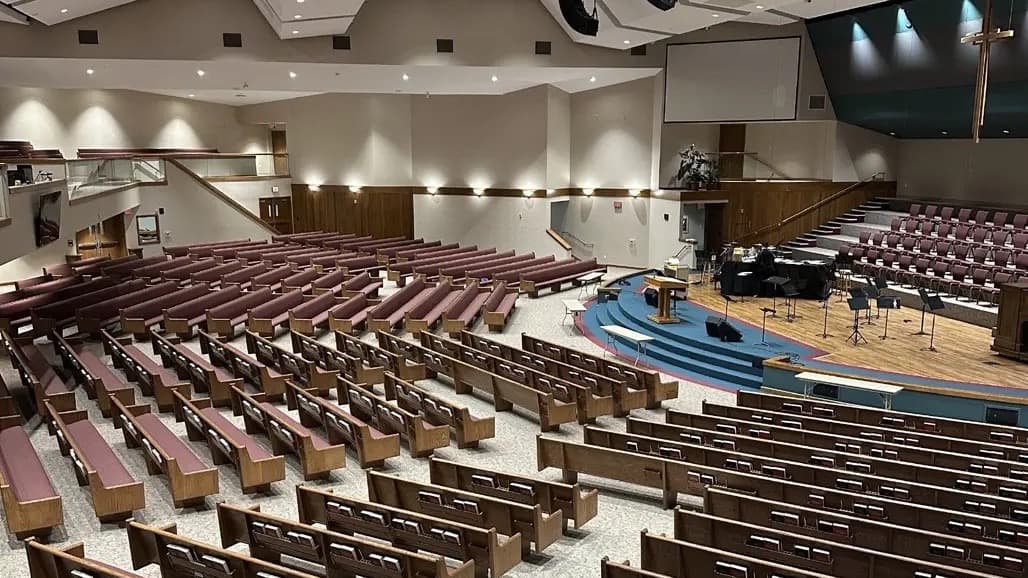
Why Sanctuary Lighting Is a Growing Challenge for Independence-Area Churches
Independence, Missouri has a remarkable concentration of faith communities. As home to several historically significant denominations — including the Community of Christ, whose world headquarters and stunning auditorium sit at the heart of the city — Independence has long been a place where houses of worship hold deep cultural and community meaning. From historic stone sanctuaries near the Independence Square to newer multi-use worship campuses spreading across the eastern Kansas City metro into Blue Springs, Lee's Summit, and Grain Valley, churches here vary enormously in size, architecture, and age.
That diversity is precisely what makes sanctuary lighting maintenance such a nuanced challenge. A 19th-century sanctuary in the Independence historic district faces very different constraints than a 2,000-seat contemporary worship center built in the 1990s. Yet both share a common thread: lighting systems that were designed for a different era of technology, energy costs, and congregational expectations are increasingly difficult and expensive to maintain.
Facility managers and operations leaders across the greater Kansas City region are confronting this reality head-on — and the lighting industry's rapid evolution offers more practical solutions today than ever before.
The Most Common Sanctuary Lighting Problems — and What's Behind Them
Understanding why sanctuary lighting fails is the foundation of any smart upgrade strategy. In our work with church facilities across Missouri and the broader Midwest, a few patterns emerge consistently.
High-Ceiling Access Is the Hidden Cost Driver
Many sanctuary fixtures are mounted 20, 30, or even 50 feet above the floor. When traditional incandescent, halogen, or fluorescent lamps burn out — which they do frequently, with lifespans measured in hundreds to low thousands of hours — replacing them requires scaffolding, aerial lifts, or specialized rigging. This isn't just expensive in labor; it disrupts the sanctuary space, requires scheduling around services, and creates ongoing liability exposure for the facility.
LED technology has fundamentally changed this equation. Quality LED fixtures carry rated lifespans of 50,000 hours or more — meaning a fixture installed today in a once-per-week service environment could realistically go a decade or longer without a lamp replacement. For facilities managers in Independence and surrounding communities like Raytown, Grandview, and Oak Grove, that shift from reactive maintenance to long-term reliability is transformative.
Aging Ballasts and Dimmer Incompatibility
Flickering lights in a sanctuary are more than an annoyance — they're a symptom of deeper electrical infrastructure issues. Many churches installed fluorescent or metal halide systems in the 1980s and 1990s with magnetic or early electronic ballasts that are now well past their designed service life. As these ballasts degrade, they produce inconsistent light output, generate heat, and in some cases create audible hum that carries through a quiet sanctuary during prayer or reflection.
Compounding the problem, many existing dimming systems were designed for incandescent loads and are fundamentally incompatible with modern LED drivers. Simply swapping bulbs without addressing the control infrastructure often results in flickering, strobing, or an inability to dim below a certain threshold. A thoughtful retrofit addresses the full system — fixtures, drivers, and controls — rather than treating symptoms in isolation.
Uneven Illumination and the Rise of Livestreaming
Congregational expectations around lighting quality have risen significantly over the past decade, driven in large part by the growth of church livestreaming and video production. What looked acceptable to the human eye in the sanctuary often appears blown out, shadowy, or color-inconsistent on camera. This is a growing concern for churches across the Kansas City metro that are investing in broadcast-quality video ministry — a platform that now reaches congregants who may never set foot in the building.
Proper sanctuary lighting design accounts for color rendering index (CRI), color temperature consistency, and directional control in ways that older systems simply weren't built to address. Modern LED solutions, particularly those with tunable white capability, allow worship leaders and technical directors to dial in the exact lighting atmosphere that serves both in-person and digital audiences.
LED Upgrades: What the Transition Actually Looks Like
For many facility managers, the idea of a full sanctuary lighting retrofit sounds daunting — expensive, disruptive, and complex. In practice, a well-planned LED upgrade is often far more manageable than expected, particularly when approached in phases or during a scheduled maintenance window.
Assessment and Audit First
The starting point for any sanctuary upgrade is a thorough lighting audit. This means documenting existing fixture types, lamp counts, control systems, and wiring infrastructure, then modeling the new system against the facility's actual needs — foot-candle targets, dimming requirements, aesthetic goals, and budget constraints. For churches in Missouri, this audit process can also identify applicable utility rebates and incentive programs that meaningfully offset project costs.
Retrofit vs. Full Fixture Replacement
Not every sanctuary requires a complete fixture overhaul. In many cases, existing housings can be retrofitted with LED modules or drivers, preserving the architectural character of the space — a particularly important consideration for historic sanctuaries in Independence and the surrounding area. Where full fixture replacement is warranted, today's LED products offer a wide range of form factors, including options designed to replicate the warm aesthetic of traditional incandescent and halogen sources that many congregations prefer.
Lighting Controls: The Multiplier Effect
Perhaps the most underappreciated element of a modern sanctuary lighting system is the controls layer. Programmable scenes, wireless dimming, and integration with presentation or AV systems allow worship teams to move seamlessly between a bright pre-service environment, an intimate candlelight-style communion setting, and full broadcast-ready illumination — all with the touch of a button. For technical directors managing complex Sunday morning productions, this kind of flexibility isn't a luxury; it's an operational necessity.
For churches in Independence and across the Kansas City region that are investing in multi-use facilities, the controls infrastructure that serves the sanctuary can often be extended to fellowship halls, classrooms, and common areas, creating a unified, energy-efficient system across the entire campus.
Financial Considerations: Rebates, Incentives, and Procurement
The financial case for LED sanctuary lighting has never been stronger. Energy savings alone — typically 40–70% compared to legacy lighting systems — generate meaningful returns over time. But the upfront investment picture is further improved by utility rebate programs and state-level incentives available to Missouri organizations.
Missouri churches and faith-based nonprofits should explore available rebate programs through their utility providers, which may include incentives tied to lighting efficiency upgrades. An experienced lighting partner can help navigate the rebate landscape, ensure projects are structured to qualify, and manage the documentation process.
A Note for Public and Institutional Facilities in the Area
For government agencies, public schools, and other public-sector organizations in the Independence area — including the Independence School District and the City of Independence itself — procurement is a practical consideration in any capital project. VOSS holds an approved state contract in Missouri, which allows public agencies to engage our services through a compliant, competitively structured vehicle. Eligible organizations may also access cooperative purchasing programs including Sourcewell, TIPS, BuyBoard, AEPA, Omnia Partners, PACE, Houston Church COOP, and the Nebraska ESU Co-Op — simplifying procurement and reducing administrative burden.
While these programs are specifically relevant to public-sector and eligible nonprofit entities, faith communities interested in learning more about available purchasing options are encouraged to ask our Kansas City team directly.
What to Look for in a Sanctuary Lighting Partner
Not all commercial lighting contractors have meaningful experience with the specific demands of worship facilities. Sanctuary projects require sensitivity to the acoustic environment (no noisy ballasts or buzzing dimmers), respect for the sacred nature of the space and the schedules of the congregation, and genuine expertise in the aesthetic dimensions of lighting design — not just the technical ones.
Beyond technical capability, the right partner brings:
- Low-disruption installation practices — scheduling work around services, retreats, and high-use periods
- Experience with historic and architecturally sensitive buildings — a real consideration for older congregations in the Independence area
- Familiarity with the full system — from fixtures and drivers to controls, emergency egress lighting, and exterior site lighting
- Long-term support capabilities — including ongoing maintenance agreements that reduce the in-house burden on your facilities team
VOSS has served church and faith-based facilities as part of our broader commercial and institutional practice for decades. Our Kansas City branch team understands the regional market, the utility programs available to Missouri organizations, and the practical realities of working in active worship facilities.
Exploring Further: Related Topics in Lighting and Energy
If your facility's lighting evaluation extends beyond the sanctuary, several related topics may be worth exploring. Our Energy Efficient Church Lighting Upgrades page goes deeper on whole-campus energy strategy for faith communities. For Missouri organizations navigating the phaseout of fluorescent lamps — a regulatory shift with real implications for church facilities — our coverage of Fluorescent Tube Bans and LED Lighting Rebates and the Minnesota Fluorescent Lamp Ban guide offer useful context. Facilities interested in the financial return on LED investment more broadly may find our Maximize ROI with Commercial LED Lighting Rebates content valuable as well.
Service Availability
While VOSS offers a comprehensive suite of national services, specific capabilities may vary by location. Please contact your local branch to confirm the current availability of specific services, technology solutions, or contracting capabilities in your immediate market.
Talk to VOSS in Kansas City
Our Kansas City branch serves Independence and surrounding communities throughout the eastern Kansas City metro — including Blue Springs, Lee's Summit, Raytown, Oak Grove, Grain Valley, Belton, and beyond. Whether you're troubleshooting an immediate maintenance problem or planning a longer-term sanctuary renovation, we're here to help you think through the options.
VOSS — Kansas City Branch Phone: (816) 471-8677
We welcome the opportunity to visit your facility, review your current lighting systems, and share what's working for other houses of worship in the region. No obligation — just a practical, honest conversation about what's possible for your space and your budget.