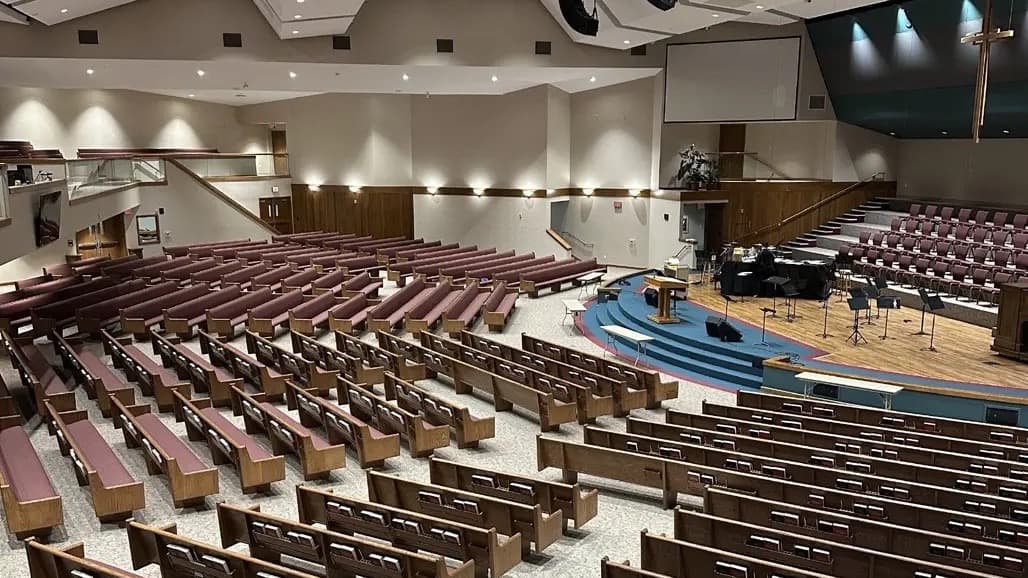
Why Sanctuary Lighting Deserves a Closer Look in The Woodlands
The Woodlands, TX is home to a remarkably active faith community. With a population of approximately 110,000 residents spread across master-planned villages — from Grogan's Mill and Panther Creek to Sterling Ridge and Creekside Park — the area's congregations serve thousands of families each week. Many of these churches are not small operations: they host multiple weekend services, midweek programming, youth ministries, livestreamed worship, and community events that run throughout the week.
That level of activity puts extraordinary demands on facility infrastructure — and sanctuary lighting is one of the first systems to show the strain. Across the Greater Houston region, church facility managers and operations leaders are increasingly confronting the same cluster of problems: high-ceiling fixtures that burn out faster than staff can safely replace them, aging dimmer systems that flicker at the worst moments, and energy bills that don't reflect the efficient, modern operation a congregation expects.
The good news is that the lighting technology available today — combined with a thoughtful maintenance strategy — can address all of these pain points simultaneously. Understanding what's driving these issues, and what a modern approach looks like, is the first step.
The Real Cost of Outdated Sanctuary Lighting
For facility managers and church administrators in The Woodlands area, the cost of outdated lighting is rarely just the electricity bill. It compounds across multiple dimensions that don't always appear in the same budget line.
Maintenance labor and access costs are often the most underappreciated expense. Traditional incandescent, halogen, and fluorescent sources burn out frequently — and in a sanctuary with 30- to 60-foot ceilings and decorative architectural fixtures, every replacement requires scaffolding, a lift rental, or a specialized contractor. When a bulb fails mid-service, it's not just an inconvenience; it's a visible disruption to the worship experience that reflects on facility leadership.
Aging ballasts and incompatible dimmers create flickering and dimming inconsistencies that affect both in-person congregants and the growing number of churches that livestream their services. In a region where many larger congregations — including several campuses along the Woodlands Parkway and I-45 corridor — have invested significantly in video production infrastructure, poor lighting quality directly undermines that investment.
Uneven light distribution is a safety and accessibility concern as well. Sanctuaries with dark aisles, poorly lit steps, or inconsistent coverage create real risk for older congregants and families with young children — a meaningful concern in a community like The Woodlands, which consistently ranks among Texas's most family-oriented communities.
Rising energy costs compound all of the above. Older fixture technologies consume significantly more wattage than modern LED equivalents, and Houston-area utility rates — like those from CenterPoint Energy, which serves much of the Greater Houston region — have seen upward pressure in recent years. Churches running outdated lighting systems for 8–12 hours a day across multiple spaces are leaving meaningful savings on the table.
What a Modern Church Lighting Strategy Looks Like
The shift happening in church facilities across The Woodlands and surrounding communities like Spring, Conroe, Tomball, and Cypress isn't simply about swapping bulbs. It represents a more comprehensive rethinking of how lighting is sourced, controlled, and maintained over time.
LED retrofit and fixture replacement is the foundation of any modern strategy. Today's commercial-grade LED sources deliver significantly longer rated lifespans — often 50,000 hours or more — which means a fixture installed today in a high-ceiling sanctuary application may not require relamping for a decade or longer under normal use. That dramatically reduces the frequency and cost of access work.
Lighting controls and dimming compatibility are equally important. A well-designed controls strategy allows worship leaders to set the exact scene they need — bright and even for Scripture readings, warm and intimate for communion, dramatically focused for special services — using programmable presets rather than manual adjustments. For churches that livestream, this consistency is not a luxury; it's a production necessity.
Proactive maintenance planning shifts facility teams from reactive fire-fighting to scheduled, predictable care. Rather than responding to failures, a maintenance program anticipates end-of-life cycles, groups replacement work to minimize lift rentals, and catches wiring and driver issues before they cause mid-service disruptions.
Historic and architectural sensitivity matters in many of The Woodlands' older and more established congregations, where original decorative fixtures are part of the sanctuary's character. Modern LED technology has advanced to the point where color temperature, CRI (color rendering index), and even fixture form factors can be matched closely to preserve the aesthetic intent of the original design while delivering modern performance.
Trends Shaping Church Lighting Decisions in Greater Houston
Several regional and national trends are accelerating the pace at which church facilities in The Woodlands area are reassessing their lighting infrastructure.
The livestream imperative has fundamentally changed what "good lighting" means for a worship space. A sanctuary that looked perfectly lit to the human eye in 2010 may perform poorly under modern camera systems, creating washed-out or shadowy video that undermines online ministry efforts. Churches that have invested in camera equipment, switching infrastructure, and streaming platforms are increasingly recognizing that the lighting system is the missing variable.
Utility incentives and rebates remain a powerful financial lever for eligible organizations. CenterPoint Energy and other Texas utility providers periodically offer rebate programs for qualifying commercial LED upgrades, which can meaningfully offset project costs. For faith-based organizations navigating tight capital budgets, understanding what rebates are currently available — and ensuring installations are completed in a way that makes them rebate-eligible — can be the difference between a project that moves forward and one that stalls. Our related article on Maximize ROI with Commercial LED Lighting Rebates provides broader context on how these programs work.
Fluorescent phase-out regulations are also creating urgency. Federal regulations are progressively restricting the manufacture and import of certain fluorescent lamp types, meaning churches still operating fluorescent systems — particularly in fellowship halls, classrooms, and narthex spaces — will face forced transitions in the coming years. Planning proactively, rather than reacting to supply shortages, puts facility teams in a much stronger position. Our article on Fluorescent Tube Bans and LED Lighting Rebates covers this topic in depth for facility operators across Texas.
Energy audits as a planning tool have become increasingly valuable for church facilities with complex, multi-use campuses. A professional energy audit provides an inventory of existing systems, a projection of savings from various upgrade scenarios, and a prioritization roadmap that helps facility managers and finance committees make informed decisions. Our Energy Audits, Incentives, and Rebate Navigation for Businesses article explores this process in detail.
Cooperative Purchasing: A Practical Path for Eligible Organizations
For churches and faith-based organizations affiliated with school districts, nonprofit networks, or other public-sector entities in The Woodlands and across Montgomery and Harris counties, cooperative purchasing programs can streamline the procurement process and reduce administrative burden.
Programs such as BuyBoard, TIPS, Sourcewell, Omnia Partners, and PACE are designed to give eligible organizations access to pre-negotiated contract vehicles that satisfy competitive bidding requirements — a meaningful benefit for organizations with governance structures that require procurement accountability. The Houston Church COOP is a particularly relevant program for faith-based facilities in this region.
Eligibility and program availability vary by organization type. If your church or ministry is affiliated with a school, a nonprofit network, or a public institution, it's worth exploring whether one of these vehicles applies to your situation.
Service Availability
While VOSS offers a comprehensive suite of national services, specific capabilities may vary by location. Please contact your local branch to confirm the current availability of specific services, technology solutions, or contracting capabilities in your immediate market.
Talk With Our Houston Team
Church facilities in The Woodlands, Spring, Conroe, Tomball, Cypress, and the broader Greater Houston area have a local resource in VOSS's Houston branch. Our team brings 85+ years of commercial electrical and lighting experience to every engagement — and we understand the unique physical, operational, and budgetary realities that church facility managers navigate every day.
Whether you're troubleshooting a persistent flickering problem, planning a full sanctuary LED retrofit, exploring rebate opportunities, or simply trying to build a more sustainable maintenance schedule, we're here to help you think it through.
VOSS Lighting — Houston Branch Phone: (713) 996-8060
Reach out to schedule a no-pressure conversation about your facility's lighting needs. We'll bring the technical expertise; you bring the questions.