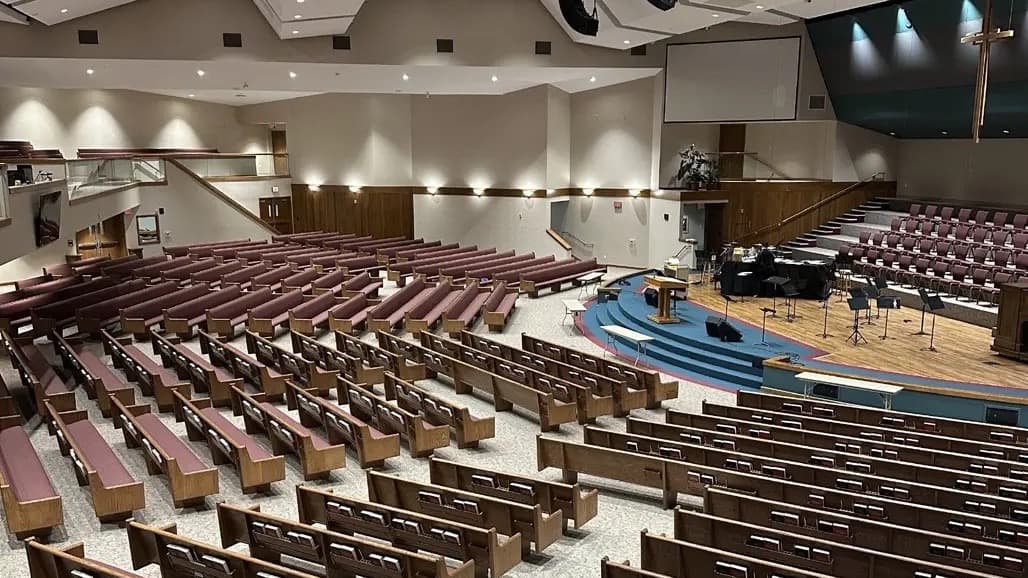
Why Sanctuary Lighting Is a Growing Priority for Sugar Land Faith Communities
Sugar Land has grown into one of the most vibrant and diverse communities in the Greater Houston region — and its faith communities reflect that vitality. From large multi-campus churches along Highway 6 and U.S. 59 to historic sanctuaries near Stafford, Missouri City, and Richmond, congregations across Fort Bend County are investing in the facilities that serve their growing memberships.
But behind the scenes, many church facility managers and maintenance supervisors are dealing with a quiet operational crisis: aging lighting systems that weren't designed for the demands of modern ministry. Flickering lights mid-service, bulbs burning out in 40-foot ceilings, energy bills that climb with every month, and illumination that falls flat on livestream cameras — these are the daily realities that pull facility teams away from mission-focused work.
As the lighting industry shifts decisively toward LED technology and smart controls, church leaders in Sugar Land and across the Houston metro are recognizing that sanctuary lighting isn't just a maintenance issue — it's a stewardship issue, a safety issue, and increasingly, a ministry effectiveness issue.
The Real Challenges of Maintaining Sanctuary Lighting in Church Facilities
Church sanctuaries present a unique set of maintenance challenges that set them apart from other commercial buildings. Understanding these challenges is the first step toward addressing them strategically.
High-ceiling fixture access is one of the most persistent pain points. Sanctuaries with vaulted ceilings, exposed trusses, or decorative fixtures often require lifts, scaffolding, or specialized rigging just to change a single bulb. When traditional incandescent, halogen, or fluorescent lamps burn out every 1,000–2,000 hours, that means multiple costly access events per year — disrupting services, consuming staff time, and adding up in labor and equipment costs.
Aging ballasts and incompatible dimming systems are another common culprit behind flickering and inconsistent light levels. Many sanctuaries in the Sugar Land area were built or last renovated in the 1980s and 1990s, when fluorescent and halogen systems were the standard. Those systems were not engineered for today's flexible worship formats, and their ballasts degrade over time — producing hum, flicker, and eventual failure.
Uneven illumination creates both practical and spiritual concerns. Congregants in darker zones of the sanctuary may struggle to read, feel less engaged, or raise accessibility concerns. For churches that livestream services — an increasingly common practice in Sugar Land's tech-savvy, professionally employed congregations — poor lighting translates directly to video quality that undermines the reach of the ministry.
Rising energy costs compound all of these issues. CenterPoint Energy serves much of the Greater Houston region, and electricity costs for facilities with large, continuously-run lighting loads can be substantial. Older fixtures operate at a fraction of the efficiency of modern LED alternatives, and that gap shows up clearly on monthly utility statements.
How LED Technology Is Changing the Standard for Church Sanctuaries
The shift to LED lighting isn't a trend — it's the new baseline for commercial and institutional facilities. For church sanctuaries specifically, the improvements go well beyond energy savings, though those savings are significant.
Extended lamp life is the most operationally meaningful benefit for facility managers. Quality LED fixtures are rated for 50,000 hours or more — compared to 1,000–2,000 hours for incandescent bulbs and 10,000–15,000 hours for fluorescent lamps. For a sanctuary that runs lighting 20 hours per week, that can translate to decades of operation before relamping is needed, dramatically reducing the frequency and cost of lift access events.
Improved light quality matters in ways that go beyond lumen counts. LED technology offers superior color rendering — meaning colors appear more vivid and true-to-life under LED light than under older fluorescent or sodium sources. For sanctuaries with stained glass, wood accents, or detailed architectural features, this can be a meaningful visual improvement. For livestreaming and video production, consistent, high-CRI (Color Rendering Index) lighting produces dramatically better results.
Dimming and control flexibility has advanced considerably with modern LED systems. Programmable scenes — a bright, even wash for Sunday morning services, a warmer, more intimate setting for Wednesday evening gatherings, a focused stage look for special events — can be set, saved, and recalled at the touch of a button. This level of control was technically complex and expensive a decade ago; today it's accessible and practical for congregations of all sizes.
Reduced heat output is a secondary but real benefit in the Texas climate. Traditional incandescent and halogen fixtures generate substantial heat — adding load to HVAC systems and creating uncomfortable conditions for musicians, speakers, and front-row congregants. LEDs run cool by comparison, which can have a modest but meaningful impact on cooling costs during Sugar Land's long, hot summers.
The sibling article Energy Efficient Church Lighting Upgrades in our Latest Lighting series explores the energy-side economics of these transitions in greater depth — a useful companion read for congregational finance committees evaluating the business case for upgrades.
What a Thoughtful Sanctuary Lighting Upgrade Looks Like
A well-executed sanctuary lighting upgrade isn't simply a product swap. It's a coordinated process that requires understanding the building's architecture, the congregation's worship style, the existing electrical infrastructure, and the facility team's long-term maintenance capacity. Here's what best practice looks like in the field:
- Lighting audit and assessment — A thorough walkthrough of the sanctuary to document existing fixture types, wiring conditions, control systems, and access considerations. This step often surfaces issues that aren't visible during normal operation, such as deteriorating wiring or undersized circuits.
- Photometric planning — Before a single fixture is ordered, lighting designers use photometric modeling software to simulate how proposed fixtures will perform in the actual space. This ensures even coverage, adequate foot-candle levels at the pew level, and appropriate stage lighting for speakers and musicians.
- Low-disruption installation scheduling — Church facilities have non-negotiable service schedules. Professional installation teams plan work around worship calendars, scheduling heavy access work during mid-week windows and completing finish work in stages to avoid dark-outs before Sunday services.
- Control system integration — Modern LED systems are most powerful when paired with programmable controls. Scene-setting panels, occupancy sensors in ancillary spaces, and even smartphone-accessible controls give facility managers unprecedented flexibility without requiring specialized technical knowledge to operate day-to-day.
- Post-installation commissioning and training — Handing over a new lighting system without proper training leaves most of its capability unused. A quality installation includes walkthrough training for the facility team and documentation of saved scenes and system settings.
For churches exploring outdoor improvements alongside sanctuary work, the Parking Lot and Outdoor LED Lighting Upgrades and Commercial LED Outdoor Lighting articles in this series offer relevant context on extending the benefits of LED technology to parking areas, walkways, and exterior facades.
Cooperative Purchasing: A Practical Path for Eligible Faith Communities
Some faith-based organizations — particularly those affiliated with educational institutions, or those that participate in group purchasing networks — may have access to cooperative purchasing programs that streamline procurement and deliver pre-negotiated pricing. Programs such as BuyBoard, TIPS, Sourcewell, Omnia Partners, and PACE are available to eligible organizations and can simplify the contracting process considerably.
Of particular relevance to the Sugar Land and Greater Houston faith community is the Houston Church COOP, a cooperative purchasing program designed specifically for churches and faith-based organizations. Eligible congregations may be able to leverage this program to access competitive pricing on lighting equipment and installation services without the administrative burden of an independent competitive bid process.
Facility administrators and business managers evaluating a sanctuary lighting project would be well-served to confirm their organization's eligibility for applicable cooperative programs — it can meaningfully affect project economics and timeline.
Service Availability
While VOSS offers a comprehensive suite of national services, specific capabilities may vary by location. Please contact your local branch to confirm the current availability of specific services, technology solutions, or contracting capabilities in your immediate market.
Talk to a Lighting Professional Who Knows the Greater Houston Market
VOSS has served commercial, institutional, and faith-based facilities across the United States for more than 85 years. Our Houston branch team works regularly with organizations across Fort Bend County — including Sugar Land, Missouri City, Stafford, Richmond, Rosenberg, and surrounding communities — and understands the practical realities of managing church facilities in this climate and this market.
If your congregation is dealing with maintenance headaches, rising energy costs, or a sanctuary lighting system that no longer serves the ministry well, we'd welcome a conversation about what a practical, low-disruption upgrade path could look like for your facility.
VOSS Houston Branch Phone: (713) 996-8060
Reach out to schedule a facility walkthrough or exploratory conversation with our local team. There's no obligation — just an opportunity to get expert perspective on a challenge that affects churches across the Greater Houston region every day.