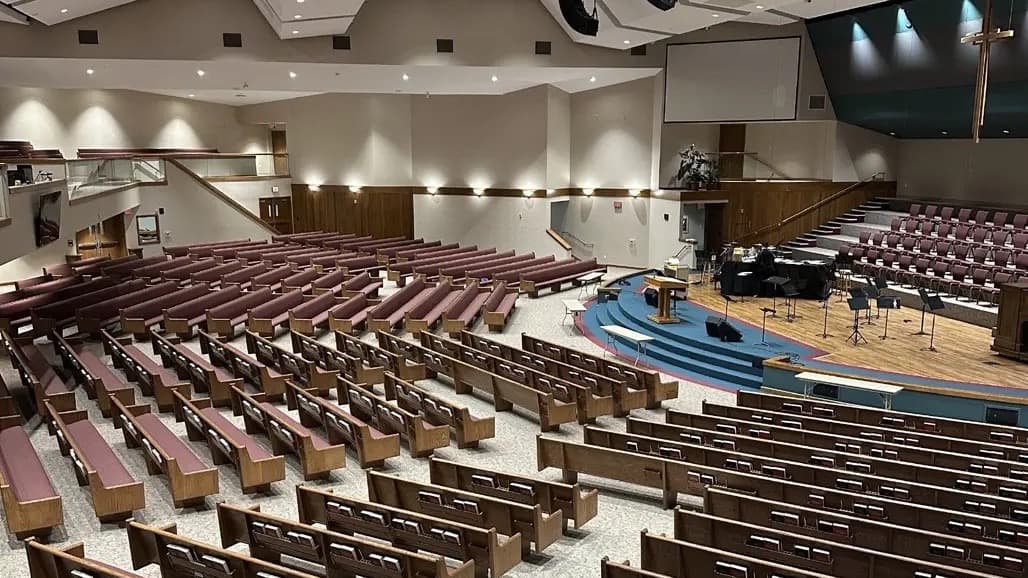
Why Sanctuary Lighting Is a Growing Priority for Pasadena-Area Churches
Churches across Pasadena, Deer Park, La Porte, Friendswood, and the broader southeast Houston corridor share a common challenge: their sanctuaries were designed and built in an era when lighting technology looked very different. Many of these facilities — some decades old, others recently expanded — rely on incandescent, halogen, or fluorescent systems that were standard at the time but are increasingly difficult and costly to maintain today.
The Greater Houston area is home to a dense and active faith community. With Pasadena's population approaching 152,000 and the region continuing to grow, many congregations are expanding their facilities, launching livestreaming ministries, or renovating sanctuaries to accommodate growing membership. In that context, lighting is no longer just about illumination — it's about creating the right environment for worship, supporting digital media production, and managing operating costs responsibly.
Understanding the most common pain points — and the innovations now available to address them — is the first step toward a more manageable, cost-effective facility.
The Most Common Sanctuary Lighting Challenges Facility Managers Face
Church sanctuaries present a unique set of maintenance demands that differ significantly from typical commercial buildings. High vaulted ceilings, intricate architectural features, and the need to preserve the aesthetic character of a worship space all add layers of complexity that general contractors often underestimate.
Frequent bulb burnout in hard-to-reach fixtures is among the most reported issues. When incandescent or halogen lamps fail in fixtures mounted 30 or 40 feet overhead, replacement requires scaffolding, aerial lifts, and significant labor — sometimes multiple times a year per fixture. For lean facility teams managing properties across Pasadena and nearby communities like South Houston or Shoreacres, this is a recurring drain on time and budget.
Aging ballasts and dimming incompatibilities are another widespread problem. Fluorescent systems in particular depend on ballasts that degrade over time, producing the flickering and humming that many congregations have simply learned to tolerate. When dimmer controls are added to these systems without proper compatibility assessments, the problems compound — creating inconsistent light levels and, in some cases, accelerating fixture failure.
Uneven illumination affects both the worship experience and, increasingly, the quality of video and livestream production. Many churches in the Houston metro have invested in camera systems and streaming infrastructure to reach online audiences, only to find that their existing lighting creates harsh shadows, blown-out highlights, or color inconsistencies that undermine the final product.
Energy costs are a practical concern for any nonprofit organization. Older sanctuary lighting systems can be significant contributors to a church's monthly utility bill, particularly in Southeast Texas where summer cooling loads already place heavy demands on building systems and energy expenses.
How LED Technology Is Changing the Calculus for Church Facilities
The shift to LED is no longer a trend — it's a widely adopted standard in commercial and institutional facility management. But for church sanctuaries specifically, the conversation has evolved well beyond simple bulb replacement. Today's LED solutions for worship spaces address the full spectrum of facility concerns: lifespan, light quality, controllability, and integration with modern audiovisual systems.
Extended lamp life is perhaps the most immediately impactful benefit for facilities teams. Quality LED fixtures designed for commercial and institutional use can last 50,000 hours or more — meaning the scaffolding and lift rentals that have become a line item in the annual facilities budget may be needed only once every several years rather than several times a season.
Improved color rendering and tunable white technology are particularly relevant for worship environments. Modern LED systems can be tuned to shift color temperature throughout a service — warmer tones for intimate, reflective moments, cooler tones for high-energy worship — without the lag, noise, or inefficiency of traditional theatrical or architectural systems. For churches in the Pasadena area that have invested in or are considering livestreaming capabilities, consistent, high-CRI (Color Rendering Index) lighting makes a measurable difference in on-camera quality.
Advanced dimming and control integration has matured significantly. Today's LED-compatible dimming systems can be programmed for scene presets, integrated with existing audiovisual and production consoles, and managed remotely — reducing the need for manual adjustments before and after every service. For facilities teams managing multiple weekly services, events, and rentals, that programmability translates directly into reduced labor and fewer errors.
Maintenance-friendly design is an often-overlooked benefit. Newer LED fixture designs prioritize modular serviceability — meaning when a component does eventually need attention, the process is simpler and less disruptive than traditional fixture repair or replacement.
What a Thoughtful Upgrade Process Looks Like
One of the most important insights for church facility managers considering a lighting upgrade is that the process matters as much as the product. A poorly planned retrofit — even with quality fixtures — can result in compatibility issues, aesthetic disappointments, or disruption to services. A well-managed process, by contrast, can be completed with minimal impact on the congregation's weekly schedule.
The most effective sanctuary lighting projects typically begin with a thorough assessment of existing conditions: fixture types and locations, wiring and circuitry, dimming infrastructure, ceiling access points, and the specific lighting goals of the facility team and ministry leadership. This diagnostic phase surfaces issues that might otherwise create problems mid-project — aging wiring that needs remediation, dimmer panels that need upgrading before LED fixtures will perform correctly, or structural access limitations that affect installation sequencing.
From there, a phased approach often makes sense for active facilities. Sanctuaries that host services multiple times per week — common across Pasadena, Pasadena's surrounding neighborhoods, and the broader southeast Houston faith community — benefit from installation schedules designed around their calendar. Work can frequently be completed in segments between services, minimizing the disruption that would otherwise deter facility teams from moving forward.
It's also worth noting that churches with historic architecture or distinctive aesthetic character — stained glass windows, exposed wood ceiling structures, or custom ornamental fixtures — require a level of design sensitivity that goes beyond standard commercial lighting practice. Preserving the visual character of the worship space while modernizing the underlying technology is a balance that experienced contractors understand and plan for from the outset.
Eligible organizations should also be aware of cooperative purchasing programs that can simplify procurement and potentially reduce costs. Cooperative contracts available through programs such as BuyBoard, TIPS, Sourcewell, Houston Church COOP, and others may be accessible to qualifying faith-based and nonprofit organizations — streamlining the vendor selection process and providing access to pre-negotiated pricing structures. Contact your local VOSS branch to learn which programs may apply to your organization.
Thinking Beyond the Sanctuary: A Whole-Facility Perspective
While the sanctuary is typically the highest-priority space for a lighting upgrade, experienced facility managers in the Pasadena area increasingly recognize the value of taking a whole-building view. Fellowship halls, classrooms, administrative offices, parking lots, and exterior walkways all present opportunities to reduce maintenance burden and energy consumption — and a coordinated approach to these spaces often yields better outcomes than addressing them in isolation.
The broader Latest Lighting content series from VOSS addresses many of these adjacent topics in depth — including commercial LED outdoor lighting, parking lot and outdoor LED upgrades, energy audits and rebate navigation, and fluorescent tube bans affecting commercial buildings. These resources are worth reviewing for any facility team developing a multi-year capital improvement plan.
For churches in the Houston area, CenterPoint Energy serves as the primary utility provider for a large portion of the region. Understanding what energy efficiency incentives and rebate programs may be available through your utility is a worthwhile step before finalizing any lighting upgrade plan — and it's a conversation VOSS can help facilitate.
Service Availability
While VOSS offers a comprehensive suite of national services, specific capabilities may vary by location. Please contact your local branch to confirm the current availability of specific services, technology solutions, or contracting capabilities in your immediate market.
Talk With VOSS About Your Sanctuary Lighting
If your facility team in Pasadena or the surrounding Greater Houston area is navigating flickering fixtures, aging ballasts, high-ceiling maintenance challenges, or simply trying to understand what a sanctuary lighting upgrade would realistically involve, we're here to help think it through.
VOSS brings more than 85 years of experience working with commercial and institutional facilities across the country, including faith-based properties with the specific architectural, operational, and budgetary considerations that make church facilities unique.
VOSS Houston Branch
Phone: (713) 996-8060
Reach out to start a conversation — not a sales process. Our team is glad to discuss your current challenges, walk through what an assessment would involve, and help your ministry make informed decisions about your facility's future.