Why Houston-Area Baseball Facilities Are Rethinking Their Lighting
Greater Houston is one of the most sports-passionate metro areas in the country — and baseball is woven into its identity, from the Houston Astros and their devoted fanbase to the thousands of youth, recreational, and scholastic leagues that fill diamonds across Harris, Fort Bend, Montgomery, Brazoria, and Galveston counties. On any given weeknight, fields in Pearland, Katy, League City, Cypress, Friendswood, Spring, and Conroe are hosting games long after sunset.
That level of activity puts enormous pressure on aging metal halide and high-pressure sodium (HPS) lighting systems — systems that were never designed for the energy demands, maintenance cycles, or broadcast expectations of today's game. Across the Houston region, facility managers, parks and recreation directors, athletic directors, and private club operators are reaching the same conclusion: the era of legacy sports lighting is over, and LED technology is the standard.
This article explores what that transition looks like in practice, why Houston's specific climate and utility environment make the case for LED even stronger, and what decision-makers should understand before planning a baseball or softball lighting project of any scale.
The Hidden Costs of Aging Field Lighting in the Houston Climate
Houston's heat and humidity are legendary — and they are among the most destructive forces for traditional metal halide and HPS lighting systems. High ambient temperatures accelerate lumen depreciation, reduce lamp life, and force more frequent re-lamping cycles. Coastal humidity along the Gulf corridor — affecting facilities in Webster, Pasadena, La Marque, and Galveston Island — further corrodes fixtures and wiring over time.
The operational math becomes difficult to ignore:
- Energy consumption — Traditional HPS and metal halide systems for a full-sized baseball complex can draw enormous amounts of power during peak evening hours, placing facilities squarely in higher demand-charge tiers on their CenterPoint Energy bills
- Maintenance labor — Replacing lamps on 60- to 80-foot poles requires specialized equipment and carries both direct cost and facility downtime — particularly disruptive during active seasons
- Warm-up and restrike time — Legacy systems can take 15–20 minutes to reach full brightness and require equal time to restrike after a power interruption, creating real complications for rain delays, game restarts, and broadcast timing
- Inconsistent light levels — As lamps age, light output degrades unevenly, creating hot spots, dark zones, and inconsistent visibility across the infield, outfield, and warning track
For Houston-area municipalities managing large parks systems — from the City of Houston's sprawling recreational inventory to the independently operated facilities in Sugar Land, Missouri City, Humble, Baytown, and Tomball — these costs compound across dozens of fields simultaneously.
What Modern LED Baseball Lighting Actually Delivers
The performance gap between legacy systems and today's purpose-built LED sports lighting is significant — and it extends well beyond simple energy efficiency.
Photometric Precision for Baseball's Unique Geometry
Baseball is not like other sports. The playing field is asymmetrical, sightlines vary dramatically between infield and outfield positions, and the ball travels at speeds and trajectories that demand exceptional vertical illuminance — not just horizontal foot-candles on the turf. Professional LED sports lighting systems are engineered with this geometry in mind, using precise beam angles, pole placement calculations, and spill-light controls to produce the uniform, shadow-free environment that players, umpires, and spectators need.
Measurable Energy Reduction
LED systems typically use significantly less energy than the metal halide systems they replace, with some installations achieving reductions of 50% or more depending on the age and configuration of the existing system. For a Houston-area facility running games four to five nights per week across a six-month season, that represents a meaningful and recurring reduction in operating costs — and a corresponding reduction in carbon output, a growing priority for municipalities and school districts across the region.
Instant-On Performance
LED lighting reaches full brightness the moment it is switched on — no warm-up, no restrike delay. For a baseball complex managing multiple fields simultaneously, coordinating rain delays, or accommodating broadcast schedules, this is not a minor convenience; it is an operational necessity.
Controls Integration and Smart Scheduling
Modern LED sports lighting systems can be integrated with centralized lighting controls platforms, allowing facility managers to schedule field lighting by game time, dim unused fields between events, respond to natural light conditions, and monitor energy consumption in real time. For larger complexes in communities like Katy, The Woodlands, or Pearland — where multiple fields may be in use simultaneously across different sports — this level of control translates directly into operational efficiency.
Reduced Light Trespass and Neighbor Impact
Houston's suburban growth has placed recreational facilities in increasingly close proximity to residential neighborhoods. Modern LED optics are engineered to direct light precisely onto the playing surface and minimize spill into surrounding areas — an important consideration for facilities navigating community relations and municipal ordinance compliance in areas like Richmond, Rosenberg, Stafford, and Cinco Ranch.
A Proven Playbook: The Page, AZ Baseball Case Study
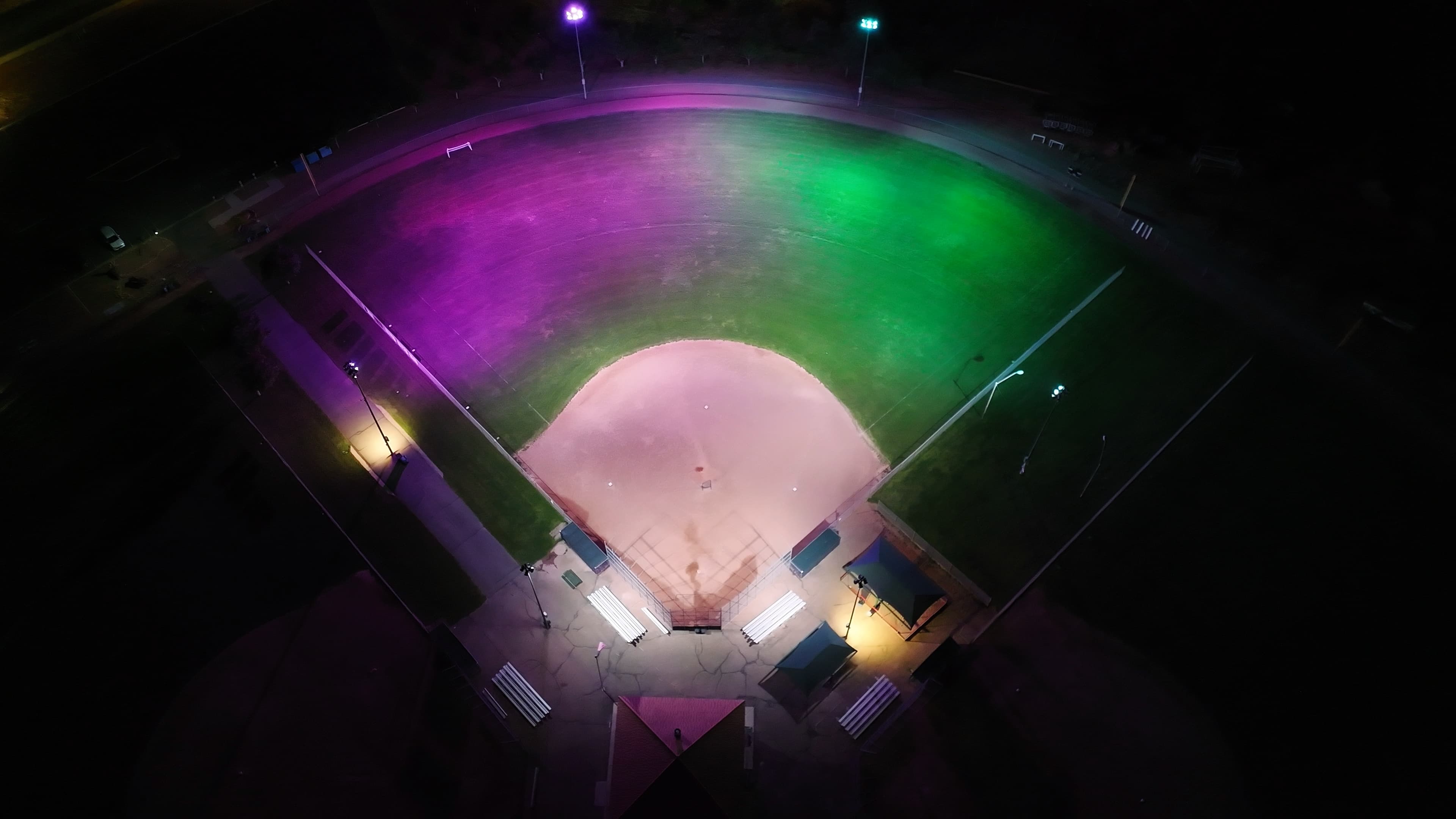
VOSS has direct, hands-on experience delivering LED lighting solutions for baseball facilities — and the results speak for themselves. In Page, Arizona, VOSS completed a full LED lighting upgrade for a baseball facility, demonstrating the kind of project execution that facility owners and parks departments across the country have come to expect: precise photometric design, compliant pole and fixture installation, and a finished product that measurably improved the playing and spectating experience while driving down long-term energy costs.
The Page, AZ project illustrates a principle that applies equally to a youth recreational complex in Deer Park or a high school varsity diamond in Humble: great sports lighting is an engineered outcome, not an off-the-shelf product. It requires a contractor who understands both the electrical infrastructure demands and the sport-specific performance standards — and who can manage the full project from design through commissioning.
For Greater Houston facilities considering a similar path, this kind of documented project experience is exactly the proof point that separates a knowledgeable partner from a general electrical contractor filling out a scope of work.
Who This Applies To Across the Houston Market
Baseball and softball lighting upgrades are relevant to a wide range of organizations across the Greater Houston area:
- Municipal parks and recreation departments in Houston, Pasadena, Pearland, League City, Sugar Land, Baytown, and surrounding communities managing aging field inventories
- Independent school districts across Harris, Fort Bend, Montgomery, Brazoria, and Galveston counties with varsity, junior varsity, and freshman baseball programs
- Private and semi-private baseball clubs and academies — a fast-growing segment across the Houston suburbs, where travel ball programs are investing in year-round training and competition facilities
- Community college and university athletic programs in the Houston metro area with NCAA compliance obligations
- Faith-based organizations and HOA communities operating recreational fields for congregation members and residents
For public-sector organizations — school districts, municipal parks departments, and county facilities — cooperative purchasing programs can simplify the procurement process. Eligible organizations in the Houston area may be able to access VOSS services through established programs including BuyBoard, TIPS, Sourcewell, Omnia Partners, AEPA, and PACE, among others. These vehicles allow qualifying entities to procure without a separate formal bid process, streamlining project timelines considerably.
Key Considerations Before Planning Your Lighting Project
For facility managers and decision-makers in the Houston area beginning to evaluate a baseball or softball lighting project, a few strategic questions are worth thinking through early:
What league or governing body standards apply? Requirements vary significantly between Little League International, NFHS (high school), NJCAA, NCAA, and professional classifications. Understanding the applicable illuminance and uniformity standards before design begins is essential to avoiding costly redesigns.
What is the condition of your existing electrical infrastructure? A lighting upgrade is often the moment when aging electrical service, buried conduit, and panel capacity come into focus. A full-service electrical contractor — not just a fixture supplier — is best positioned to evaluate and address these underlying infrastructure needs alongside the lighting scope.
Are utility rebates available? CenterPoint Energy and other providers serving the Houston area offer programs that may offset a portion of project costs for qualifying energy-efficiency upgrades. Understanding what incentives are available — and how to document and claim them — is a meaningful part of project planning.
What is your long-term maintenance strategy? LED systems dramatically extend maintenance intervals, but they are not maintenance-free. Understanding warranty terms, fixture replacement logistics, and ongoing support options should be part of the evaluation, not an afterthought.
For deeper context on energy incentives and rebate navigation, VOSS's related article on Maximize ROI with Commercial LED Lighting Rebates in Dallas, TX offers useful framing on how utility programs work — much of which applies to the Houston market as well. And for organizations evaluating LED upgrades across other sports venues, our articles on Pickleball LED Lighting Solutions, Tennis Court Lighting and Energy Solutions, and LED Gymnasium Lighting Solutions cover adjacent topics in the same series.
Service Availability
While VOSS offers a comprehensive suite of national services, specific capabilities may vary by location. Please contact your local branch to confirm the current availability of specific services, technology solutions, or contracting capabilities in your immediate market.
Talk With VOSS About Your Houston-Area Baseball Facility
Whether you are managing a single community field in Friendswood or overseeing a multi-diamond complex in The Woodlands, VOSS is ready to help you think through the right approach — from photometric design and infrastructure assessment to installation, commissioning, and long-term support. Our Houston team brings the local market knowledge and technical depth to make your project successful from the first conversation to the final walk-through.
VOSS — Houston Branch
Phone: (713) 996-8060
We welcome the opportunity to discuss your facility's specific needs and help you understand what a well-executed LED lighting project could mean for your players, your fans, and your bottom line.