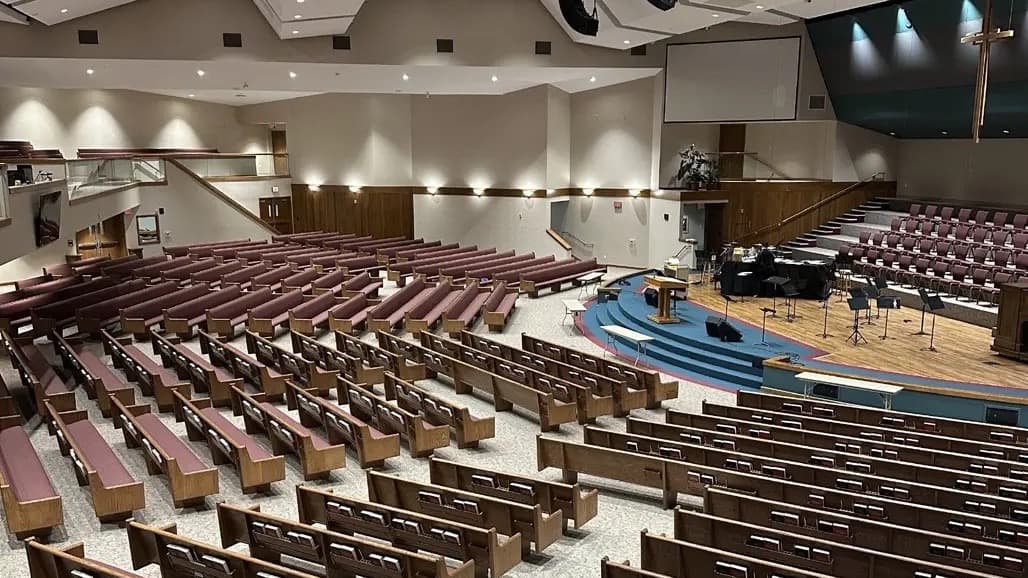
Why Sanctuary Lighting Is a Growing Priority for Conroe-Area Churches
Conroe, Texas has experienced remarkable growth over the past decade — the city's population has surpassed 90,000, and Montgomery County as a whole continues to be one of the fastest-growing counties in the United States. That growth has brought new residents, new families, and new congregants to churches throughout Conroe, The Woodlands, Willis, Montgomery, and Magnolia. For many congregations, this expansion has created a pressing question: are your facilities — including your sanctuary lighting — ready to meet the demands of a growing community?
For facility managers and ministry operations leaders, sanctuary lighting is rarely top of mind until something goes wrong. A bulb burns out in a 40-foot ceiling. A dimmer starts flickering mid-service. A livestream camera operator struggles with uneven, yellow-tinged light that makes video quality look unprofessional. These are the moments that reveal how much is riding on systems that are often decades old.
The good news is that lighting technology has advanced dramatically, and churches of every size — from small congregation chapels to large multi-campus ministries — are finding that thoughtful upgrades pay dividends in operational efficiency, congregant experience, and long-term cost reduction.
The Unique Lighting Challenges Church Sanctuaries Present
Church sanctuaries are among the most technically demanding environments for lighting professionals. Unlike a commercial office or retail space, sanctuaries combine soaring ceilings, ornate architectural features, and emotionally significant aesthetics with the practical need for reliable, functional illumination. Understanding the most common challenges helps facility leaders make informed decisions.
High-Ceiling Access and Bulb Replacement Costs
Many sanctuaries in the Conroe area — whether traditional houses of worship or modern megachurch facilities — feature ceiling heights of 30 to 60 feet or more. Replacing a single bulb in a traditional incandescent or halogen fixture at that height requires scaffolding, boom lifts, or specialized access equipment. In a region like Greater Houston, where heat and humidity accelerate bulb degradation, the frequency of those replacements can be significant. Maintenance teams find themselves scheduling lifts multiple times per year, pulling staff and resources away from other priorities.
Aging Ballasts and Dimming Incompatibilities
Fluorescent fixtures — still common in many sanctuaries, fellowship halls, and narthex spaces — rely on electronic or magnetic ballasts that degrade over time. Flickering, buzzing, and slow warm-up times are the most visible symptoms, but aging ballasts also reduce energy efficiency and can become a fire or electrical risk if left unaddressed. Texas has not yet implemented a statewide fluorescent lamp ban, but federal regulations are already phasing out many fluorescent lamp types at the manufacturing level. Facility managers who stay ahead of this shift avoid the scramble for replacement inventory.
Uneven Illumination and Livestream Demands
Modern ministry increasingly involves video production. Whether a congregation streams weekly services online, records teaching content, or hosts hybrid events, lighting quality directly affects production value. Uneven color temperatures, dark zones near the stage or altar, and poor rendering of skin tones under outdated fixtures are challenges that grow more visible — and more important — as camera technology improves. Upgrading to LED systems with high Color Rendering Index (CRI) ratings and tunable color temperatures addresses these concerns while also improving the in-person worship environment.
Historic and Architectural Constraints
Some of Conroe's established congregations occupy buildings with significant architectural character — stained glass, exposed wood, masonry, or ornamental fixtures that cannot simply be replaced. In these settings, retrofitting existing housings with LED-compatible components often preserves the visual character of the space while delivering the performance benefits of modern technology. This approach requires experienced professionals who understand both the technical requirements and the sensitivity of the environment.
What Modern Sanctuary Lighting Upgrades Look Like in Practice
The landscape of lighting technology available to churches today is meaningfully different from what it was even five years ago. LED fixtures have matured well beyond basic efficiency — they now offer precision dimming, color temperature tunability, wireless control integration, and lifespans measured in decades rather than months.
LED Retrofits: The Practical Starting Point
For most facilities, a phased LED retrofit is the most practical path forward. Rather than replacing entire luminaire systems at once, experienced contractors assess the existing fixture inventory and identify which housings can be retrofitted with LED components and which require full replacement. This approach minimizes capital outlay while delivering immediate reductions in energy consumption and maintenance frequency.
In a typical sanctuary retrofit, facility managers can expect LED fixtures to last significantly longer than the fluorescent or incandescent lamps they replace — dramatically reducing the number of times scaffolding or lifts need to be deployed each year. That operational simplification has real value in a busy church calendar where minimizing disruption to services, rehearsals, events, and community programming matters.
Lighting Controls and Scene Management
Modern sanctuary lighting systems increasingly incorporate digital control platforms that allow facilities teams — or even volunteer tech crews — to save and recall lighting scenes for different programming needs. Sunday morning worship, a weekday memorial service, a youth event, and a community banquet all have different lighting requirements. A well-designed control system makes those transitions seamless without requiring technical expertise every time.
For churches in the Conroe area investing in audio-visual infrastructure, lighting control integration is a natural complement to sound and projection upgrades — creating a unified production environment that enhances every type of gathering.
Emergency and Safety Lighting Compliance
Sanctuary lighting upgrades also provide an opportunity to audit and update emergency egress lighting — exit signs, path-of-travel illumination, and backup lighting systems. Texas building codes and life-safety standards have specific requirements for occupied assembly spaces, and many older church facilities have emergency lighting that predates current standards. A comprehensive lighting assessment should include this review as a matter of course.
The Business Case: Energy Savings, Rebates, and Long-Term ROI
For facility managers and church administrators managing tight operational budgets, the financial case for LED upgrades is well-established. Energy costs in Texas, while subject to the competitive retail electricity market, remain a significant line item for facilities that operate sanctuaries, fellowship halls, classrooms, and offices across extended hours each week.
LED fixtures consume substantially less energy than the incandescent, halogen, and fluorescent systems they replace — reductions that compound over time as electricity costs fluctuate. Beyond the utility bill, reduced maintenance frequency translates directly to labor savings and fewer emergency repair calls.
Churches with eligible 501(c)(3) nonprofit status should also explore whether utility rebate programs or cooperative purchasing arrangements apply to their procurement. Organizations affiliated with programs such as Houston Church COOP, BuyBoard, TIPS, Sourcewell, or Omnia Partners may have access to pre-negotiated pricing structures that simplify the purchasing process and reduce administrative burden. Eligible public-sector and nonprofit entities in Montgomery County and surrounding areas are encouraged to ask their lighting contractor about which programs are available and applicable to their specific situation.
For a deeper dive into navigating utility incentives and rebate programs, the Maximize ROI with Commercial LED Lighting Rebates in Dallas, TX and Energy Audits, Incentives, and Rebate Navigation for Businesses articles in this series offer useful context on how these programs work in the Texas market.
Serving Conroe and the Greater Houston Region
VOSS brings more than 85 years of commercial electrical and lighting experience to church facilities across Conroe, The Woodlands, Huntsville, Spring, Tomball, Cypress, and the broader Greater Houston metropolitan area. Our Houston branch team understands the specific demands of the Texas Gulf Coast climate — high humidity, intense heat, and storm-related power variability all affect lighting system longevity and performance in ways that matter to facility planning.
We work with congregations of all sizes and denominations, from smaller community churches to large multi-site ministries with complex technical requirements. Our approach prioritizes low-disruption scheduling, honest assessments of existing infrastructure, and practical recommendations that align with each facility's budget and ministry calendar.
If your organization is also exploring broader energy efficiency topics — including outdoor lighting, parking areas, or EV charging infrastructure for your campus — our Energy Efficient Church Lighting Upgrades, Parking Lot and Outdoor LED Lighting Upgrades, and Commercial EV Charging Stations and Rebates articles in this series offer additional context relevant to church and faith-based facility operators.
Service Availability
While VOSS offers a comprehensive suite of national services, specific capabilities may vary by location. Please contact your local branch to confirm the current availability of specific services, technology solutions, or contracting capabilities in your immediate market.
Talk With Our Houston Team About Your Sanctuary
If your church facility in Conroe or the surrounding Greater Houston area is dealing with aging sanctuary lighting, frequent maintenance calls, rising energy costs, or a need to improve the quality of your worship environment, we welcome the conversation. Our team is available to conduct a facility assessment, walk through your options, and help you develop a plan that fits your timeline and budget — without pressure.
VOSS Houston Branch
Phone: (713) 996-8060
Reach out to start a consultative discussion about what modern sanctuary lighting can do for your congregation and your facility team.