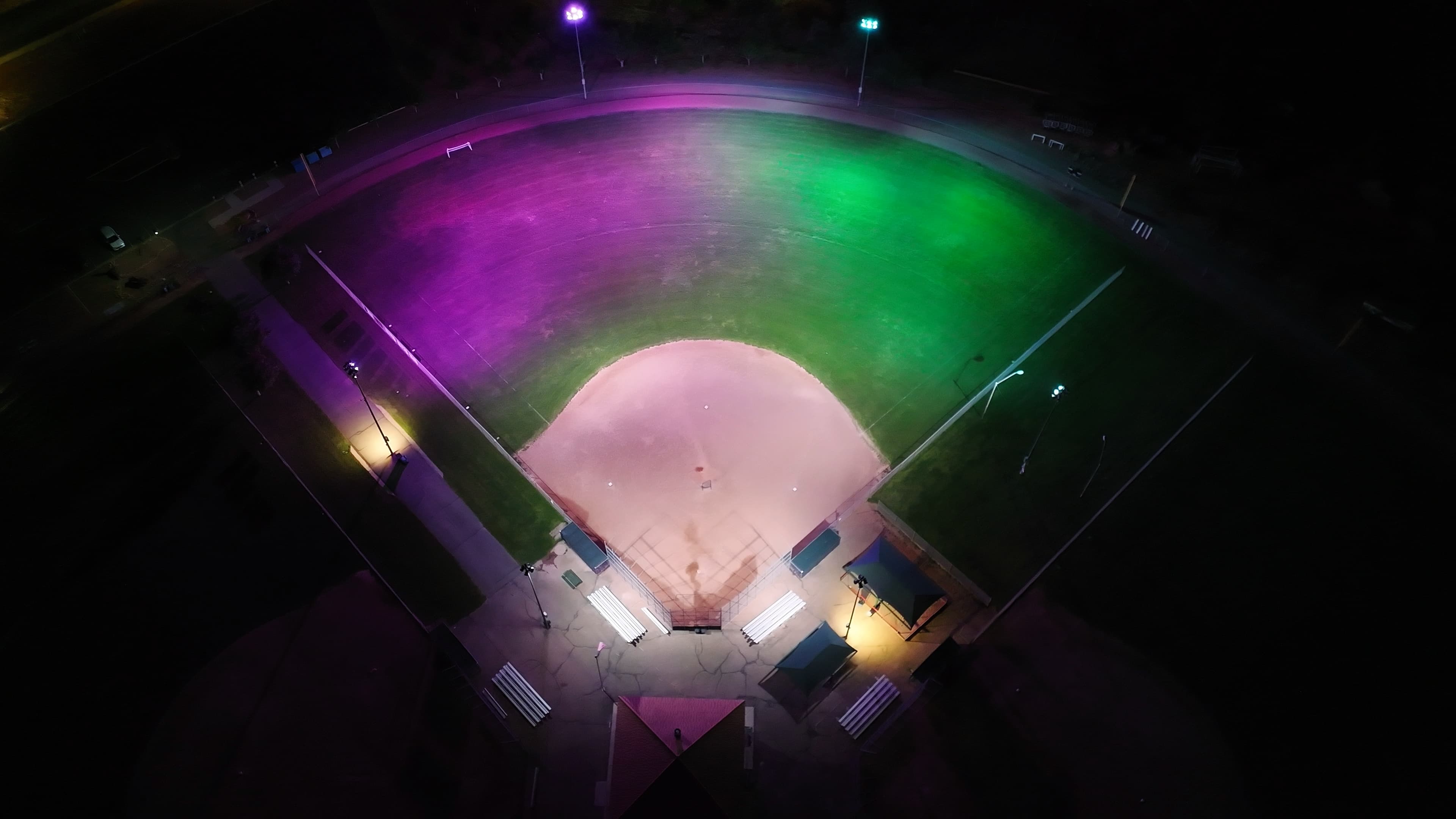
Conroe, TX has grown into one of the most dynamic communities in the Greater Houston area — and the demand for quality recreational and competitive sports infrastructure has grown right alongside it. With a population pushing 90,000 and a broader Montgomery County region that continues to attract families, corporate relocations, and major development, the pressure on parks and recreation departments, school districts, and private athletic associations to deliver world-class facilities has never been greater.
Baseball and softball are at the center of that story. From youth leagues playing under the lights at community parks to high school varsity programs competing for district championships, the quality of field lighting directly affects the quality of play — and the experience of everyone in the stands. Across Conroe and neighboring communities like The Woodlands, Spring, Tomball, Magnolia, and Huntsville, facility operators are discovering that aging metal halide and high-pressure sodium lighting systems are no longer up to the task.
This is where the shift to LED technology isn't just a trend — it's a practical, financially sound decision that is reshaping how Texas athletic facilities approach their infrastructure.
What Makes Baseball and Softball Lighting Uniquely Challenging
Not all sports lighting is the same. Baseball and softball fields present some of the most technically demanding lighting challenges in athletics, and understanding those challenges is essential before any upgrade begins.
The geometry of a baseball diamond — with its mix of infield, outfield, warning track, and foul territory — requires lighting that delivers uniform illuminance across dramatically different distances and angles. A batter tracking a fastball needs consistent brightness and minimal glare. An outfielder reading a fly ball against a night sky needs depth perception that only well-designed, high-quality optics can provide. Umpires, base coaches, and broadcasters all have distinct visibility requirements that compound the design challenge.
Add to that the variability of field configurations — from 200-foot youth fields to 400-foot collegiate and professional dimensions — and it becomes clear why baseball lighting demands a purpose-built engineering approach, not an off-the-shelf solution. Key design considerations include:
- Pole placement and height — Positioning poles to minimize shadows and obstructions while staying within property boundaries requires careful photometric modeling
- Beam angle and distribution — Precise optical control ensures light reaches the playing surface where it's needed, rather than spilling into neighboring properties or the night sky
- Glare management — Shielding and directional control protect players from direct glare, which is especially critical for infielders and catchers
- Uniformity ratios — League and governing body standards (including those set by the IES, NCAA, and Little League Baseball) define minimum uniformity requirements that must be met for sanctioned play
- Spill and obtrusive light control — Communities like Conroe and Montgomery County increasingly expect responsible light management that protects residential neighbors and natural environments
Facilities that attempt to retrofit LED fixtures into legacy pole and mounting infrastructure without addressing these design elements often find themselves with an expensive system that still fails to meet standards or deliver the visual experience players and fans expect.
The LED Advantage: What the Data and Experience Tell Us
The transition from metal halide to LED technology in sports lighting has accelerated dramatically over the past decade, and the evidence supporting that shift is compelling. For facility managers and administrators evaluating capital projects in the Conroe area, the case for LED rests on several converging advantages.
Energy Efficiency at Scale LED fixtures typically consume 50–70% less energy than the metal halide systems they replace. For a multi-field complex running lights several evenings per week through a spring and fall season — plus summer tournaments — that reduction translates into meaningful annual savings on electricity bills. In a region served by competitive Texas electricity markets, those savings compound over time and can be factored directly into project ROI calculations.
Improved Light Quality and Consistency Modern LED sports lighting systems deliver superior color rendering (high CRI), which means colors appear more natural and true under the lights. This matters for players reading ball spin and trajectory, for coaches evaluating player technique on video, and increasingly for live streaming and broadcast production — a capability that even community-level facilities are now investing in as youth sports media grows.
Instant-On Performance and Controls Integration Unlike metal halide systems that require a warm-up period before reaching full brightness — and a cool-down before restarting — LED fixtures reach full output immediately. This is a practical advantage during rain delays, power interruptions, and evening events that start close to scheduled game time. When paired with modern lighting controls — programmable schedules, remote monitoring, dimming capability, and occupancy sensing — LED systems give facility operators a level of management flexibility that legacy technology simply cannot match.
Reduced Maintenance Burden Metal halide lamps have relatively short rated lifespans and require regular group relamping — a labor-intensive and costly process, particularly on tall sports lighting poles. LED fixtures are rated for dramatically longer service life, reducing the frequency and cost of maintenance interventions. For parks departments and school districts managing lean maintenance budgets, that's a significant operational benefit.
Proven Results in the Field VOSS's work in Page, AZ offers a concrete illustration of what a well-executed baseball lighting project can deliver. That project demonstrated how a carefully engineered LED solution — designed to meet the specific dimensional and standards requirements of the facility — can transform the playing experience while achieving the energy and operational savings that justify the capital investment. It's the kind of outcome that VOSS brings to every project, regardless of scale.
Considerations for Schools, Parks, and Private Associations in Montgomery County
The decision-making process for a baseball or softball lighting project varies depending on who owns and operates the facility — and understanding those differences is important for planning a successful project.
Public School Districts High school programs across Montgomery County Independent School District and Conroe ISD operate some of the region's most heavily used baseball and softball facilities. For these organizations, lighting projects are capital expenditures that must navigate procurement requirements, bond funding considerations, and compliance with UIL (University Interscholastic League) standards. The good news is that eligible Texas school districts can access cooperative purchasing programs — including BuyBoard, TIPS, Sourcewell, and Omnia Partners — that streamline vendor selection and contracting while ensuring compliance with state procurement law. VOSS is available through these programs, making it easier for districts to move a lighting project forward without a lengthy standalone bid process.
Municipal Parks Departments City of Conroe parks and recreation staff, along with Montgomery County Precinct operations, manage a range of athletic facilities serving youth and adult leagues. For these clients, the calculus around LED lighting often centers on total cost of ownership, maintenance reduction, and the ability to extend evening programming hours — all of which LED technology directly addresses. Municipal organizations may also benefit from cooperative purchasing vehicles such as AEPA, PACE, and Omnia Partners.
Private Athletic Associations and Facility Operators Youth baseball and softball associations, tournament facilities, and privately operated complexes have more flexibility in how they structure and fund projects — but face the same pressure to compete for players, families, and event revenue. For these clients, the ability to host evening tournaments, broadcast games, and deliver a premium experience is directly tied to lighting quality. LED upgrades are increasingly positioned not just as a cost-saving measure, but as a revenue-enabling one.
For any of these segments, the broader question is the same: how do you approach a project of this complexity in a way that delivers the right outcome the first time? The answer lies in partnering with a contractor who brings both engineering rigor and project management experience to the table.
VOSS's Approach: Engineering First, Installation Second
At VOSS, we believe that a great lighting project begins long before a single fixture is mounted. Our process for baseball and softball LED lighting projects is grounded in a disciplined engineering methodology:
- Photometric Design and Modeling — We develop detailed photometric layouts that account for field dimensions, pole placement options, target illuminance levels, and uniformity requirements before any equipment is specified or purchased
- Standards Compliance — Our designs are engineered to meet IES (Illuminating Engineering Society) recommendations for the applicable level of play, as well as any league-specific or governing body requirements
- Equipment Selection — We work with leading sports lighting manufacturers and technology platforms to specify fixtures that match the performance requirements of your facility — not simply what's available or expedient
- Full Project Management — From permitting and electrical infrastructure coordination through installation, commissioning, and post-project support, VOSS manages the full scope of work with experienced field crews and project managers
- Controls Integration — Where appropriate, we integrate advanced controls systems — including programmable scheduling, remote access, and dimming — to maximize energy savings and operational convenience
This approach reflects our broader commitment, as part of the Latest Lighting practice, to delivering solutions that are engineered to perform — not just to check a box. Readers interested in related sports facility lighting topics may find our content on LED Gymnasium Lighting Solutions, Pickleball LED Lighting Solutions, and Tennis Court Lighting and Energy Solutions useful as companion resources, as well as our broader coverage of LED Football Stadium Lights and Sports Field Lighting Solutions.
Service Availability
While VOSS offers a comprehensive suite of national services, specific capabilities may vary by location. Please contact your local branch to confirm the current availability of specific services, technology solutions, or contracting capabilities in your immediate market.
Talk to VOSS About Your Conroe or Greater Houston Baseball Facility
Whether you're planning a full LED retrofit at an established multi-field complex, evaluating options for a new facility, or simply trying to understand what a project like this would involve and cost, VOSS is ready to have that conversation. Our Houston branch serves Conroe, Montgomery County, The Woodlands, Spring, Tomball, Magnolia, Huntsville, and communities throughout the Greater Houston region.
We don't lead with a proposal — we lead with questions. What's the current state of your field lighting? What standards does your program need to meet? What does success look like for your players, your fans, and your budget? Those answers shape the right solution.
VOSS Houston Branch Phone: (713) 996-8060
Contact our Houston team today to schedule a consultation and learn how a thoughtfully engineered LED lighting solution can elevate your baseball or softball facility for years to come.