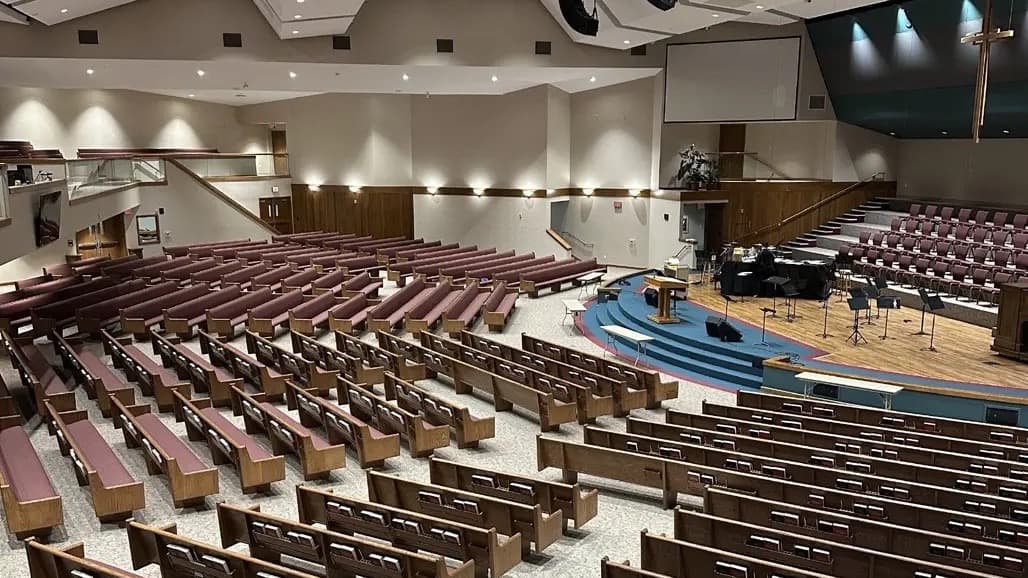
Why Sanctuary Lighting Is a Growing Priority for Michigan Churches
Across Wyoming, Grandville, Kentwood, and the broader Grand Rapids metro, faith communities face a challenge that often doesn't surface until it becomes urgent: their sanctuary lighting systems are quietly aging out of serviceability. Incandescent, halogen, and fluorescent fixtures that were installed decades ago now require frequent bulb replacements, battle aging ballasts, and struggle to deliver the consistent, warm illumination that modern worship — and modern media — demands.
This isn't just a comfort issue. For facility managers and operations leaders at churches of all sizes, lighting maintenance is increasingly a significant line item. When fixtures are mounted 30, 40, or even 60 feet overhead in a vaulted sanctuary, every bulb replacement requires scaffolding or a lift — and in a working church with services, rehearsals, and community events on the calendar, scheduling that access is its own logistical challenge. Meanwhile, energy costs continue to climb, and outdated fixtures consume far more power than their modern LED equivalents.
The good news: the technology and implementation strategies available today make this a very solvable problem — and the return on investment is well-documented.
The Real Challenges Facing Church Facility Managers
Understanding why sanctuary lighting maintenance has become such a persistent issue requires a clear-eyed look at what these facilities are actually dealing with. Churches in the Wyoming and Grand Rapids area — from smaller congregations along 28th Street SW to large multi-campus ministries serving tens of thousands across Kent County — tend to share a common set of pain points:
- High-frequency bulb burnout in elevated fixtures that demand costly lift rentals and labor hours, sometimes multiple times per year
- Flickering and dimming inconsistencies caused by aging ballasts, incompatible dimmer switches, or deteriorating wiring — a problem that compounds over time and distracts during services
- Uneven light distribution that creates bright spots near the altar or stage and dim zones in the congregation, affecting both the in-person experience and the quality of livestreamed or recorded services
- Rising utility costs from legacy high-wattage fixtures that run for hours during services, rehearsals, and community events throughout the week
- Historic or architectural constraints in older sanctuaries where modifying fixture mounting points or running new conduit requires sensitivity and planning
Each of these challenges represents a real drain on the facility team's time and the congregation's operating budget. And each one has a modern, proven solution.
LED Retrofits: What the Technology Actually Delivers
The shift to LED in commercial and institutional settings has been well underway for years, but the application of that technology in worship spaces has matured significantly. Today's LED fixtures designed for sanctuary environments offer capabilities that earlier generations of LED simply couldn't match — including warm color temperatures that complement wood, stone, and stained glass, tunable white options that allow lighting to shift from intimate to celebratory, and dimming performance that is smooth, silent, and compatible with the kinds of theatrical control systems many modern churches already use.
From a maintenance standpoint, the difference is dramatic. Where a traditional incandescent or halogen lamp might last 1,000 to 2,000 hours, a quality LED fixture can deliver 50,000 hours or more of rated life. For a sanctuary running services, events, and rehearsals throughout the week, that difference translates directly into fewer lift rentals, less staff time, and lower long-term costs.
Wattage reductions are equally significant. Many churches making the transition to LED find that they can achieve equal or better light levels while using 50% or less of the energy consumed by their previous fixtures — a meaningful reduction for a building that may be lit for 20 or more hours per week.
For churches exploring available incentives, it's also worth noting that utility rebate programs — including those accessible through providers serving the Grand Rapids area — can offset a meaningful portion of upfront project costs. Organizations interested in understanding available rebates and incentive structures may find the Maximize ROI with Commercial LED Lighting Rebates article in the Latest Lighting section a helpful companion resource.
Lighting Controls: The Often-Overlooked Upgrade
A lighting retrofit is most powerful when it includes a thoughtful controls strategy. For church sanctuaries, this means moving beyond simple on/off switches to scene-based control systems that allow facility staff to program and recall preset configurations for different types of services and events — Sunday worship, a candlelight Christmas Eve service, a midweek youth gathering, or a community rental event all have different lighting needs.
Modern dimming and scene control systems can be remarkably intuitive, reducing the learning curve for volunteers and staff who aren't lighting professionals. When integrated with a broader building management platform, they can also contribute to energy savings by ensuring lights aren't left at full intensity during low-occupancy periods.
For larger congregations or multi-campus churches in the Wyoming–Grand Rapids corridor, centralized controls that offer remote monitoring and management add another layer of operational efficiency — reducing the burden on facilities teams who are often managing multiple properties across the region.
Procurement Options for Faith-Based Organizations
For qualifying faith-based organizations and nonprofit institutions in Michigan, cooperative purchasing programs can provide a streamlined path to procuring lighting products and services without a lengthy competitive bidding process. VOSS participates in several cooperative purchasing programs relevant to this sector, including Houston Church COOP, Sourcewell, TIPS, and Omnia Partners, among others. These programs allow eligible organizations to leverage pre-negotiated contracts, simplifying procurement and accelerating project timelines.
Facility managers and administrators at congregations in Wyoming, Grandville, Caledonia, Byron Center, and surrounding communities are encouraged to ask about cooperative purchasing options when discussing project scope with our Grand Rapids team.
Service Availability
While VOSS offers a comprehensive suite of national services, specific capabilities may vary by location. Please contact your local branch to confirm the current availability of specific services, technology solutions, or contracting capabilities in your immediate market.
Connect With VOSS in Grand Rapids
VOSS has served commercial, institutional, and faith-based facilities across Michigan and the nation for more than 85 years. Our Grand Rapids branch team understands the unique demands of church properties in Wyoming and the surrounding communities — from the practical constraints of high-ceiling access to the operational rhythms of an active congregation. Whether you're managing a single sanctuary or overseeing facilities across multiple campuses, we're ready to help you think through a lighting strategy that fits your building, your budget, and your mission.
Our Grand Rapids branch serves Wyoming, Grandville, Kentwood, Walker, Caledonia, Byron Center, Rockford, and communities throughout Kent and Ottawa counties.
VOSS Grand Rapids Phone: (616) 975-9914 Toll-Free: (800) 706-8677
To explore how modern lighting technology and maintenance strategies apply to your facility specifically, we invite you to reach out for a consultative conversation — no obligation, just a practical discussion about where your facility stands and what your options look like.