Why Church Lighting Is a Growing Conversation in West Michigan
West Michigan has one of the most vibrant and densely concentrated faith communities in the United States. From large multisite congregations along the M-6 corridor to historic neighborhood churches in Heritage Hill, East Hills, and Wyoming, to growing suburban campuses in Kentwood, Caledonia, Grandville, and Rockford — the region's houses of worship are as architecturally and operationally diverse as the communities they serve.
That diversity is exactly what makes sanctuary lighting such a nuanced topic. A church built in the 1920s near Fulton Street faces an entirely different set of maintenance realities than a modern 2,000-seat auditorium-style campus off of 28th Street. But across building types, a common set of challenges has emerged — and facility teams throughout the Grand Rapids metro are increasingly looking for practical, long-term answers.
The broader conversation around LED technology, energy efficiency, and building modernization is accelerating here, driven by factors ranging from utility incentive programs to the growing importance of livestream and video production in contemporary worship. For facility managers and operations leaders, understanding where sanctuary lighting technology stands today — and where it's heading — is increasingly important to planning and budgeting.
The Real Maintenance Challenges Facing Grand Rapids-Area Church Facilities
For facility directors and maintenance supervisors managing church properties across Kent County and the surrounding communities, sanctuary lighting maintenance is rarely a single, isolated issue. It tends to show up as a cluster of interconnected problems that compound over time.
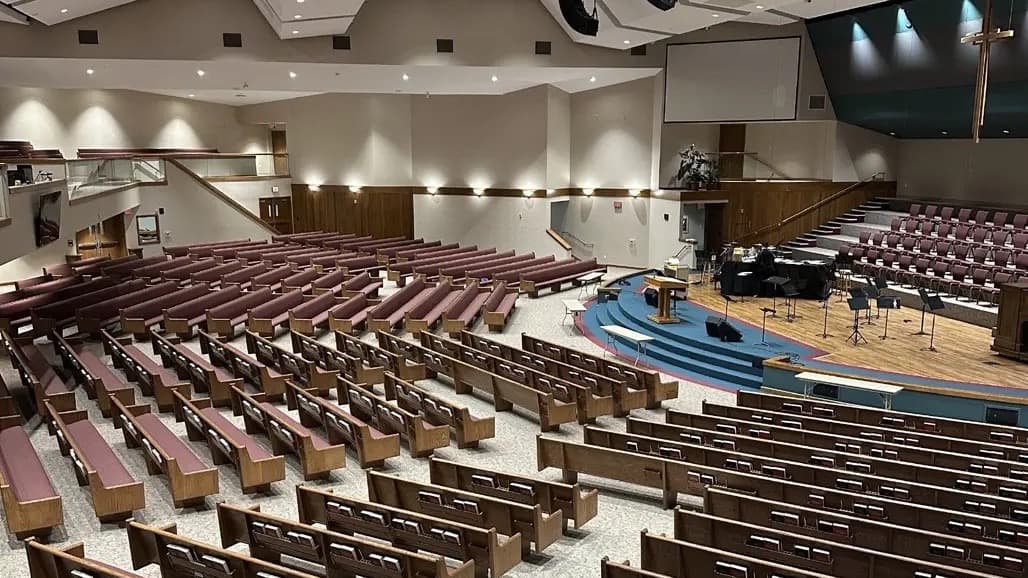
High-ceiling access is one of the most persistent operational headaches. Many sanctuaries — particularly those in older buildings throughout Grand Rapids' established neighborhoods — feature vaulted ceilings, exposed truss systems, or ornate architectural details that make routine bulb replacement a significant undertaking. Scheduling a lift, coordinating access, and pulling a volunteer or staff member off other priorities can turn a simple lamp swap into a half-day project. When it happens multiple times a year across dozens of fixtures, the cumulative labor cost is substantial.
Aging ballasts and dimmer incompatibility create flickering and control issues that are easy to dismiss until they become a congregational distraction. Fluorescent and older HID fixtures with degrading ballasts often produce inconsistent light output long before they fail entirely — affecting the quality of the worship environment and, increasingly, the performance of camera and livestream systems that many West Michigan congregations now operate.
Uneven illumination is another common finding in sanctuaries that have never undergone a formal photometric analysis. Spotty coverage across the nave, choir loft, or platform areas can create safety concerns, make it difficult for congregants to follow printed materials, and undermine the visual consistency that video production requires. This is a solvable problem — but it requires looking at the lighting system holistically, not fixture by fixture.
Energy costs add up. Incandescent, halogen, and legacy fluorescent systems draw significantly more power than modern LED equivalents, and they generate more heat — which can affect HVAC loads in tightly sealed sanctuary spaces. For congregations managing tight operating budgets, the energy line item in facility costs is one of the most actionable places to look for savings.
What LED Retrofits Actually Mean for a Church Sanctuary
The term "LED retrofit" gets used broadly, and it's worth being specific about what a well-executed sanctuary upgrade actually involves — because the difference between a thoughtful conversion and a rushed fixture swap is significant.
Lighting quality is not just about brightness. Color rendering index (CRI), color temperature, and dimming performance all shape how a space feels and functions. A sanctuary that feels cold, clinical, or over-lit after an LED upgrade is often the result of selecting fixtures based on wattage reduction alone, without accounting for how the light interacts with wood finishes, stained glass, stone, or fabric — all common materials in West Michigan church buildings. A properly specified LED system enhances the warmth and character of a space while delivering the efficiency gains the facility team is looking for.
Dimming and control compatibility matters more than ever. Many congregations use their sanctuaries for multiple purposes throughout the week — Sunday morning worship, Wednesday evening services, community events, concerts, funerals, and weddings. Each use case benefits from a different lighting scene. Modern LED systems paired with appropriate dimming controls and scene presets make it straightforward for a facilities team or AV volunteer to recall the right configuration at the touch of a button. This is a meaningful quality-of-life improvement for the people managing these spaces week to week.
Fixture life and reduced maintenance frequency are core value drivers. Quality LED fixtures rated for 50,000 or more hours of operation dramatically reduce the cadence of high-ceiling access and lamp replacement. For a church with 60 fixtures in a vaulted sanctuary, the difference between replacing lamps annually and replacing them once a decade is not a minor operational improvement — it's a fundamental shift in how the facility team allocates its time and budget.
The experience our team gained on education and institutional projects — like the North Hills Middle School Athletic Facility LED retrofit in Bloomfield, Michigan, where a complete photometric redesign transformed a field that had been unusable for night events — informs the way we think about institutional lighting upgrades broadly. Thoughtful layout analysis, fixture selection, and installation planning produce outcomes that hold up over time. The same principles apply whether the space is an athletic field or a sanctuary nave.
Incentives, Rebates, and Financial Planning for West Michigan Congregations
One of the most underutilized tools available to church facility teams in the Grand Rapids area is utility incentive programs. West Michigan's utility landscape includes programs that offer rebates for qualified LED upgrades — programs that can meaningfully reduce the net cost of a sanctuary retrofit project. Facility managers who are unfamiliar with these programs often leave significant money on the table simply because navigating the application process feels complex or unfamiliar.
This is an area where working with an experienced lighting contractor — one that has processed rebate applications across multiple utility territories — can make a practical difference. Understanding which fixtures qualify, how to document existing conditions, and how to submit claims correctly is part of the service that a knowledgeable partner brings to a project.
For churches that are affiliated with faith-based networks or denominations with shared purchasing structures, cooperative purchasing programs may also offer a practical path to cost-efficient procurement. VOSS works with several programs including Houston Church COOP, Sourcewell, and TIPS, among others, which eligible congregations may be able to leverage for lighting and electrical work. These programs are worth exploring during the planning phase, particularly for larger projects or multisite church organizations in the West Michigan region.
A related article in this series — Energy Audits, Incentives, and Rebate Navigation for Businesses — goes deeper on how organizations can systematically identify and capture available incentives. It's a useful companion resource for any facility team beginning to think about a broader energy modernization plan.
Planning a Sanctuary Lighting Project: What the Process Looks Like
For facility managers approaching a sanctuary lighting project for the first time, the process can feel uncertain — particularly when the building has historical significance, an active weekly schedule, or a congregation with strong aesthetic opinions about the space. A few principles tend to hold across well-run projects.
Start with an assessment, not a product decision. Understanding existing conditions — fixture inventory, wiring, control infrastructure, ceiling height and access challenges, current light levels, and energy consumption — gives both the facility team and the contractor a shared baseline. It prevents surprises mid-project and surfaces opportunities that a surface-level fixture swap would miss.
Plan around your calendar, not just your budget. Sanctuary renovation work, even when it's purely a lighting upgrade, requires scheduling around worship services, seasonal events, and community programming. Grand Rapids congregations with active weekly calendars — and many in this region are genuinely busy year-round — benefit from phased approaches that allow work to proceed in sections without disrupting Sunday services or major events like Easter or Christmas.
Involve your AV and media team early. If your congregation produces livestreamed content, records services, or hosts events where video quality matters, your lighting design decisions will directly affect your production team's outcomes. Integrating their requirements into the fixture and control specification from the beginning avoids the frustrating (and expensive) scenario of making lighting adjustments after installation to correct camera performance issues.
Think system, not just fixture. The goal of a well-executed sanctuary lighting upgrade is a cohesive system — one that the facility team can operate confidently, that performs reliably over years without significant maintenance intervention, and that serves the congregation across all the ways they actually use the space. That systems-level thinking is what separates a lighting upgrade that delivers lasting value from one that simply replaces old fixtures with new ones.
Service Availability
While VOSS offers a comprehensive suite of national services, specific capabilities may vary by location. Please contact your local branch to confirm the current availability of specific services, technology solutions, or contracting capabilities in your immediate market.
Talk With Our Grand Rapids Team
VOSS has deep roots in Michigan and serves church facilities throughout the Greater Grand Rapids area — including communities across Kent County, Ottawa County, and the broader West Michigan region, from Holland and Zeeland to Lowell, Cedar Springs, and beyond. Our team understands the operational realities of managing a house of worship, and we approach every project as a long-term partner, not a one-time vendor.
If your congregation is dealing with aging fixtures, high-ceiling maintenance headaches, rising energy costs, or simply asking whether now is the right time to make a change — we welcome the conversation.
VOSS Grand Rapids Phone: (616) 975-9914 Toll-Free: (800) 706-8677
Reach out to schedule a facility consultation and learn how a thoughtful lighting assessment can serve as the foundation for a smarter, more efficient sanctuary environment.