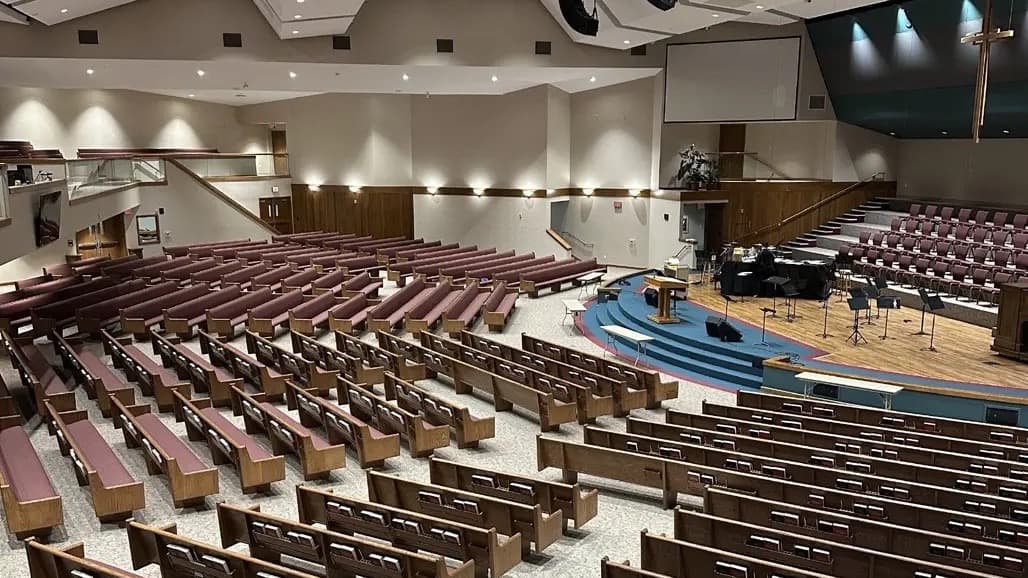
Why Sanctuary Lighting Is a Growing Priority for West Michigan Churches
Kentwood is one of the fastest-growing communities in the Greater Grand Rapids metro — a region that is home to one of the highest concentrations of churches per capita in the United States. From the established congregations along 28th Street and Division Avenue to newer and growing houses of worship spreading into the surrounding communities of Wyoming, Grandville, Caledonia, and Byron Center, church facilities across Kent County are facing a shared challenge: lighting systems that were installed decades ago are becoming increasingly difficult and expensive to maintain.
This is not simply a matter of aesthetics. Sanctuary lighting directly affects the safety of congregants, the experience of weekly worship, the quality of video and livestream productions, and the operational burden placed on facility managers and maintenance volunteers. As LED technology matures and utility rebate programs expand, the conversation around sanctuary lighting has shifted from "can we afford to upgrade?" to "can we afford not to?"
This article explores what's driving that conversation in West Michigan — and what church facility managers should understand before embarking on a lighting upgrade project.
The Hidden Costs of Outdated Sanctuary Lighting
For many church facilities in the Kentwood and Grand Rapids area, the real cost of older lighting systems isn't always visible on the utility bill. It accumulates in ways that are easy to overlook until they become a crisis.
Frequent relamping in hard-to-reach fixtures is one of the most cited frustrations among church facility managers. Traditional incandescent, halogen, and fluorescent lamps in vaulted sanctuaries — some with ceiling heights of 30, 40, or even 60 feet — require scaffolding or aerial lifts to replace. When a lamp fails mid-week before a Sunday service or a special event, the response is costly and disruptive.
Aging ballasts and incompatible dimmers introduce flicker and inconsistent color rendering, both of which are increasingly problematic as more congregations invest in video and livestreaming technology. A sanctuary that looks beautiful to the human eye may appear washed out, shadowy, or color-shifted on camera — directly affecting the quality of digital ministry efforts that many West Michigan churches have prioritized in recent years.
Uneven illumination can create safety concerns, particularly for older congregants navigating pews, steps, and aisles in dimly lit areas of the sanctuary. It also affects the visual experience of worship — from the readability of hymnals and bulletins to the clarity of signage and projection screens.
Rising energy costs are felt across every ministry budget. Older HID and fluorescent systems running for multiple services each week, plus rehearsals, events, and building rentals, can represent a significant and avoidable line item.
What LED Technology Means for Church Sanctuaries Today
The LED retrofit market has matured considerably in the past five years. What was once a technology primarily suited for warehouses and parking lots has evolved into a sophisticated, nuanced solution for architecturally complex and atmospherically sensitive spaces like worship environments.
Today's LED fixtures for sanctuary applications offer several capabilities that were not available — or not affordable — in earlier generations:
- Tunable white technology allows the color temperature of light to shift throughout a service, from a warm, intimate glow during prayer and communion to a brighter, more energizing tone during music and teaching.
- High CRI (Color Rendering Index) fixtures reproduce colors accurately and faithfully, which is critical for projection screen readability, floral arrangements, stained glass illumination, and skin tones during video recording.
- Dimming compatibility and scene control enable facility teams to program preset lighting "scenes" for different service types — Sunday morning worship, midweek Bible study, a wedding, a memorial service — with a single button press rather than manual adjustment.
- Extended lamp life means that a quality LED fixture installed today may operate for 50,000 to 100,000 hours before requiring replacement — dramatically reducing the frequency of high-ceiling relamping and the associated labor and equipment costs.
Our work at North Hills Middle School in Bloomfield, Michigan — where we replaced sixty-eight 1,500-watt HID fixtures with 750-watt LED alternatives and designed a full photometric layout — illustrates how right-sized LED retrofits can transform both light quality and operational reliability in facilities with complex access and high-ceiling challenges. As Jacob McDermott, Director of Maintenance & Operations, noted after that project: "The new lights themselves are nothing short of amazing, providing brilliant and uniform illumination that dramatically enhances the field for both players and spectators." While that project focused on athletic facilities, the core principles — reducing wattage, improving uniformity, and simplifying long-term maintenance — apply directly to the sanctuary environment.
Navigating a Sanctuary Lighting Project: What Facility Managers Should Know
For church facility directors and maintenance supervisors in the Kentwood and Greater Grand Rapids area, a sanctuary lighting upgrade involves more than simply swapping out fixtures. Several factors shape how a project is scoped, sequenced, and executed.
Photometric planning matters. A well-designed sanctuary lighting system begins with a lighting audit and photometric analysis — a computational model that maps how light will distribute across the space at different mounting heights, angles, and fixture spacings. This step ensures that the finished installation meets target foot-candle levels, avoids dark spots, and is optimized for the sanctuary's unique geometry. Skipping this step is one of the most common causes of disappointing results in DIY or under-planned retrofits.
Historic buildings require special consideration. Many established congregations in the Grand Rapids area — including those in Heritage Hill, East Grand Rapids, and older neighborhoods of Kentwood itself — worship in buildings with architectural or historic significance. Preserving the character of exposed beams, decorative ceilings, and period fixtures while integrating modern LED technology requires a contractor with experience navigating these constraints sensitively.
Minimizing disruption is a practical priority. Churches operate on a schedule that rarely pauses. A sanctuary lighting project needs to be sequenced around worship services, special events, holidays, and community programs. Experienced contractors plan installations in phases, communicate clearly with facility teams, and work during off-peak hours to ensure that the building remains functional throughout the project.
Controls and dimming systems add long-term value. Pairing a new LED fixture package with a modern lighting controls system — including scene presets, occupancy sensing, and scheduling — multiplies the return on investment by automating energy savings and reducing the hands-on management load for facility staff.
Cooperative Purchasing: A Practical Option for Eligible Organizations
Some churches and affiliated faith-based organizations in the Kentwood area may be eligible for cooperative purchasing programs that simplify procurement and provide access to pre-negotiated pricing on lighting equipment and installation services. VOSS participates in several programs, including Houston Church COOP, which is specifically designed to serve houses of worship, as well as broader cooperative platforms such as Sourcewell, TIPS, BuyBoard, and Omnia Partners.
For church administrators who manage tight budgets and board approval processes, cooperative purchasing can reduce the time and administrative burden associated with a lighting project while providing confidence that pricing has been competitively vetted. We recommend asking your local VOSS representative whether your organization qualifies when you schedule your initial consultation.
Utility Incentives and Rebate Opportunities in Michigan
Church facilities in Kentwood are served by utilities that offer energy efficiency rebate programs for commercial customers upgrading to LED technology. These programs can meaningfully offset the upfront cost of a retrofit project, improving the payback period and making it easier to build a compelling case for board or elder approval.
Rebate structures, eligible equipment categories, and application requirements change periodically, and navigating them effectively requires familiarity with current program rules. VOSS helps church facility managers understand what incentives are available in their specific utility territory, identify which fixtures and controls qualify, and manage the application process to maximize the rebate value captured.
Our broader resources on commercial LED lighting rebates — including our article on maximizing ROI with LED rebates and our guide to energy audits, incentives, and rebate navigation for businesses — offer additional context for organizations in the early stages of planning. Those articles are part of the same Latest Lighting resource series as this one.
Service Availability
While VOSS offers a comprehensive suite of national services, specific capabilities may vary by location. Please contact your local branch to confirm the current availability of specific services, technology solutions, or contracting capabilities in your immediate market.
Talk to Your Local VOSS Team in Grand Rapids
VOSS serves church facilities throughout Kentwood, Grand Rapids, Wyoming, Grandville, Walker, Caledonia, Byron Center, Rockford, and the broader Kent County region from our local Grand Rapids branch. Whether your congregation is dealing with a chronic maintenance problem, exploring an LED retrofit for the first time, or planning a full sanctuary renovation, we welcome the conversation.
Our team can help you assess your current system, develop a photometric plan, identify available rebates and cooperative purchasing options, and design a project timeline that works around your ministry schedule.
Grand Rapids Branch Phone: (616) 975-9914 Toll-Free: (800) 706-8677
We're not here to sell you a fixture — we're here to help you build a lighting system that serves your congregation faithfully for decades to come. Reach out to start the discussion.