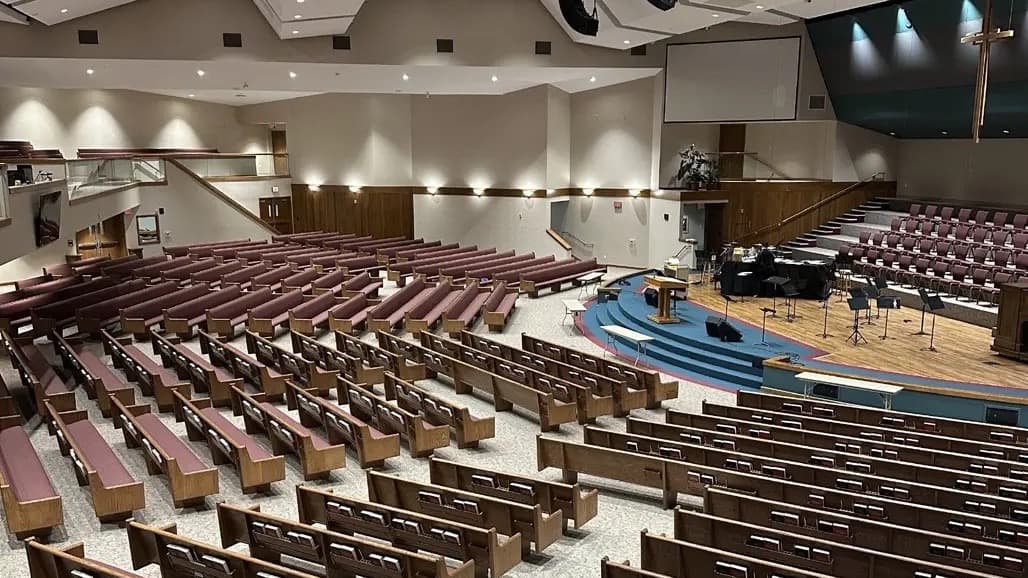
Why Sanctuary Lighting Is a Growing Priority for Warren-Area Churches
Warren is home to one of the most diverse and active faith communities in Macomb County, with congregations ranging from historic neighborhood churches to large contemporary worship centers. Many of these facilities were constructed or last renovated decades ago, when incandescent, halogen, and fluorescent lighting were the industry standard. Today, those same fixtures are creating daily headaches for facility managers and maintenance teams.
The challenge isn't simply aesthetics — it's operational. Sanctuaries with 30- to 50-foot ceilings require lifts or scaffolding every time a bulb burns out. Aging ballasts cause flickering that disrupts services and frustrates worshippers. Inconsistent light levels create visibility and safety concerns, and for the growing number of congregations that livestream or record services for remote audiences in communities like Sterling Heights, Clinton Township, and East Pointe, poor illumination directly undermines video quality.
As energy costs continue to rise across Southeast Michigan, the cumulative expense of running outdated high-wattage fixtures through multiple weekly services, rehearsals, and community events adds up quickly. What was once a manageable line item is now a meaningful budget concern for churches of every size.
The LED Transition: What's Changed — and Why It Matters Now
LED technology has matured significantly over the past several years, and the solutions available to church facilities today are meaningfully different from early-generation LED products. Modern LED fixtures deliver color rendering that closely mimics natural light, making congregational spaces feel warmer and more welcoming. Dimming performance has improved dramatically, with smooth, flicker-free control across a wide range of levels — critical for churches that transition between intimate candlelit services, high-energy contemporary worship, and brightly lit fellowship events.
For facilities managers in Warren and surrounding communities like Roseville, Center Line, and Fraser, the practical benefits of LED conversion are significant:
- Dramatically reduced relamping frequency — quality LED fixtures are rated for 50,000 hours or more, compared to 1,000–4,000 hours for halogen and incandescent sources
- Lower energy consumption — LED equivalents typically consume 50–75% less wattage than the HID and fluorescent sources they replace
- Improved fixture compatibility — modern LED drivers and dimmer controls are designed to work together, eliminating the ballast-related flickering that plagues older systems
- Better light distribution — optical engineering in today's LED fixtures reduces hot spots and dark zones, creating more even illumination across the worship floor and seating areas
The North Hills Middle School Football Field LED Retrofit in Bloomfield, Michigan offers a compelling parallel for facility managers thinking about the transition. In that project, VOSS replaced sixty-eight 1,500-watt HID fixtures with 750-watt Keystone Sports Lighter LED units — cutting wattage in half while dramatically improving uniformity and reliability. Jacob McDermott, Director of Maintenance & Operations, noted that "the new lights themselves are nothing short of amazing, providing brilliant and uniform illumination." While the context is athletic rather than liturgical, the underlying challenge — aging high-wattage fixtures, difficult access, and the need for dependable, uniform light — maps directly onto what sanctuary facility managers face.
Navigating the Unique Constraints of Church Facilities
Church buildings present a distinct set of installation challenges that set them apart from typical commercial retrofits. Facility managers across Metro Detroit understand this well — and it shapes how any responsible contractor should approach a sanctuary lighting project.
Access and Structural Complexity High vaulted ceilings, exposed timber trusses, decorative plasterwork, and stained glass windows all require careful navigation. Proper rigging plans, lift equipment selection, and sequenced work schedules are essential to avoid disruption or damage.
Historic Preservation Considerations Many of Warren's older congregations occupy buildings with architectural or historical significance. Lighting upgrades in these spaces must be approached with sensitivity — preserving the visual character of the sanctuary while modernizing the technology behind it.
Operational Scheduling Unlike office buildings or schools, church facilities operate on schedules that are community-driven and often non-negotiable. Installation work needs to be planned around Sunday services, Wednesday programs, choir rehearsals, holiday events, and community gatherings. Low-disruption, phased installation approaches are often the right solution.
Control System Integration Many sanctuaries benefit from scene-based lighting control — the ability to program and recall specific lighting looks for different service types, media presentations, or events. Modern LED systems are well-suited for integration with architectural dimming controls, and the transition from an older system is an ideal time to evaluate whether upgraded controls could simplify operations and reduce the burden on volunteer and part-time tech staff.
Trends Shaping Church Lighting in Greater Detroit
Across Southeast Michigan, several broader trends are influencing how congregations think about their lighting infrastructure.
Livestreaming and Video Ministry The expansion of remote worship — accelerated in recent years and now a permanent feature of many congregations' ministry strategy — has created new lighting performance expectations. Camera sensors behave differently than the human eye, and what looks acceptable in person may appear flat, shadowy, or washed out on screen. Facilities that have invested in proper illumination levels, color temperature consistency, and dimmer control are seeing measurable improvements in their broadcast quality.
Energy Incentive Programs Michigan utilities and state energy efficiency programs periodically offer rebates and incentives for commercial LED upgrades. Faith-based organizations are often eligible, and the financial impact of these programs can meaningfully improve project payback timelines. It's worth noting that for churches affiliated with networks, dioceses, or multi-site organizations, cooperative purchasing programs such as the Houston Church COOP and Sourcewell may provide additional procurement options that simplify the process and deliver favorable pricing. Eligible organizations should ask about available programs when planning a project.
Whole-Facility Thinking Forward-looking facility managers are moving beyond sanctuary-only thinking, evaluating lighting in fellowship halls, classrooms, lobbies, parking areas, and exterior spaces as part of a unified upgrade strategy. This approach often improves project economics and ensures that the entire facility reflects a consistent standard of quality and stewardship. Related topics covered in VOSS's Latest Lighting series — including Energy Efficient Church Lighting Upgrades, Parking Lot and Outdoor LED Lighting Upgrades, and Energy Audits, Incentives, and Rebate Navigation for Businesses — offer further perspective on how these decisions fit together.
Service Availability
While VOSS offers a comprehensive suite of national services, specific capabilities may vary by location. Please contact your local branch to confirm the current availability of specific services, technology solutions, or contracting capabilities in your immediate market.
Talk to a Lighting Expert Serving Warren and Metro Detroit
VOSS has served commercial and institutional facilities across the United States for more than 85 years, and our team has hands-on experience with the operational and technical realities that church facility managers navigate every day. If your congregation in Warren, Sterling Heights, Roseville, Shelby Township, or anywhere across Macomb and Oakland Counties is weighing a sanctuary lighting upgrade — or simply trying to get a handle on recurring maintenance costs — we'd welcome the conversation.
Our Grand Rapids branch serves the Greater Detroit region and is ready to help you think through what a lighting assessment or retrofit project might look like for your facility.
VOSS — Grand Rapids Branch Phone: (616) 975-9914 Toll-Free: (800) 706-8677
Reach out to schedule a consultation. We'll listen first, ask the right questions, and help you understand your options — on your timeline, and with your community's needs at the center of the conversation.