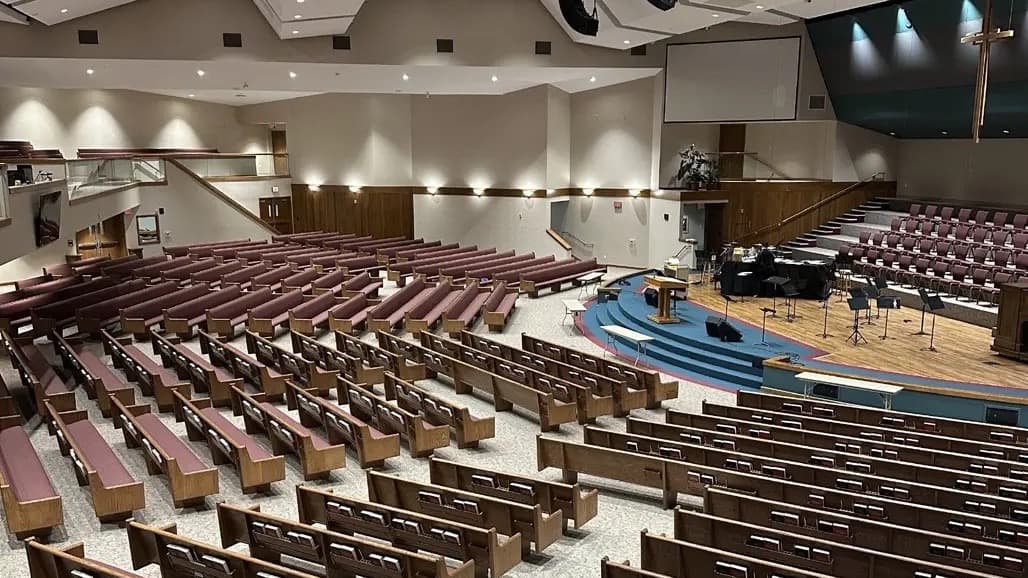
Why Sanctuary Lighting Deserves a Closer Look in Troy and the Greater Detroit Area
Troy, Michigan is home to a remarkably diverse and active faith community. With a population of approximately 87,000 and a dense concentration of congregations spanning denominations and traditions — from long-established churches along Big Beaver Road to newer houses of worship in surrounding communities like Clawson, Rochester Hills, Sterling Heights, and Bloomfield Township — the demand for well-maintained, welcoming sanctuary spaces is significant.
What many church facility managers across the Detroit metropolitan area share in common, regardless of congregation size or denomination, is a common set of lighting challenges that quietly drain budgets, increase maintenance workloads, and compromise the worship environment. The good news is that the same industry-wide shift toward LED technology and intelligent lighting controls that is transforming commercial buildings, schools, and sports facilities throughout Michigan is equally transformative for church sanctuaries — and often more so.
This article explores what facility managers and church operations leaders should know about the current state of sanctuary lighting maintenance, what modern upgrades look like in practice, and why now may be the right time to take a strategic approach to your facility's lighting.
The Hidden Cost of Aging Sanctuary Lighting
Church sanctuaries present some of the most technically demanding lighting maintenance environments of any building type. High vaulted ceilings, ornate architectural details, theatrical-style stage or altar lighting, and the need to serve everything from quiet early morning services to full production-level livestreamed worship — these are not standard commercial lighting scenarios.
For facility managers overseeing Troy-area church properties, a few persistent pain points tend to surface repeatedly:
- Frequent lamp replacements in difficult-to-reach fixtures. Incandescent, halogen, and older fluorescent sources in ceiling fixtures mounted 30, 40, or even 60 feet above the floor require scaffolding or aerial lifts to service. Each replacement event costs time, labor, and disruption — sometimes requiring services to be rescheduled or held in alternative spaces.
- Flickering and dimming failures. Aging ballasts and dimmers that were designed for older lamp technologies often become incompatible as components age, resulting in the kind of visible flickering that distracts congregants and creates an unprofessional appearance on video.
- Uneven illumination. Sanctuary spaces that were lit based on older photometric standards may have bright and dark zones that make it difficult for congregants to read printed materials, follow projected content, or feel fully engaged in the service — particularly in larger worship halls.
- Energy costs that compound over time. Older sanctuary lighting systems — especially those still running high-wattage incandescent or HID fixtures for stage and altar areas — consume significantly more electricity than their modern LED equivalents. For a congregation managing a building budget that also covers HVAC, facility maintenance, and community programming, energy overhead is a real concern.
These are not abstract problems. They represent concrete operational friction that facility managers in Troy, Bloomfield Hills, Royal Oak, and across Oakland County navigate week after week.
What Modern Sanctuary Lighting Upgrades Actually Involve
The conversation around church lighting has evolved well beyond simply swapping bulbs. A thoughtful sanctuary lighting upgrade today is a systems-level project that considers the full lifecycle of the facility's lighting environment.
LED Retrofit and Fixture Replacement
The foundation of most sanctuary upgrades is transitioning from older lamp technologies to LED. Modern LED fixtures designed for sanctuary applications deliver dramatically longer rated lifespans — often 50,000 hours or more — which directly addresses the labor and disruption costs associated with frequent lamp changes in high-ceiling environments. Equally important, high-quality LED sources now offer color rendering properties that are warm, natural, and aesthetically appropriate for worship spaces, overcoming the early reputation LED had for harsh or clinical light quality.
Photometric Planning for Worship Environments
Effective sanctuary lighting is not just about brightness — it is about distribution, contrast, and purpose. A well-designed photometric layout ensures that the congregation area receives consistent, comfortable illumination, while focal points such as the altar, pulpit, baptistry, or stage receive the intentional accent lighting that supports both in-person worship and video production. This kind of detailed planning is what separates a strategic lighting upgrade from a simple fixture swap.
Dimming and Controls Integration
Modern sanctuary lighting systems are designed to be programmable and scene-based. A single touchpad or automated schedule can transition the space from a bright Sunday morning service to a candlelit evening prayer service to a fully lit mid-week event setup — without anyone manually adjusting individual fixtures. For facility managers, this represents a significant reduction in operational complexity. For worship leaders and AV teams, it means the lighting environment can be a consistent, repeatable part of the service experience rather than a source of last-minute troubleshooting.
Addressing Michigan's Evolving Regulatory Environment
Church facility managers in Troy and surrounding communities should also be aware of broader regulatory trends affecting lighting technology. Fluorescent lamp restrictions at the federal level — and related state-level guidance — are accelerating the transition away from older fluorescent technology across all building types. For congregations still operating fluorescent fixtures in fellowship halls, classrooms, or secondary sanctuaries, this adds a practical urgency to upgrade planning that goes beyond energy savings alone. VOSS has published additional guidance on fluorescent tube bans and their implications for commercial building operators, which is worth reviewing for facility managers overseeing multi-use church campuses.
Lessons from the Field: Lighting Upgrades in Michigan and Beyond
While every sanctuary is unique, real-world project experience in the region provides useful context for what is possible. VOSS recently completed a sports lighting retrofit at North Hills Middle School in Bloomfield, Michigan — a community directly adjacent to Troy — that illustrates the kind of outcomes a well-executed LED upgrade can deliver even in challenging, high-ceiling environments.
The project involved replacing sixty-eight 1,500-watt HID fixtures with 750-watt LED equivalents across an outdoor athletic field, cutting energy consumption in half while delivering dramatically improved, uniform illumination. Jacob McDermott, Director of Maintenance and Operations, described the results as "truly outstanding," noting that the project unfolded "seamlessly from start to finish" with "brilliant and uniform illumination."
While a football field and a church sanctuary are obviously different environments, the underlying lesson is directly relevant: aging high-wattage fixtures in difficult-to-access locations can be replaced with modern LED technology that consumes significantly less energy, requires far less maintenance, and delivers measurably better light quality. The logistical principles — careful planning, minimal disruption, and professional execution — apply equally in both settings.
Strategic Considerations for Troy-Area Church Facility Managers
For facility managers and church operations leaders evaluating whether now is the right time for a sanctuary lighting project, a few strategic factors are worth weighing:
- Utility incentive programs. Michigan utility providers have historically offered rebate and incentive programs for commercial LED upgrades. Eligible projects can offset a meaningful portion of project costs. Working with an experienced lighting partner who understands how to identify and document qualifying upgrades is important to capturing available value.
- Cooperative purchasing programs. For faith-based organizations affiliated with qualifying networks, cooperative purchasing programs can simplify procurement and provide access to pre-negotiated pricing. VOSS works with several established cooperative purchasing programs — including the Houston Church COOP — that may be available to eligible congregations, potentially streamlining both the procurement process and budget approval.
- Phased project approaches. Not every congregation has the budget or appetite for a full sanctuary overhaul in a single project cycle. A phased approach — starting with the highest-maintenance or highest-impact fixtures — allows facilities to begin realizing operational and energy benefits while managing cash flow and minimizing disruption.
- Livestream and video production requirements. An increasing number of congregations in Troy, Southfield, Warren, and across the Detroit metro are investing in livestream capabilities. Lighting that was designed before video production was a priority may create challenges — color temperature inconsistencies, shadows, or glare — that a modern lighting redesign can address directly.
Service Availability
While VOSS offers a comprehensive suite of national services, specific capabilities may vary by location. Please contact your local branch to confirm the current availability of specific services, technology solutions, or contracting capabilities in your immediate market.
Talk to VOSS About Your Sanctuary Lighting
Church facility managers across Troy, Rochester Hills, Clawson, Bloomfield Township, Sterling Heights, and the greater Detroit metro area are welcome to connect with our Grand Rapids branch team to discuss your sanctuary lighting challenges and explore what a maintenance or upgrade project might look like for your facility.
We approach every conversation as a consultation — not a sales call. Our goal is to help you understand your options, identify available incentives, and build a realistic plan that fits your facility's needs and your congregation's budget.
VOSS Grand Rapids Branch
Phone: (616) 975-9914
Toll-Free: (800) 706-8677
To learn more about related topics, explore our articles on Energy Efficient Church Lighting Upgrades, Commercial LED Lighting Fixtures, and Energy Audits, Incentives, and Rebate Navigation for Businesses — all available in the Latest Lighting section of the VOSS website.