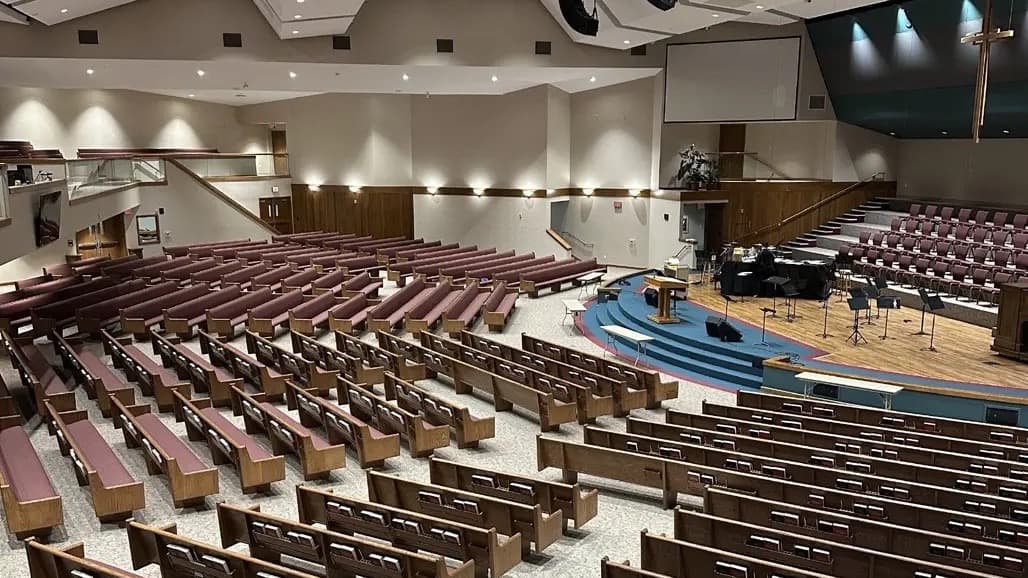
Why Sanctuary Lighting Deserves a Closer Look in Sterling Heights
Sterling Heights is home to one of Michigan's most diverse and active faith communities. With a population of approximately 134,000 and a strong tradition of community life rooted in its churches, mosques, temples, and multi-faith worship centers — many of which serve Metro Detroit's broader Macomb County corridor — places of worship here carry significant operational complexity. From the dense residential areas near Dodge Park to the sprawling campuses along Van Dyke Avenue and Schoenherr Road, these facilities are often large, heavily used, and staffed by lean maintenance teams.
Many of these sanctuaries were built or last renovated decades ago, when incandescent, halogen, or fluorescent lighting was standard. What was acceptable then has become a growing operational burden today: fixtures mounted 30 to 60 feet overhead, ballasts wearing out mid-service, and energy bills that climb each year without a corresponding improvement in light quality.
Across the Greater Detroit area — from Sterling Heights and Warren to Troy, Utica, and Shelby Township — facility managers at houses of worship are increasingly asking the same question: is there a smarter, more sustainable way to light a sanctuary?
The Real Cost of Deferred Sanctuary Lighting Maintenance
For church facility managers and operations leaders, the temptation to defer lighting work is understandable. Scheduling around weekly services, special events, holiday gatherings, and community programs leaves little room for disruptive maintenance windows. But the cost of inaction compounds quietly over time.
Common pain points VOSS encounters in sanctuary environments include:
- Frequent bulb burnout in high-ceiling fixtures — Traditional HID, halogen, or T8 fluorescent lamps in vaulted or cathedral spaces require scaffolding or boom lifts to replace, often multiple times per year. Each service call adds labor cost and scheduling complexity.
- Aging ballast failures — Flickering or dimming lights are often a symptom of ballasts nearing end of life. In older buildings throughout Macomb County, it's not uncommon to find ballasts that are 20 or more years old, well past their designed service life.
- Uneven illumination — Sanctuary lighting that hasn't been professionally designed or updated often creates hot spots near the altar and dim areas toward the rear pews, compromising both the worship experience and the quality of video livestreams — an increasingly important consideration for congregations that broadcast services.
- Incompatible dimming systems — Many churches have added dimmer controls over the years without replacing the underlying fixtures, leading to buzz, flicker, and premature lamp failure.
These aren't just inconveniences. They represent a measurable drain on operational budgets and volunteer energy that could be directed toward mission-driven work.
What Modern LED Retrofits Actually Deliver in a Worship Environment
LED technology has matured significantly, and today's commercial-grade sanctuary fixtures bear little resemblance to early-generation LED products that drew criticism for color rendering and warmth. For church environments, the relevant advances include:
Dramatically longer lamp life. Commercial LED fixtures rated for 50,000 to 100,000 hours dramatically reduce the frequency of replacements in high-ceiling applications. For a sanctuary that runs services four or five times a week, that can translate to a decade or more between major lamp replacement cycles — a meaningful reduction in lift rentals, labor hours, and disruption.
Superior color rendering. Modern LED fixtures with high Color Rendering Index (CRI) ratings — typically 90 or above — render natural skin tones, fabric colors, and architectural details more accurately than fluorescent or halogen sources. This matters for congregants experiencing the space in person and for video production teams capturing services for online audiences.
Tunable white and dimming capability. Many contemporary sanctuary LED systems support tunable white light, allowing facility teams to shift color temperature for different service formats — warmer tones for contemplative worship, cooler tones for educational programming or community events. When properly paired with compatible dimming controls, these systems eliminate the flicker and buzz associated with legacy dimmer-ballast mismatches.
Energy efficiency. The efficiency gains from LED over HID, fluorescent, or incandescent sources are well-established. While specific savings vary by facility, churches making the transition commonly see substantial reductions in lighting-related energy consumption — a meaningful consideration for faith communities that operate on tight, donation-funded budgets.
Our work at North Hills Middle School in Bloomfield, Michigan offers a useful parallel: when the facility's athletic director faced multiple lamp outages that rendered the field unusable, VOSS replaced 68 high-output HID fixtures with energy-efficient LED alternatives, producing what the Director of Maintenance and Operations described as "brilliant and uniform illumination" delivered seamlessly and professionally. The same disciplined approach — photometric planning, appropriate fixture selection, and low-disruption installation — applies directly to sanctuary environments throughout Metro Detroit.
Practical Considerations for Church Facility Leaders
Lighting upgrades in historic or architecturally significant sanctuaries require a level of care and sensitivity that distinguishes a true commercial electrical partner from a general contractor. VOSS approaches these projects with several factors in mind that are particularly relevant for faith communities in the Sterling Heights area:
Historic and architectural constraints. Some of the most beautiful sanctuaries in Macomb County and the surrounding communities of Clinton Township, Fraser, and Roseville feature original woodwork, stained glass, and decorative ceiling elements. Fixture selection and installation methods must account for these features — both to preserve their integrity and to maximize the effect of new lighting on the space.
Access planning. Scheduling lift access, coordinating with church staff, and staging work around the service calendar requires project management experience specific to faith-based facilities. Disruption to weekly programming should be minimized, and phased approaches are often the right solution for larger campuses.
Livestream and media production needs. An increasing number of Sterling Heights churches and congregations across Metro Detroit are investing in video production capabilities to extend their reach online. Lighting that looks beautiful to the human eye may not perform optimally on camera without attention to color temperature consistency, shadow control, and flicker-free operation at camera shutter speeds.
Budget realities. Church facility projects are often funded through capital campaigns, endowment draws, or phased operational budgets. VOSS works with facility leaders to scope projects in a way that aligns with available funding cycles — prioritizing the highest-impact interventions first.
Cooperative Purchasing: A Practical Option for Eligible Organizations
For churches affiliated with educational institutions, or for faith communities that also operate schools, early childhood programs, or community service organizations that may qualify as public or nonprofit entities, cooperative purchasing programs can simplify procurement and reduce administrative burden. VOSS participates in several nationally recognized cooperative purchasing programs, including Houston Church COOP, Sourcewell, TIPS, BuyBoard, Omnia Partners, AEPA, PACE, and Nebraska ESU Co-Op. Eligible organizations should ask our team whether their structure qualifies them to leverage these vehicles for lighting upgrades and electrical work.
Further Reading in This Series
This article is part of VOSS's Latest Lighting content series, which covers trends, innovations, and practical guidance across a range of commercial and institutional lighting topics. If you found this piece useful, you may also want to explore our related articles on Energy Efficient Church Lighting Upgrades, Commercial LED Lighting Fixtures, Fluorescent Tube Bans and LED Lighting Rebates, and Energy Audits, Incentives, and Rebate Navigation for Businesses — all of which offer complementary perspectives relevant to faith community facility leaders.
Service Availability
While VOSS offers a comprehensive suite of national services, specific capabilities may vary by location. Please contact your local branch to confirm the current availability of specific services, technology solutions, or contracting capabilities in your immediate market.
Talk to VOSS About Your Sanctuary Lighting
If your church in Sterling Heights, Warren, Shelby Township, Utica, or anywhere across Macomb County is dealing with maintenance headaches, aging fixtures, or an upcoming renovation project, we'd welcome the opportunity to walk through your facility and share what we're seeing in comparable spaces across Michigan and the broader Midwest.
Our Grand Rapids branch serves the Michigan market and is ready to connect you with the right expertise for your project.
VOSS — Grand Rapids Branch Phone: (616) 975-9914 Toll-Free: (800) 706-8677
Reach out to start a conversation about what better sanctuary lighting could mean for your congregation — and your maintenance team.