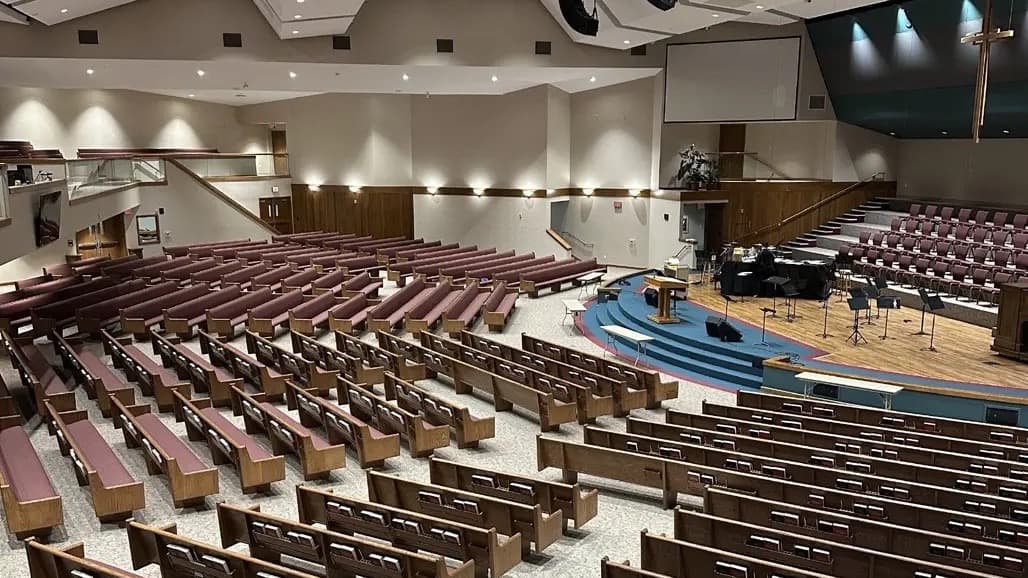
Why Sanctuary Lighting Is a Growing Priority for Michigan Churches
Across Livonia, Westland, Farmington Hills, and the broader Wayne and Oakland County corridor, faith communities are quietly confronting one of the most persistent facility management challenges in the built environment: aging sanctuary lighting systems that were never designed for today's demands.
Churches in this region — many of them built during Michigan's mid-century suburban expansion — house sanctuaries with soaring ceilings, intricate architectural features, and lighting infrastructure that hasn't been meaningfully updated in decades. The result is a familiar combination of problems: incandescent or halogen fixtures burning out faster than staff can replace them, ballasts flickering during Sunday services, energy bills that climb year over year, and illumination that simply doesn't meet the expectations of modern congregants or the technical requirements of livestreamed worship.
This isn't a minor inconvenience. Lighting shapes the atmosphere of worship. It affects safety. And increasingly, it affects how a congregation's message reaches people beyond the physical walls of the building.
The Real Cost of "Keeping the Lights On" the Old Way
For facility managers and operations leaders at churches throughout the Livonia area, the hidden costs of maintaining legacy lighting systems rarely appear on a single line item — but they add up quickly and significantly.
The maintenance burden alone is substantial. Traditional incandescent, halogen, and even older fluorescent fixtures installed in high-ceiling sanctuaries require scaffolding or powered lifts for routine bulb changes. In a 40- or 50-foot nave, that means scheduling equipment rentals, coordinating around worship calendars, and pulling staff or volunteers away from other priorities — sometimes multiple times per year for the same fixtures.
Aging ballasts and incompatible dimming systems create the flickering and inconsistent color rendering that distract worshippers and degrade video quality for churches producing online services or broadcast ministry content. In a region where Detroit-area congregations are increasingly investing in media and streaming infrastructure, poor lighting at the source undermines that entire investment.
Energy consumption is the third dimension of cost. Legacy HID and fluorescent systems draw substantially more wattage than equivalent LED systems — and they run for extended hours across Sunday services, mid-week programming, weddings, funerals, and community events. Michigan utility rates have trended upward over the past decade, making the efficiency gap between old and new technology more consequential with each passing year.
The cumulative picture — maintenance labor, equipment rental, energy waste, and fixture replacement frequency — often makes a compelling case for capital investment in a modern LED retrofit, even before factoring in available incentive programs.
What Modern LED Retrofits Actually Deliver for Church Facilities
The shift to LED sanctuary lighting isn't simply a technology swap. When planned and executed well, it represents a fundamental change in how a congregation's facility operates and how its worship space feels.
Dramatically extended lamp life is the most immediate operational benefit. Quality LED fixtures designed for commercial and institutional applications are rated for 50,000 hours or more — far beyond the lifespan of the halogen or incandescent sources they replace. For a church in Livonia running services and events five or six days per week, that translates to years of reduced maintenance interventions and fewer disruptions to programming.
Improved light quality is equally important, and often underappreciated until it's experienced firsthand. Modern LED systems offer precise color temperature control, better color rendering index (CRI) scores, and the ability to tune the character of light to suit different moments in a worship service — from the soft warmth of contemplative prayer to the crisp brightness needed for livestream cameras during a sermon. For congregations with historic sanctuaries featuring stained glass, wood finishes, or painted ceilings, high-CRI LED sources bring architectural details to life in ways that older technology simply cannot.
Intelligent controls integration is the third major advancement. Contemporary LED systems pair with dimming controls, scene presets, and building automation platforms that allow a single staff member or volunteer to shift the entire sanctuary's lighting environment with minimal effort. Preset scenes for Sunday morning worship, Wednesday evening Bible study, a Saturday wedding, and a community dinner can all be stored and recalled instantly — reducing human error and creating consistent, intentional experiences across every event.
VOSS's proven experience in complex lighting environments — including our work on the North Hills Middle School football field LED retrofit in Bloomfield, Michigan, where we replaced 68 high-wattage HID fixtures with energy-efficient LED alternatives and delivered what the client described as "brilliant and uniform illumination" — reflects the same commitment to photometric planning and seamless installation that we bring to church sanctuary projects across the region.
Navigating the Unique Challenges of Church Buildings
Sanctuary lighting upgrades require a different kind of planning than a straightforward commercial retrofit. Churches present a combination of architectural, operational, and budgetary constraints that demand experienced, thoughtful project management.
Access and structural complexity top the list. Vaulted ceilings, exposed timber trusses, choir lofts, organ pipes, and ornate millwork all create installation challenges that require careful coordination — and often specialized rigging or lift equipment. A disruptive or poorly planned installation can damage irreplaceable architectural elements or disrupt a congregation's weekly calendar.
Historic and aesthetic sensitivities matter enormously. Many churches in the Livonia area and across the Detroit suburbs have sanctuary interiors with significant heritage value to their congregations. Fixture selection must honor the visual character of the space — not just meet a lumen target. The best LED retrofits are nearly invisible to the casual observer while delivering measurably better light.
Budget phasing and prioritization are practical realities for most congregations. Not every church can or should undertake a complete sanctuary overhaul in a single project phase. A well-structured assessment can identify which fixtures are causing the most operational pain, which areas offer the greatest energy savings opportunity, and how to sequence upgrades over time in a way that matches the congregation's financial planning cycles.
Cooperative purchasing programs can be a meaningful resource for eligible faith-based organizations. VOSS works with several cooperative purchasing platforms — including the Houston Church COOP, specifically designed for churches and religious organizations — as well as programs like TIPS, Sourcewell, and Omnia Partners. These frameworks can simplify procurement, reduce administrative burden, and in some cases deliver more favorable pricing structures for qualifying institutions.
Trends Shaping Church Lighting in the Detroit Metro Region
The broader context for sanctuary lighting investment in the Livonia area and across Metro Detroit reflects several converging trends that facility managers and church leadership teams are navigating simultaneously.
Livestreaming and media ministry have become permanent fixtures of congregational life across denominations. What began as an emergency response during 2020 has matured into an intentional outreach and discipleship strategy for churches of every size. Sanctuary lighting that was designed purely for an in-person audience now needs to perform for camera systems as well — a requirement that older fluorescent and incandescent sources often fail to meet due to color inconsistency and poor CRI performance.
Sustainability and stewardship commitments are increasingly shaping how church boards evaluate capital expenditures. Many congregations in Southeast Michigan have adopted formal stewardship goals that include environmental responsibility — and lighting modernization represents one of the most measurable and achievable steps toward reduced energy consumption and carbon footprint.
The fluorescent lamp phase-out is adding urgency to upgrade timelines for churches that haven't yet transitioned away from T12 and T8 fluorescent systems. Federal regulations have been tightening the availability of certain fluorescent lamp types, and churches relying on legacy fluorescent fixtures in fellowship halls, classrooms, and narthex spaces may find replacement lamps increasingly difficult to source. Our sibling article on the Fluorescent Tube Bans and LED Lighting Rebates covers this topic in depth and is worth reviewing for any facility team still operating fluorescent infrastructure.
For congregations interested in a broader energy efficiency strategy — including rebate capture and utility incentive navigation — our Energy Efficient Church Lighting Upgrades and Energy Audits, Incentives, and Rebate Navigation for Businesses resources in the Latest Lighting section offer additional context on how to structure a project for maximum financial return.
Service Availability
While VOSS offers a comprehensive suite of national services, specific capabilities may vary by location. Please contact your local branch to confirm the current availability of specific services, technology solutions, or contracting capabilities in your immediate market.
Talk to a Lighting Specialist Who Knows This Market
VOSS serves faith communities throughout Livonia, Westland, Farmington Hills, Novi, Plymouth, Dearborn, and the broader Greater Detroit region from our Grand Rapids branch. If your congregation is experiencing maintenance headaches, rising energy costs, or lighting quality that no longer serves your worship and media needs, we'd welcome the opportunity to learn more about your facility and share what we've seen work well for comparable churches in Michigan.
This isn't a sales call — it's a conversation. Our team can walk through your current system, identify the highest-impact opportunities, and help you think through a realistic path forward whether that means a phased upgrade over several years or a comprehensive retrofit approached as a single project.
VOSS Lighting — Grand Rapids Branch
Phone: (616) 975-9914 Toll-Free: (800) 706-8677