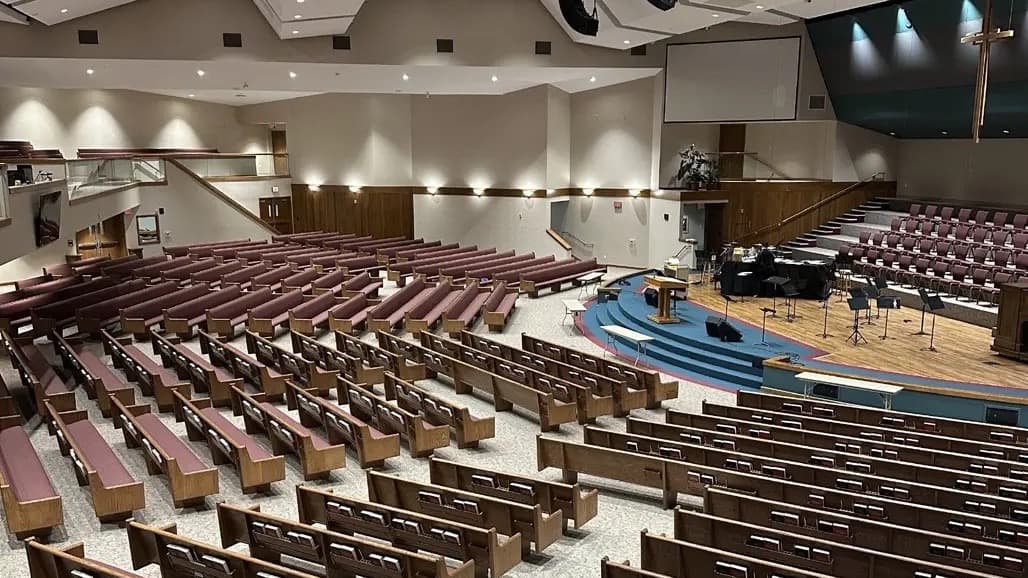
Why Sanctuary Lighting Is a Growing Concern for Detroit-Area Churches
Greater Detroit is home to one of the most diverse and active faith communities in the Midwest. From historic brick churches in Detroit's Midtown and Corktown neighborhoods to large contemporary campuses in Novi, Farmington Hills, Rochester Hills, and Macomb County, houses of worship across this region share a common set of facilities challenges — and sanctuary lighting is increasingly at the top of the list.
Many of these buildings were constructed or last renovated decades ago, when incandescent, halogen, and fluorescent lighting systems were the standard. Today, those same systems are showing their age. Bulbs burn out in hard-to-reach fixtures mounted forty or fifty feet overhead. Aging ballasts cause flickering that disrupts services. Uneven illumination leaves parts of the sanctuary in shadow. And utility bills — already a significant line item for nonprofits — keep climbing.
The good news is that lighting technology has advanced dramatically, and churches across Michigan are beginning to take advantage of upgrades that pay dividends in both performance and cost savings for years to come.
The Unique Maintenance Reality of Church Sanctuaries
Church sanctuaries aren't like office buildings or retail spaces. Their lighting demands are layered, irregular, and often emotionally significant to the people who worship in them. Understanding those unique characteristics is essential before considering any upgrade path.
Access is a persistent challenge. Vaulted ceilings, ornate architecture, and open floor plans mean that replacing even a single burned-out bulb often requires scaffolding or a lift — a significant logistical and financial undertaking for a small facilities team. In historic sanctuaries found throughout Detroit, Dearborn, and Grosse Pointe, the structural constraints make routine maintenance even more complex.
Usage patterns are unpredictable. Unlike a commercial building with consistent weekday hours, sanctuaries may sit dark for days and then operate for extended stretches during holiday seasons, special services, or community events. These stop-start cycles are particularly hard on traditional light sources, accelerating failure rates.
Livestreaming and video production have raised the stakes. Across metro Detroit — from megachurches in Sterling Heights to mid-size congregations in Westland and Southgate — more churches are broadcasting services online. Poor or uneven illumination that was previously tolerable is now visibly problematic on screen, affecting how a congregation presents itself to the broader community.
Budget constraints are real. Faith communities operate as nonprofits, and every dollar spent on emergency maintenance or unplanned lamp replacements is a dollar not serving the congregation's mission. Predictable, low-maintenance systems aren't just a convenience — they're a stewardship issue.
What Modern LED Retrofits Actually Deliver for Michigan Churches
The shift from traditional light sources to LED is well documented in commercial settings, but churches are increasingly discovering that the benefits translate directly to their environment. Here's what facility managers and operations leaders across Michigan are seeing in practice:
- Dramatically reduced relamping frequency. Quality LED fixtures carry rated lifespans of 50,000 hours or more — a meaningful improvement over the 1,000–2,000 hours typical of incandescent sources or the 10,000–15,000 hours of fluorescent. For sanctuaries with challenging ceiling heights, fewer replacements means fewer scaffold rentals and less disruption to the worship calendar.
- Improved light quality and color rendering. LED technology offers superior color rendering (CRI), which matters deeply in sanctuaries where stained glass, woodwork, altar elements, and congregation members' faces all benefit from true, natural light. High-CRI LED sources bring out warmth and depth that older fluorescent systems simply cannot match.
- Energy consumption reductions. While we don't publish specific dollar figures, the wattage reductions achieved through LED retrofits are substantial — often cutting lighting energy use by 50% or more. For churches managing tight operating budgets in communities like Warren, Canton, and Ann Arbor, that ongoing reduction compounds meaningfully over time.
- Dimming and scene control. Modern LED systems pair naturally with dimming controls and programmable scene settings, allowing a sanctuary to transition smoothly from a bright Sunday morning service to soft candlelit ambiance for a Christmas Eve gathering — without straining fixtures or creating compatibility problems with aging dimmers.
- Reduced flicker and outage events. By eliminating aging ballasts and incompatible components, LED retrofits address the root causes of the flickering and dimming complaints that frustrate congregants and distract from worship.
Our work at North Hills Middle School in Bloomfield, Michigan — a community just north of Detroit — offers a useful parallel. When multiple lamp outages rendered the athletic facility unusable for evening events, we replaced 68 aging 1,500-watt HID fixtures with 750-watt Keystone Sports Lighter LED fixtures and developed a full photometric layout to ensure uniform illumination. The result, in the words of Jacob McDermott, Director of Maintenance & Operations: "The results are truly outstanding. The project unfolded seamlessly from start to finish, with Voss Lighting demonstrating professionalism and efficiency throughout the process." While a school athletic field is a different environment than a church sanctuary, the underlying principles — eliminating unreliable legacy sources, improving uniformity, and minimizing operational disruption — translate directly.
Planning a Sanctuary Lighting Upgrade: What to Consider First
Approaching a sanctuary lighting upgrade thoughtfully avoids costly missteps. Facility managers and church leadership across Southeast Michigan should consider several factors before moving forward.
Start with a lighting audit. Before specifying any new equipment, a professional audit documents existing fixture types, wattages, control systems, and known failure patterns. It also captures current light levels throughout the space, identifying areas of deficiency that a new design should address. This data-driven starting point prevents over- or under-specifying the solution.
Account for historic or architectural constraints. Many Detroit-area churches — particularly in older communities like Hamtramck, Highland Park, and the City of Detroit itself — have architectural or historic preservation considerations that affect fixture selection. Period-appropriate aesthetics, plaster ceiling details, and original woodwork all factor into a responsible design approach.
Evaluate controls alongside fixtures. The fixture is only part of the system. Dimming infrastructure, zone controls, and programmable presets should be considered as part of the same decision. A well-designed controls strategy extends the life of LED fixtures and gives ministry and facilities staff intuitive, easy-to-operate tools.
Plan around the worship calendar. Installation timing matters. Scheduling major lighting work during lower-activity seasons — late summer, early January, or specific weekday windows — minimizes disruption to Sunday services, midweek programming, and special events.
Consider phased approaches. For churches with limited capital budgets, phased upgrades — addressing the highest-priority areas first, such as the main sanctuary, followed by fellowship halls, narthex, and exterior — can spread costs across multiple budget cycles while delivering early results.
Cooperative Purchasing: A Practical Path for Eligible Detroit-Area Organizations
For church organizations and affiliated nonprofit or public-sector entities exploring purchasing options, cooperative purchasing programs can simplify procurement and potentially reduce costs. VOSS works with several nationally recognized cooperative purchasing programs, including Houston Church COOP, Sourcewell, TIPS, BuyBoard, Omnia Partners, AEPA, PACE, and Nebraska ESU Co-Op. Eligible organizations should consult with their purchasing or finance staff to determine which programs apply to their situation.
Service Availability
While VOSS offers a comprehensive suite of national services, specific capabilities may vary by location. Please contact your local branch to confirm the current availability of specific services, technology solutions, or contracting capabilities in your immediate market.
Connect with VOSS in Greater Detroit
VOSS serves faith communities and commercial facilities throughout Greater Detroit, Southeast Michigan, and surrounding communities — including Oakland, Wayne, Macomb, Washtenaw, and Livingston counties. Our Grand Rapids branch supports Michigan clients with the resources of a national contractor and the responsiveness of a local team.
If your church is experiencing lighting maintenance challenges, considering a sanctuary retrofit, or simply looking for a professional perspective on where to start, we invite you to connect with our team.
Grand Rapids Branch Phone: (616) 975-9914 Toll-Free: (800) 706-8677
For facility managers and ministry leaders ready to explore what a modern lighting strategy could mean for your congregation, our team is available for a no-pressure consultation. We'll help you understand the options, the process, and what outcomes are realistic for your building — so your leadership can make a confident, informed decision.
Related reading in the Latest Lighting series: Energy Efficient Church Lighting Upgrades, Commercial LED Lighting Fixtures, and Energy Audits, Incentives, and Rebate Navigation for Businesses offer additional context on the broader lighting upgrade landscape.