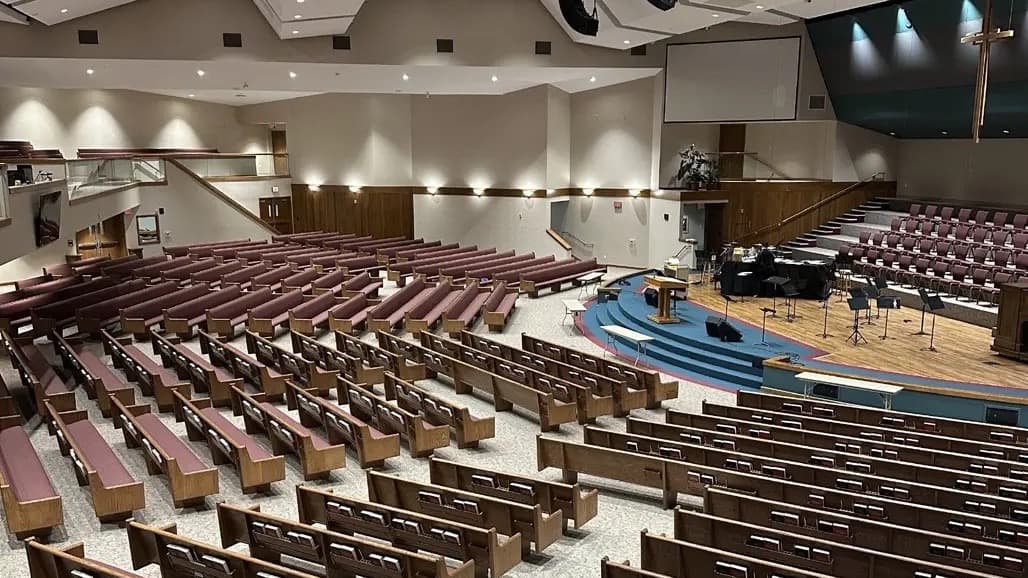
Why Sanctuary Lighting Is a Growing Priority for Detroit-Area Churches
Detroit has one of the most storied faith community landscapes in the Midwest. From historic Gothic Revival sanctuaries in neighborhoods like Midtown and Boston-Edison to modern worship centers in Dearborn, Southfield, Warren, and Livonia, the greater Detroit metro is home to hundreds of congregations of every size and denomination. Many of these facilities were built or last renovated decades ago — and their lighting systems reflect that age.
Today, church facility managers and operations leaders across Wayne, Oakland, and Macomb counties are confronting the same set of converging pressures: aging incandescent and fluorescent fixtures that demand constant maintenance, energy costs that climb year over year, and growing expectations from congregations who stream services online and host community events throughout the week. Sanctuary lighting is no longer just about aesthetics — it's a facility management challenge with real budget and operational consequences.
This article explores what's driving the shift toward modern lighting in faith communities, what the best-practice approaches look like today, and what Detroit-area facility leaders should know before planning their next upgrade.
The Hidden Cost of "Just Replacing the Bulb"
For many congregations, the instinct when a sanctuary light fails is simply to replace it. It's familiar, it feels low-risk, and it defers a larger decision. But this approach has a compounding cost that facility managers across metro Detroit are increasingly recognizing.
Traditional sanctuary fixtures — particularly incandescent, halogen, and fluorescent — have short lifespans that are dramatically shortened in the demanding conditions of a worship space. High ceilings, frequent on/off cycling, and theatrical dimming all accelerate fixture degradation. When those fixtures are mounted 30, 40, or 50 feet overhead, each replacement requires scaffolding or lift equipment, adding labor cost and operational disruption to an already routine task.
Beyond labor, aging ballasts are one of the most common — and most misdiagnosed — sources of lighting problems in older sanctuaries. Flickering lights and inconsistent dimming are often blamed on bulbs when the underlying issue is a failing ballast that will continue causing problems regardless of how many times the lamp is swapped out. The same pattern holds for incompatible dimmers, which were designed for incandescent loads and create visible strobe or buzz effects when used with fluorescent systems.
The result is a maintenance cycle that grows more expensive over time while delivering a consistently degraded experience for worshippers — and for the growing number of Detroit-area congregations that livestream or record services, poor lighting quality is a visible problem that reaches well beyond the physical sanctuary.
What Modern Sanctuary Lighting Actually Looks Like
The LED revolution that transformed commercial and industrial lighting over the past decade has matured considerably, and today's options for sanctuary environments are genuinely sophisticated. Understanding what's available helps facility leaders make more informed decisions — and avoid the trap of selecting technology that solves one problem while creating new ones.
LED Retrofit vs. Full Fixture Replacement For many historic or architecturally significant sanctuaries — a common consideration in Detroit's older faith communities — a full fixture replacement isn't desirable or even feasible. LED retrofit kits allow congregations to preserve the original aesthetic of chandeliers, wall sconces, or pendant fixtures while replacing the light source and driver with modern, efficient technology. This approach dramatically reduces energy consumption and extends the maintenance cycle without altering the visual character of the space.
For newer or more utilitarian facilities, full fixture replacement with purpose-built LED sanctuary luminaires delivers the most comprehensive performance improvement, including better optical control, integrated dimming compatibility, and longer-rated lifespans that can extend well beyond 50,000 hours under typical use.
Dimming and Scene Control One of the most meaningful quality-of-life improvements for worship spaces is the ability to create lighting "scenes" — pre-set configurations for Sunday services, choir rehearsals, funerals, weddings, and community events — that can be recalled with a single button press. Modern LED dimming systems are compatible with theatrical-grade control protocols and require far less programming complexity than the legacy systems they replace. For a facility hosting multiple event types each week, this kind of control flexibility reduces the burden on volunteers and staff while consistently delivering the right atmosphere.
Addressing Video and Livestream Quality A growing number of metro Detroit congregations have invested in video production infrastructure — cameras, broadcast equipment, and streaming platforms — to reach members who can't attend in person. Lighting designed for the human eye doesn't always translate well on camera. LED systems can be calibrated for consistent color temperature and high Color Rendering Index (CRI) values, both of which dramatically improve video quality without the color shifts and flicker that older fluorescent systems introduce on screen.
Lessons from the Field: What Facility Managers Are Learning
VOSS has worked with faith communities and institutional facilities across Michigan and the broader Midwest, and several consistent themes emerge from those engagements.
Access planning is as important as fixture selection. The single largest driver of maintenance cost in tall sanctuaries isn't the fixture — it's the access required to service it. Facilities that transition to long-life LED systems and plan proactively for group relamping cycles can reduce the number of times per year they need to deploy a lift from four or five visits to one or fewer. That planning conversation should happen before procurement, not after installation.
Historic constraints are manageable with the right partner. Many of Detroit's most beloved sanctuaries — particularly those in the Woodward Corridor, Indian Village, and older suburban communities like Grosse Pointe and Royal Oak — have architectural and historic preservation considerations that complicate lighting upgrades. The solution isn't to avoid modernization; it's to engage early with a contractor who understands how to work within those constraints, using retrofit approaches that preserve the original fixture profile while delivering modern performance.
The North Hills Middle School project in Bloomfield, Michigan illustrates the broader principle well. When VOSS replaced sixty-eight 1,500-watt HID fixtures with 750-watt LED equivalents on that athletic field, the result wasn't just energy savings — it was a fully functional, consistently illuminated space that supported the community's actual needs. Jacob McDermott, Director of Maintenance and Operations, noted that "the new lights themselves are nothing short of amazing, providing brilliant and uniform illumination." While that project was athletic rather than ecclesiastical, the operational lesson is directly applicable: upgrading to the right LED system, with proper photometric planning, transforms both the physical environment and the facility team's workload. The same transformation is achievable in sanctuary environments.
Phased upgrades are a legitimate strategy. Congregations operating on tight budgets — which describes most faith communities regardless of size — don't have to tackle a full sanctuary overhaul at once. Prioritizing the fixtures that are failing most frequently, or the areas most visible to livestream cameras, allows organizations to begin realizing benefits immediately while planning subsequent phases as budget allows.
Energy Incentives and Cooperative Purchasing: Making the Business Case
One of the most underappreciated aspects of LED sanctuary upgrades is the financial support available to eligible organizations. Utility rebate programs, which compensate organizations for retiring inefficient fixtures and installing qualifying LED replacements, can meaningfully offset project costs. Faith communities in the Detroit metro area served by DTE Energy or Consumers Energy should engage with their utility's energy efficiency programs early in the planning process — rebate availability and qualifying fixture lists change regularly, and a project planned around available incentives looks very different from one designed in isolation.
For faith communities that qualify, cooperative purchasing programs can also streamline procurement and reduce costs. VOSS works with several nationally recognized cooperative purchasing vehicles, including Houston Church COOP — a program specifically designed for faith-based organizations — as well as Sourcewell, Omnia Partners, TIPS, BuyBoard, AEPA, PACE, and Nebraska ESU Co-Op. These programs allow eligible organizations to purchase through pre-negotiated contracts, simplifying the procurement process and often delivering better pricing than individual bidding. Church facility administrators and finance committees should ask whether their organization qualifies before finalizing any project approach.
Questions Worth Asking Before Your Next Sanctuary Project
For facility managers and church administrators in the greater Detroit area who are beginning to think about sanctuary lighting, the following questions provide a useful starting framework:
- How often are we replacing lamps in our highest fixtures, and what is the fully loaded cost of that labor? Including lift rental or contractor fees often reveals a maintenance cost that far exceeds what leadership assumes.
- Are our current dimmers compatible with the fixtures we're considering? LED dimming compatibility is a technical specification that varies by manufacturer and product line — it should be verified before purchase, not after installation.
- What color temperature best serves our congregation's worship environment? Warmer color temperatures (2700K–3000K) tend to create an inviting, intimate atmosphere; cooler temperatures (4000K+) work better for detail tasks. Many sanctuaries benefit from a layered approach.
- Does our facility have any historic preservation designations or architectural restrictions? Identifying these early prevents expensive mid-project changes.
- Are we capturing all available utility rebates? This question is best asked with a contractor who actively tracks utility incentive programs, not one who treats rebates as an afterthought.
Service Availability
While VOSS offers a comprehensive suite of national services, specific capabilities may vary by location. Please contact your local branch to confirm the current availability of specific services, technology solutions, or contracting capabilities in your immediate market.
VOSS serves the greater Detroit area — including communities across Wayne, Oakland, and Macomb counties, as well as Dearborn, Southfield, Sterling Heights, Troy, Livonia, and the Grosse Pointe communities — from our Grand Rapids branch location.
Grand Rapids Branch Phone: (616) 975-9914 Toll-Free: (800) 706-8677
Talk to a Lighting Specialist About Your Sanctuary
Every sanctuary is different — in architecture, in use patterns, in budget, and in the specific challenges keeping facility managers up at night. If your congregation is dealing with persistent maintenance issues, rising energy costs, or lighting that no longer serves the needs of your community or your media team, we'd welcome the opportunity to discuss what a thoughtful upgrade path might look like for your facility.
Reach out to our Grand Rapids branch to start a conversation. There's no obligation — just a practical discussion about what's possible, what's realistic, and how to make the most of the resources available to your organization.
For further reading, explore related articles in our Latest Lighting series, including Energy Efficient Church Lighting Upgrades, Fluorescent Tube Bans and LED Lighting Rebates, and Energy Audits, Incentives, and Rebate Navigation for Businesses — each of which addresses topics directly relevant to faith community facility planning.