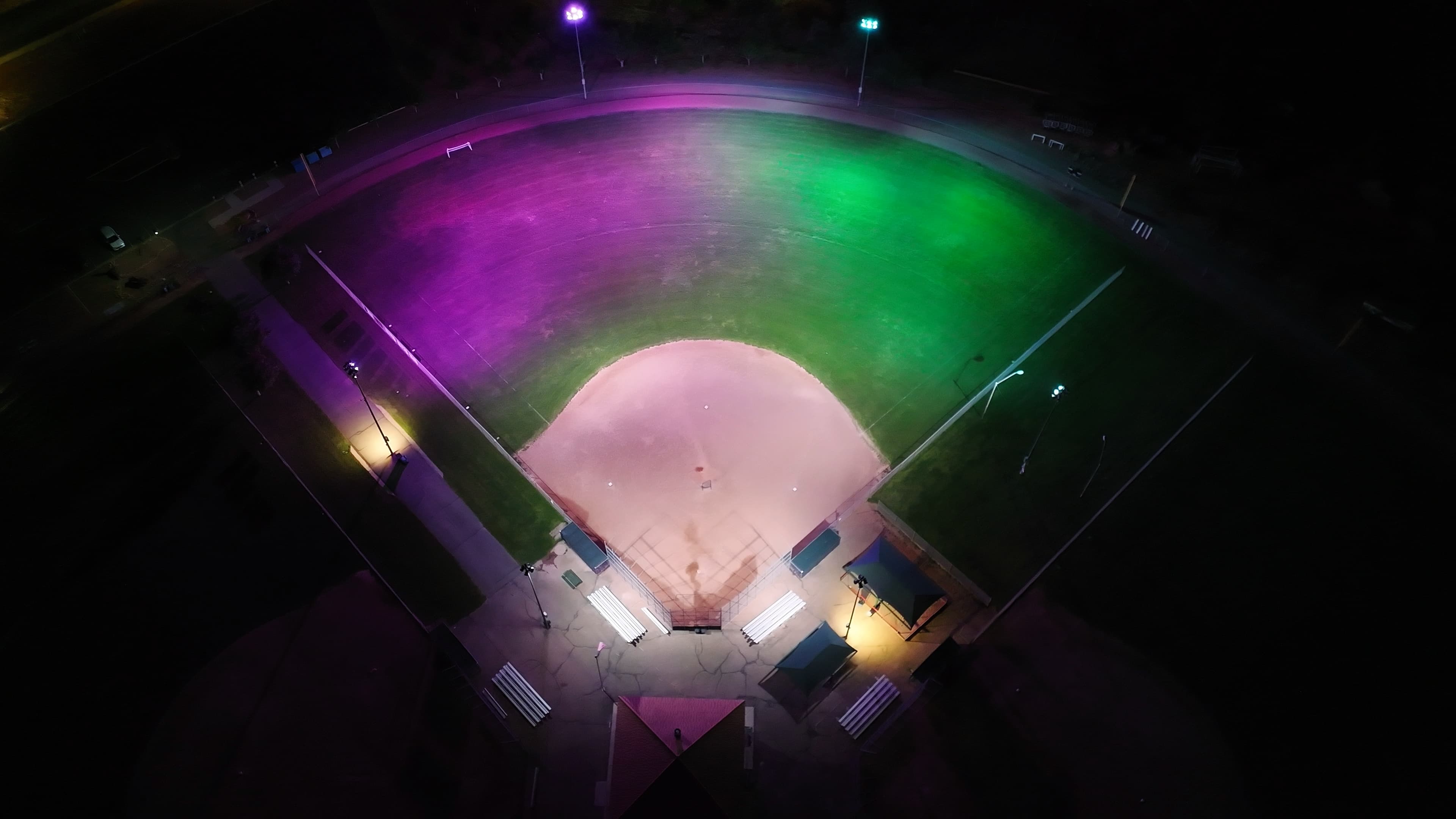
Baseball is more than a pastime in Detroit — it's woven into the fabric of the region's identity. From youth leagues in Dearborn and Warren to competitive high school programs in Bloomfield Hills, Birmingham, and Royal Oak, to community parks serving Detroit's 620,000 residents, athletic fields across Greater Detroit are in constant demand. And as leagues push to extend playing seasons deeper into the evening hours, the quality of field lighting has become a critical — and often underinvested — infrastructure issue.
Traditional metal halide and high-pressure sodium (HPS) field lighting systems, many of which were installed decades ago, are increasingly showing their age. Lamp outages, long warm-up times, uneven illumination, and soaring energy costs are frustrating facility managers, athletic directors, and parks departments across the region. LED technology has fundamentally changed what's possible — and Michigan facilities that have made the switch are seeing results that speak for themselves.
At VOSS, we've been working alongside facility operators, school districts, and municipalities across Michigan and the Midwest for over 85 years. We understand the technical demands of baseball and softball lighting, and we understand the budget pressures facing the organizations that maintain these fields.
What Makes Baseball Lighting Uniquely Challenging
Not all sports lighting is created equal. Baseball and softball fields present specific engineering challenges that demand precision design — and shortcuts can have real consequences for players, officials, and spectators.
Field geometry creates complex lighting demands. Unlike rectangular courts or football fields, a baseball diamond's asymmetrical shape — with a narrow infield, expansive outfield, and foul territory extending in multiple directions — requires careful pole placement and fixture aiming to deliver uniform illumination without dark spots or harsh transitions.
Glare control is critical for player safety. Batters tracking a pitch, outfielders reading a fly ball, and infielders following a line drive all depend on being able to see clearly without blinding glare from overhead fixtures. Poorly designed systems create safety hazards, not just aesthetic problems.
Broadcast and multi-use requirements add complexity. Facilities that host televised games, league championships, or multi-sport events need lighting systems capable of delivering the consistent illuminance levels and color rendering quality required by cameras and governing bodies.
Standards vary by level of play. Little League, NFHS, NCAA, and professional organizations each publish specific footcandle and uniformity requirements. A lighting design that satisfies a recreational park may fall short for a varsity high school program — and a high school system may not meet the bar for collegiate or professional play.
Modern LED systems address all of these challenges — but only when designed by engineers who understand the sport. VOSS brings photometric analysis, fixture selection expertise, and installation experience together in a single, accountable project team.
The LED Advantage: What Detroit Facilities Are Gaining
Facilities across Southeast Michigan and the broader Detroit metro area that have upgraded to LED baseball lighting are realizing benefits that go well beyond simply replacing old bulbs.
Dramatic energy reduction. LED fixtures typically consume 40–60% less energy than the metal halide systems they replace. For a facility running lights multiple nights per week through a full spring and summer season, that translates into meaningful operating cost savings — money that can be redirected toward field maintenance, equipment, or program expansion.
Instant-on performance. Metal halide lamps require a 15–20 minute warm-up period before reaching full brightness — and if they're cycled off during a rain delay, they need another warm-up cycle before play can resume. LED systems reach full output immediately, giving facility operators flexibility and eliminating the awkward delays that frustrate players and fans.
Longer service life and lower maintenance burden. Quality LED sports fixtures are rated for 100,000+ hours of operation, compared to 15,000–20,000 hours for traditional HID sources. For a school district or municipal parks department managing multiple facilities with limited maintenance staff, that difference is significant. Fewer lamp replacements mean fewer bucket truck rentals, fewer work orders, and fewer nights when a field sits dark because a lamp burned out.
Superior light quality. Modern LED systems deliver high color rendering index (CRI) values, making the game easier to follow for players, umpires, and spectators. Uniform illumination across the infield, outfield, and warning track reduces eye strain and improves depth perception — meaningful safety and performance benefits.
The VOSS project at North Hills Middle School in Bloomfield, Michigan illustrates exactly what's at stake. The Athletic Director had been dealing with multiple lamp outages across the football field that rendered it unusable for night games and caused the school to lose field rental revenue. VOSS replaced all sixty-eight 1,500-watt HID fixtures with new 750-watt Keystone Sports Lighter LED fixtures — cutting energy consumption in half while delivering a full photometric lighting layout engineered for the field. The results were immediate. Jacob McDermott, Director of Maintenance & Operations, described the outcome: "The results are truly outstanding. The project unfolded seamlessly from start to finish, with Voss Lighting demonstrating professionalism and efficiency throughout the process. The new lights themselves are nothing short of amazing, providing brilliant and uniform illumination that dramatically enhances the field for both players and spectators." While that project focused on a football field, the same design process, fixture technology, and project management approach applies directly to baseball and softball facilities throughout the Detroit area.
Controls Integration: Smarter Lighting for Busy Facilities
One of the most underappreciated advantages of LED sports lighting is the opportunity it creates for intelligent controls integration. Facilities in Detroit and surrounding communities — including those in Livonia, Sterling Heights, Troy, Ann Arbor, and the Downriver communities — are increasingly looking beyond the fixture itself to the system as a whole.
Wireless scheduling and dimming allow facility operators to pre-program lighting levels by time of day, day of week, or event type — reducing energy use during warm-ups or batting practice without manual intervention. Remote monitoring provides real-time visibility into system performance, enabling proactive maintenance before failures occur. Occupancy-based controls ensure lights aren't left burning on an empty field after a game ends.
For facilities that host multiple sports or community events, controls systems can store preset scenes for different configurations — full game illumination, maintenance mode, or partial lighting for early-morning groundskeeping. VOSS designs these integrations from the ground up, ensuring that the controls system and the fixtures work together as a cohesive solution rather than as afterthoughts bolted on separately.
Our related content on LED sports lighting controls and energy solutions — including articles on LED Football Stadium Lights, Pickleball LED Lighting Solutions, and Tennis Court Lighting and Energy Solutions — explores many of these themes in parallel contexts. If your facility manages multiple athletic venues, a coordinated lighting strategy across all surfaces can yield compounding energy and operational benefits.
A Note for Schools, Parks Departments, and Municipal Organizations
Public-sector organizations across Greater Detroit — including school districts in Wayne, Oakland, and Macomb counties, as well as city and township parks departments — often face procurement requirements that add complexity to capital improvement projects. VOSS is experienced in navigating these processes and is an approved contractor through multiple cooperative purchasing programs, including Sourcewell, TIPS, BuyBoard, AEPA, Omnia Partners, and PACE. Eligible organizations can leverage these contracts to streamline procurement, reduce administrative burden, and move projects forward without the delays of a full competitive bid process.
If your organization is exploring a baseball or softball field lighting upgrade and needs to understand your procurement options, our team can walk you through the programs available and help you identify the path of least resistance to getting your project funded and completed.
Service Availability
While VOSS offers a comprehensive suite of national services, specific capabilities may vary by location. Please contact your local branch to confirm the current availability of specific services, technology solutions, or contracting capabilities in your immediate market.
Talk to VOSS About Your Detroit-Area Baseball Lighting Project
Whether you're managing a single community field in Hamtramck or overseeing a multi-field athletic complex in Novi, Canton, or Westland, VOSS has the expertise and resources to help you design, fund, and execute a baseball or softball LED lighting upgrade that delivers real, lasting results. Our team brings photometric engineering, energy analysis, and full-service installation together — so you're working with one accountable partner from concept through commissioning.
We serve Detroit and the greater Southeast Michigan region from our Grand Rapids branch. We invite you to reach out for a consultative conversation about how LED lighting technology applies to your specific facility, your league requirements, and your operating budget.
VOSS — Grand Rapids Branch
Phone: (616) 975-9914 Toll-Free: (800) 706-8677