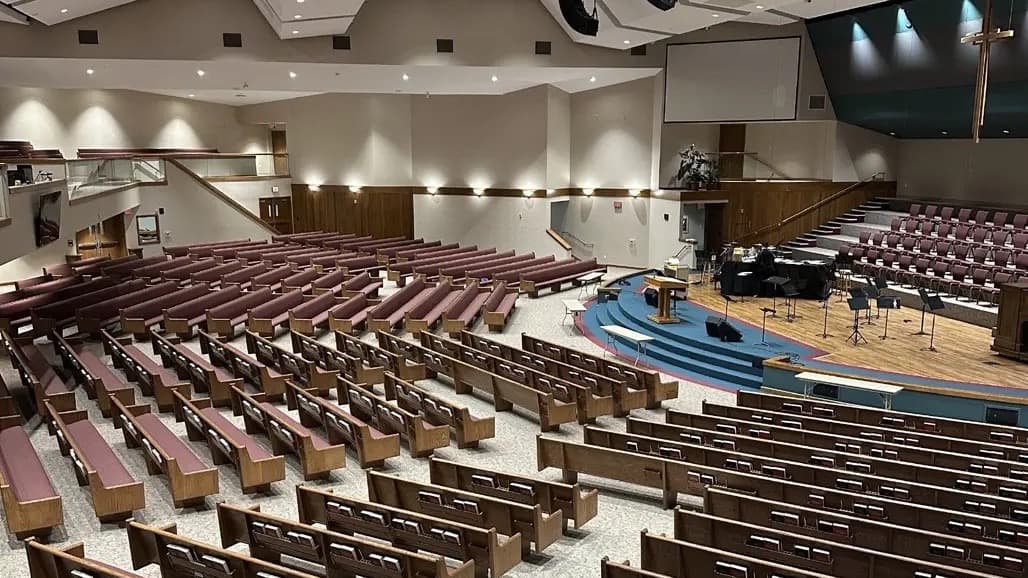
Why Sanctuary Lighting Deserves a Closer Look in Dearborn
Dearborn is home to one of the most culturally and spiritually diverse faith communities in the United States. With a population of approximately 110,000, the city supports a rich array of churches, mosques, temples, and multi-faith worship centers — many housed in older buildings with aging electrical infrastructure that was never designed for the lighting demands of modern congregational life. Across the broader Greater Detroit area, from Dearborn Heights and Allen Park to Taylor and Inkster, faith communities of every denomination are confronting the same fundamental challenge: their sanctuary lighting is falling behind.
The issue is rarely just aesthetic. Flickering fixtures, frequent bulb failures in vaulted ceilings, inconsistent illumination across the nave, and rising utility costs are operational realities that weigh on facility managers and maintenance supervisors every week. As congregations increasingly rely on livestreaming, video recording, and broadcast-quality services to reach members beyond their walls, the quality of sanctuary lighting has taken on new strategic importance. A dim or uneven room doesn't just detract from the worship experience — it can undermine a congregation's ability to connect with its broader community.
The Hidden Costs of Aging Sanctuary Lighting Systems
Many church facilities across Dearborn and the wider Wayne County region are still running incandescent, halogen, or fluorescent lighting systems installed decades ago. These technologies carry maintenance burdens that compound over time, and the true cost is often underestimated.
High-access maintenance is among the most significant pain points. Sanctuaries with soaring ceilings — a defining architectural feature of many historic Detroit-area churches — require scaffolding or aerial lifts simply to change a burned-out bulb. When fixtures fail frequently, those access events stack up, consuming staff time and budget that congregations can ill afford to lose.
Aging ballasts and incompatible dimmer systems are another common culprit behind flickering and dimming complaints. As fluorescent ballasts age, they become inconsistent — sometimes tripping breakers, sometimes simply failing mid-service. Replacing individual ballasts as they fail is a short-term fix that often costs more in aggregate than a planned retrofit would.
Uneven illumination creates both safety and experiential problems. Congregants navigating dimly lit aisles, musicians reading from poorly lit music stands, and video cameras struggling to capture a balanced image are all symptoms of a lighting system that has outlived its design life.
The pattern VOSS observed at Corewell Health's facility in Dearborn mirrors what many local organizations — faith-based and otherwise — experience with aging fluorescent systems. At that project, suspended fixture lenses had become dusty, brittle, and were physically falling apart during routine lamp and ballast changes. The solution — replacing the existing fixtures with uniform linear LED lighting and energy-efficient suspended LED fixtures with up and downlights — dramatically improved both the ambiance and the maintainability of the space. As Luke Sandzik, Supervisor of Facilities Management Plant Operations, noted after completion: "Everything looked really good. Thank you for your hard work in getting this completed. SSU looks amazing." While that project was healthcare-focused, the infrastructure challenges and the outcomes translate directly to church environments facing the same aging fluorescent infrastructure.
What Modern LED Retrofits Actually Deliver for Faith Communities
LED technology has matured significantly over the past decade, and for church sanctuaries specifically, the results go well beyond energy savings — though those savings are real and meaningful.
Dramatically reduced maintenance frequency is the benefit that resonates most immediately with facility managers. Quality LED fixtures carry rated lifespans of 50,000 hours or more, which in a typical sanctuary environment can translate to 15–25 years of service before replacement is necessary. For a congregation that has been scheduling lift rentals two or three times a year, that shift represents a fundamental change in how the building is managed.
Improved light quality and controllability are equally important. Modern LED systems offer excellent color rendering — critical for capturing the warmth and texture of stained glass, woodwork, and architectural detailing that define so many Dearborn-area sanctuaries. Dimming systems designed to work natively with LED sources eliminate the flickering and inconsistency that plague legacy fluorescent and halogen systems.
Energy efficiency gains vary by project, but the trajectory is consistently downward on utility bills. With DTE Energy serving much of the Greater Detroit area, understanding available rebate programs and utility incentives is an important part of planning any LED retrofit. A thoughtful upgrade combines fixture selection, controls integration, and rebate capture to optimize the total financial picture. Our article on Maximize ROI with Commercial LED Lighting Rebates explores these programs in depth and is worth reviewing alongside any sanctuary upgrade conversation.
Livestream and video readiness has become a practical requirement for many congregations. LED systems with high color rendering index (CRI) values and flicker-free driver technology produce the stable, consistent light that cameras require — without the color casts and hot spots that older systems introduce.
Planning a Church Lighting Upgrade: What Facility Managers Should Know
A successful sanctuary lighting project requires more than selecting the right fixture. The planning process matters enormously, especially in buildings that cannot simply be shut down for extended periods.
Photometric analysis should precede any fixture selection. A full lighting layout — mapping foot-candle levels across the sanctuary floor, chancel, choir loft, and gathering spaces — establishes a baseline and ensures the proposed solution actually delivers the illumination levels the space needs. This is the same analytical approach VOSS applied to the North Hills Middle School football field retrofit in Bloomfield, Michigan, where a complete photometric layout guided the fixture selection and ensured the field met the uniformity standards required for competitive athletics. The principle is identical in a sanctuary context: data-driven planning prevents costly surprises.
Phased installation is often the right approach for active congregations. Completing work section by section — or scheduling primary installation during lower-activity periods — minimizes disruption to regular services, rehearsals, and events. VOSS's experience with occupied-facility retrofits, including healthcare environments and active educational campuses across Michigan, informs a low-disruption installation methodology.
Historic and architectural constraints deserve careful attention in older Detroit-area church buildings. Surface mounting options, conduit routing, and fixture profiles all need to work within the existing architectural character of the space. The goal is always a result that feels native to the building, not retrofitted onto it.
Controls and smart systems integration is worth considering from the outset rather than as an afterthought. Scene-based lighting controls — allowing a single preset to transition the sanctuary from a bright Sunday morning service to an intimate candlelight setting — are increasingly accessible and add lasting operational value. Integration with building automation systems, occupancy sensing in ancillary spaces, and remote monitoring capabilities all contribute to a more manageable facility long-term.
A Note for Eligible Organizations: Cooperative Purchasing Options
For faith-based organizations, nonprofits, and any affiliated institutions exploring cooperative purchasing, VOSS works through several established programs that can streamline procurement and reduce administrative complexity. The Houston Church COOP is specifically designed for faith communities and may offer a straightforward path for eligible congregations. Programs such as Sourcewell, TIPS, BuyBoard, and Omnia Partners are also available to qualifying organizations. We encourage facility managers and business administrators to ask our team which programs may apply to their specific situation.
Service Availability
While VOSS offers a comprehensive suite of national services, specific capabilities may vary by location. Please contact your local branch to confirm the current availability of specific services, technology solutions, or contracting capabilities in your immediate market.
Talk to VOSS About Your Sanctuary Lighting Challenges
If your congregation in Dearborn, Dearborn Heights, Allen Park, Lincoln Park, Melvindale, or anywhere across the Greater Detroit area is dealing with aging fixtures, high maintenance costs, or a sanctuary environment that no longer serves your community well, we'd welcome the opportunity to discuss what a thoughtful upgrade could look like for your facility.
VOSS's Grand Rapids branch serves the Michigan market with lighting design, fixture procurement and supply, and installation expertise built on 85+ years of commercial electrical experience.
VOSS Lighting — Grand Rapids Branch
Phone: (616) 975-9914 Toll-Free: (800) 706-8677
Reach out to start a no-obligation conversation about your facility's lighting needs. We're here to help you build a smarter, more sustainable worship environment — one that serves your congregation for decades to come.
For additional insights on related topics, explore our articles on Energy Efficient Church Lighting Upgrades, Fluorescent Tube Bans and LED Lighting Rebates, and Energy Audits, Incentives, and Rebate Navigation for Businesses — all part of the VOSS Latest Lighting series.