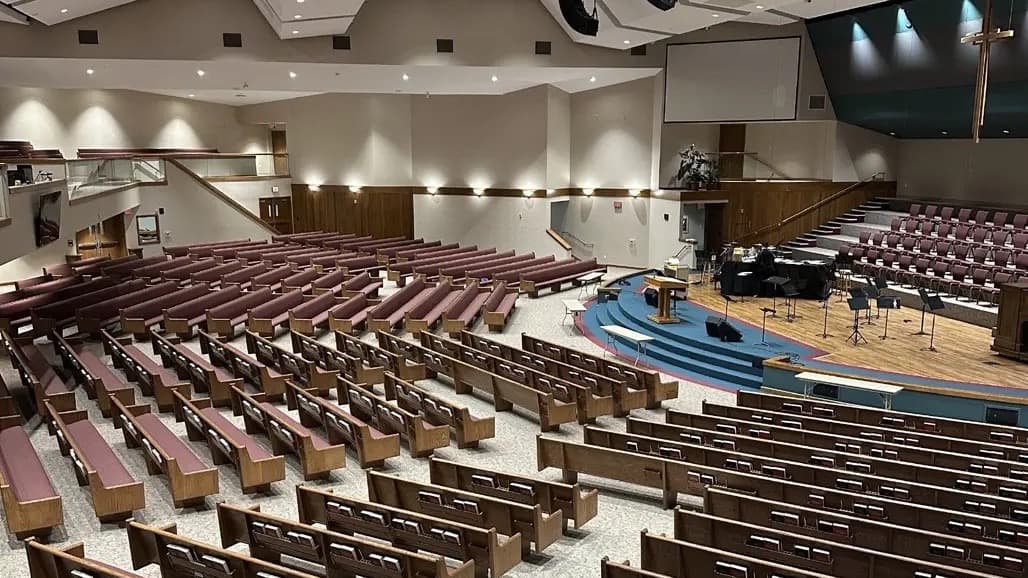
Why Sanctuary Lighting Deserves a Closer Look in Ann Arbor
Ann Arbor is home to a remarkably diverse and active faith community. From historic congregations near the University of Michigan campus to growing multi-site churches serving families in surrounding communities like Dexter, Chelsea, and Saline, places of worship here range from century-old sanctuaries with ornate architecture to modern facilities built for contemporary services and live-streaming.
What unites them — regardless of size, style, or denomination — is the growing pressure on facility managers and operations teams to do more with less. Aging lighting infrastructure is rarely at the top of a church's capital improvement list, yet it is often the source of the most persistent maintenance headaches: burned-out bulbs in 40-foot ceilings, ballasts that flicker mid-service, dimmer systems that no longer respond predictably, and energy bills that don't reflect the church's stewardship values.
The good news is that the lighting industry has undergone a genuine transformation over the past decade, and faith communities in the Ann Arbor area are well-positioned to benefit — if they understand what's available, what's practical, and what questions to ask.
The Unique Lighting Challenges of Church Sanctuaries
Church sanctuaries present a combination of conditions that make lighting maintenance more complex than a typical commercial facility. Understanding these challenges is the first step toward building a smarter long-term strategy.
Architectural access difficulties are perhaps the most immediate pain point. Sanctuaries with vaulted ceilings, clerestory windows, or decorative truss systems often require scaffolding, scissor lifts, or boom equipment to reach fixtures — meaning even a single bulb replacement can become a multi-hour, multi-person event that disrupts weekday programming or requires scheduling around weekend services.
Legacy lamp and ballast technology compounds the problem. Many Ann Arbor-area churches built or renovated in the 1980s and 1990s are still running fluorescent or metal halide systems with original ballasts. As these components age, they become less reliable, harder to source, and increasingly incompatible with modern dimming and control systems. Michigan's statewide momentum toward fluorescent lamp phase-outs — a trend VOSS has documented in depth in our article on the Minnesota Fluorescent Lamp Ban and its implications for commercial building operators — is a relevant signal for facility managers here as well, underscoring the value of proactive planning.
Multi-use programming demands add another layer of complexity. The modern church sanctuary isn't used only for Sunday worship. It may host livestreamed services, community events, performing arts programs, youth gatherings, and rental functions throughout the week. Each use case may require a different lighting atmosphere — from warm, reverent illumination for traditional worship to bright, even coverage for video production. Systems that can't adapt are a liability.
Historic preservation considerations affect a meaningful number of Ann Arbor congregations. Churches located in or near historic districts, or those with architecturally significant interiors, must balance upgrade ambitions against preservation requirements — a tension that requires experienced lighting professionals who understand both the technical and regulatory dimensions.
LED Technology: What's Actually Changed, and Why It Matters for Faith Communities
The transition from traditional light sources to LED is not simply a matter of swapping bulbs. For sanctuary environments, the advances in LED technology over the past five to seven years have been especially significant.
Color rendering and warmth were historically a concern with early LED products, which could feel harsh or clinical in a worship space. Modern LED fixtures designed for sanctuary applications now routinely achieve Color Rendering Index (CRI) scores of 90 or above, with tunable color temperature options that allow congregations to dial in the warm, inviting quality of traditional incandescent or halogen sources — without the energy consumption or maintenance burden.
Dimming compatibility has improved substantially. Earlier LED retrofits frequently caused flickering or buzzing when paired with existing dimmer infrastructure. Today's purpose-built LED drivers and fixtures are engineered to work with a wide range of dimming protocols, and where full control system upgrades are warranted, the options are more accessible and affordable than ever.
Fixture lifespan is the factor that most directly affects facility operations teams. Quality LED fixtures rated for 50,000 or more hours of operation represent a fundamental shift in maintenance planning. For a congregation holding services twice weekly and running daytime programming, that lifespan can translate to a decade or more between major fixture replacements — dramatically reducing the frequency of high-ceiling access events.
Energy consumption reductions are significant and measurable. The transition from 1,500-watt HID fixtures to modern LED equivalents, for example, can cut wattage by 50% or more while delivering superior illumination quality. VOSS completed exactly this kind of transformation at North Hills Middle School in Bloomfield, Michigan, replacing sixty-eight 1,500-watt HID fixtures with 750-watt Keystone Sports Lighter LED units. The results — as described by Jacob McDermott, Director of Maintenance and Operations — were "truly outstanding," with "brilliant and uniform illumination that dramatically enhances" the space. While that project focused on athletic facilities, the underlying principle applies directly to sanctuary environments: modern LED technology delivers more light for fewer watts, with greater reliability and consistency.
Smart Controls: Turning Lighting Into a Strategic Asset
For many Ann Arbor congregations, the conversation about lighting upgrades is an opportunity to rethink not just the fixtures, but the entire control ecosystem that governs them.
Scene-based preset controls allow a worship director or A/V volunteer to recall a pre-programmed lighting scene — "Sunday morning worship," "candlelight service," "video recording," "cleaning mode" — with a single button press. This eliminates the guesswork and inconsistency that comes with manual dimmer adjustments, and it reduces the burden on staff and volunteers who may not have lighting expertise.
Integration with A/V and streaming infrastructure is increasingly important for churches that broadcast services online. Poor or uneven lighting is one of the most common technical complaints in faith community livestreams, and it's entirely preventable. Lighting systems designed with camera coverage in mind — appropriate light levels, minimized shadows, consistent color temperature — make a meaningful difference in how a congregation's online presence is perceived.
Occupancy and scheduling automation can further reduce energy consumption during non-service hours, ensuring that systems aren't running at full output in empty spaces. For a church operating a daycare, food pantry, or community center out of the same facility — a common model in communities like Ypsilanti and Ann Arbor — automated controls help manage energy use across diverse programming schedules without requiring constant manual intervention.
Churches eligible for cooperative purchasing programs may find procurement easier than expected. Qualifying organizations can access pre-negotiated contracts through programs such as Houston Church COOP, Sourcewell, BuyBoard, or TIPS — frameworks that streamline vendor selection and purchasing while ensuring compliance and value.
Planning a Sanctuary Lighting Project: Key Considerations for Facility Leaders
Whether a congregation is responding to an immediate maintenance crisis or thinking proactively about a multi-year capital plan, a few principles should guide the conversation.
- Start with an audit, not a product. A thorough lighting audit documents existing fixture types, wattages, condition, dimming compatibility, and control infrastructure before any upgrade decisions are made. This baseline is essential for accurate budgeting, utility rebate applications, and photometric planning.
- Think about the whole room, not just the fixtures. Sanctuary lighting design involves the interplay of natural light, architectural surfaces, chancel or stage illumination, and aisle/pew safety lighting. An upgrade that addresses only overhead fixtures while ignoring theatrical or accent elements may not achieve the desired result.
- Factor in utility incentive programs. Michigan utilities offer rebate and incentive programs for commercial LED upgrades that can meaningfully offset project costs. VOSS helps clients identify, apply for, and maximize available incentives — a topic explored further in our articles on Commercial LED Lighting Rebates and Energy Audits, Incentives, and Rebate Navigation for Businesses.
- Plan for minimal service disruption. Professional installation teams with experience in church environments understand the importance of working around worship schedules. Projects can typically be phased to avoid disruption to Sunday services, midweek programming, or special events.
- Consider long-term serviceability. The best upgrade is one that reduces future maintenance burden. Selecting fixtures with long-rated lifespans, accessible mounting systems, and local parts availability ensures that the investment holds its value over time.
Service Availability
While VOSS offers a comprehensive suite of national services, specific capabilities may vary by location. Please contact your local branch to confirm the current availability of specific services, technology solutions, or contracting capabilities in your immediate market.
VOSS serves Ann Arbor, Ypsilanti, Saline, Chelsea, Dexter, and the broader Greater Detroit region from our Grand Rapids branch. Our team works with faith communities of all sizes and denominations across Michigan, bringing national resources and local relationships to every project.
Grand Rapids Branch Phone: (616) 975-9914 Toll-Free: (800) 706-8677
Start the Conversation
If your congregation is navigating aging fixtures, rising maintenance costs, or a sanctuary that no longer supports your programming vision, we'd welcome the opportunity to talk through what's possible. VOSS offers consultative lighting assessments designed to help facility managers and church leadership understand their options, evaluate costs and incentives, and build a practical roadmap — without pressure or obligation.
Reach out to our Grand Rapids team to schedule a conversation about your Ann Arbor-area facility. We're here to help you find solutions that serve your congregation, your budget, and your mission for years to come.