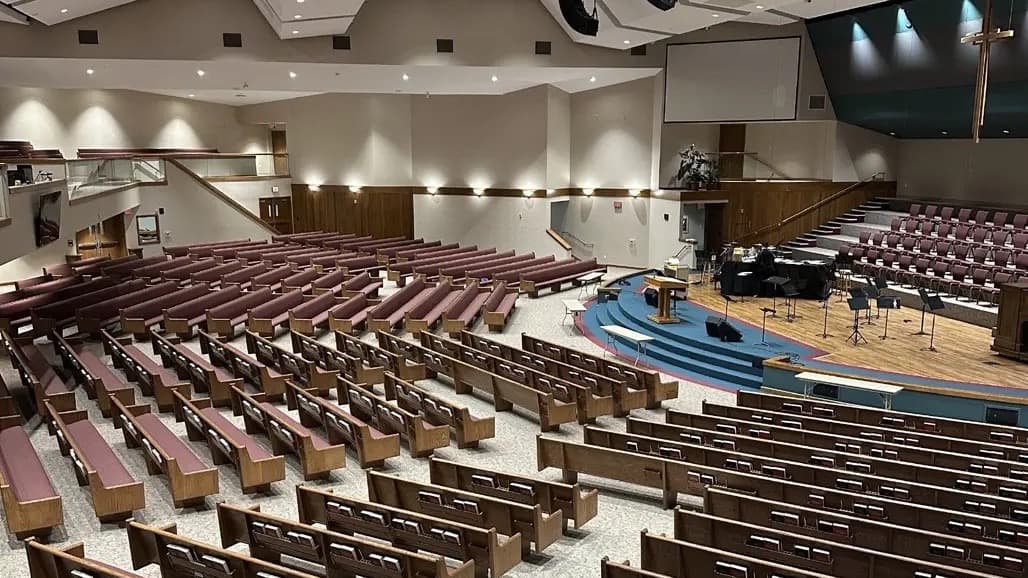
Why McKinney Churches Are Rethinking Sanctuary Lighting
McKinney is one of the fastest-growing cities in Texas — and in the country. With a population approaching 195,000 and rapid residential expansion pushing northward from the greater Dallas metro into Collin County, McKinney's faith communities are growing right alongside the city itself. Congregations that were small twenty years ago are now managing large, multi-use campuses with sanctuaries that seat hundreds, or even thousands.
That growth brings a familiar challenge: aging lighting infrastructure that was designed for a much smaller facility and a different era of technology. Sanctuaries across McKinney and surrounding communities like Allen, Frisco, Prosper, and Celina are increasingly dealing with the hidden costs of outdated fixture systems — costs that show up not just on the utility bill, but in the time and labor of maintenance teams trying to keep pace with burnouts, ballast failures, and complaints from congregants and livestream production crews alike.
Understanding why these problems occur — and what modern lighting systems can actually do — is the first step toward making a well-informed decision for your facility.
The Real Cost of Deferred Sanctuary Lighting Maintenance
For many church facility managers, lighting maintenance has historically been reactive: a bulb burns out, someone calls a vendor, and the problem gets fixed — until it happens again next month. In a small sanctuary, that model is manageable. In a modern McKinney worship center with 30-foot vaulted ceilings, theatrical lighting rigs, and services happening six or seven days a week, it becomes unsustainable.
The actual costs of deferred or piecemeal sanctuary lighting maintenance are broader than most facility leaders initially recognize:
- Labor and access costs: Replacing incandescent, halogen, or fluorescent lamps in elevated fixtures typically requires scaffolding, articulating lifts, or aerial work platforms — each visit representing significant time, equipment rental, and scheduling disruption.
- Ballast failures and compatibility issues: Older fluorescent and HID fixtures rely on ballasts that degrade over time. Flickering lights, slow start times, and dimmer incompatibility are almost always ballast-related — and as manufacturers phase out these components, replacement parts are becoming harder to source.
- Uneven illumination: Sanctuaries are rarely lit uniformly by aging systems. Congregants in certain zones may struggle to read, and production teams running video or livestream operations — increasingly common across North Texas congregations — will find that inconsistent foot-candle levels create serious camera exposure problems.
- Energy waste: Traditional incandescent and halogen sources convert a significant portion of their energy into heat, not light. In a large sanctuary running multiple services weekly, that inefficiency compounds quickly on the monthly utility statement.
A number of states, including Texas, are also seeing pressure from federal regulatory changes around fluorescent lamp availability — a topic covered in more depth in the related article on fluorescent tube bans and LED lighting rebates in the Latest Lighting series. For McKinney churches still operating T8 or T12 fluorescent systems, this regulatory context adds urgency to upgrade conversations.
What Modern LED Systems Mean for Worship Environments
The LED lighting conversation in faith communities has matured considerably over the past decade. Early adopters occasionally encountered color rendering problems, incompatible dimmers, or fixtures that felt too "cold" for a contemplative worship setting. Today's commercial-grade LED systems are a fundamentally different product — and the results in sanctuary environments are meaningfully better across nearly every dimension.
Lighting quality and atmosphere: Modern LED fixtures are available across a wide range of color temperatures and CRI (color rendering index) ratings, allowing design teams to dial in the warmth and vibrancy appropriate for traditional or contemporary sanctuary aesthetics. High-CRI fixtures render skin tones, wood finishes, stained glass, and liturgical textiles more accurately and vividly than their fluorescent or incandescent predecessors.
Dimming and control integration: One of the most significant advances in LED technology for sanctuary applications is dimming performance. Well-specified LED systems can dim smoothly from full output to near-zero without the flicker, hum, or premature burnout that plagued early LED dimmers. For churches running theatrical lighting cues, transitions between musical segments, or variable lighting during different service elements, this matters enormously.
Maintenance interval extension: A quality commercial LED lamp or integrated fixture is rated for 50,000 hours or more of useful life — compared to 1,000–2,000 hours for incandescent sources and 10,000–15,000 hours for fluorescent. For a facility running services and events 20 or more hours per week, that translates into years — sometimes decades — between relamping cycles. The reduction in lift rentals and maintenance labor alone often justifies the upgrade investment.
Livestream and broadcast performance: Across the DFW Metroplex, churches of all sizes are investing in video production infrastructure to reach congregants online. LED fixtures with stable, flicker-free output at standard camera frame rates are essential for producing clean footage. This is a technical specification that deserves direct attention during any sanctuary lighting design conversation.
For congregations also managing gymnasium spaces, fellowship halls, or outdoor parking and campus lighting, VOSS's Latest Lighting series covers LED gymnasium lighting solutions, parking lot and outdoor LED lighting upgrades, and energy-efficient church lighting upgrades — all relevant companion topics for multi-building campus planning.
Practical Considerations for McKinney Church Facility Teams
Knowing that LED is a superior technology is one thing. Understanding how to actually execute an upgrade in an active, schedule-driven worship environment is another. Church facility managers in McKinney face real constraints that differ meaningfully from commercial office or retail retrofit projects.
Scheduling around services and events: A McKinney congregation may run Sunday morning services, Wednesday evening programming, youth events, weddings, funerals, community meetings, and rehearsals across a single week. Finding installation windows that don't disrupt ministry operations requires careful coordination. Experienced contractors who have worked in faith-based environments understand this constraint and plan accordingly — staging work in phases, completing the most disruptive access work overnight or on low-activity days.
Historic and architectural considerations: McKinney's older neighborhoods and established faith communities include sanctuaries with significant architectural character — ornate woodwork, stained glass, historic plasterwork, and decorative fixture housings. Retrofit approaches in these settings must account for the aesthetic integrity of the space, not just the technical specifications of the new fixtures.
Budget phasing: Large sanctuary upgrades represent meaningful capital expenditures. For many church facilities operating on annual budgets with limited capital reserves, a phased approach — prioritizing the highest-maintenance and highest-impact zones first — may be more practical than a single comprehensive project. Understanding the full picture of available utility rebates and incentive programs can also change the financial calculus significantly.
Utility rebates and incentive programs: Oncor Electric Delivery serves the McKinney area and offers commercial energy efficiency rebate programs that can offset a portion of LED upgrade costs. Facility managers and business administrators considering sanctuary lighting projects should explore these programs early in the planning process — eligibility, rebate structures, and available incentive dollars can influence both fixture selection and project timing. The related article on maximizing ROI with commercial LED lighting rebates in the Dallas area provides a useful overview of how these programs typically work.
Cooperative purchasing options: For faith-based organizations affiliated with cooperative purchasing networks, programs such as Houston Church COOP, BuyBoard, TIPS, and Sourcewell may offer pre-negotiated contract vehicles that simplify procurement, reduce administrative burden, and in some cases provide access to preferred contractor pricing. Organizations eligible for these programs should confirm applicability with their purchasing administrator before initiating a project.
How VOSS Approaches Church Lighting Projects in the Greater Dallas Area
VOSS has spent more than 85 years working alongside facility teams across a broad range of building types and operational environments. Our Dallas branch serves McKinney and the surrounding Collin County communities — including Plano, Allen, Frisco, Prosper, Anna, and Melissa — with the resources and project experience that large-scale sanctuary work demands.
Our approach to church lighting projects is grounded in a few consistent principles:
- Facility-first planning: We start with an honest assessment of your current system — what's failing, what's still serviceable, and where the highest-priority improvements will deliver the fastest return. We don't recommend wholesale replacement when targeted retrofits will solve the problem.
- Low-disruption execution: We plan project staging around your ministry calendar, not the other way around. Lift work, electrical rough-in, and fixture installation are coordinated to minimize interference with services and events.
- Specification quality: We specify commercial-grade fixtures from proven manufacturers — not commodity product — because sanctuary lighting systems need to perform reliably for a decade or more, not just pass inspection.
- Controls and integration guidance: We help facility teams think through dimming controls, switching schemes, and integration with existing theatrical or AV systems before installation begins, avoiding costly rework after the fact.
Service Availability
While VOSS offers a comprehensive suite of national services, specific capabilities may vary by location. Please contact your local branch to confirm the current availability of specific services, technology solutions, or contracting capabilities in your immediate market.
Let's Talk About Your Sanctuary
If your McKinney congregation is navigating flickering fixtures, aging ballasts, rising energy costs, or the operational headache of frequent high-ceiling maintenance, we'd welcome the opportunity to walk through your facility and offer a candid assessment. There's no obligation — just a practical conversation about what's working, what isn't, and what your options are.
Reach our Dallas branch team at (972) 432-8367, or toll-free at (800) 736-8677. We serve McKinney and communities throughout Collin County and the Greater Dallas area.