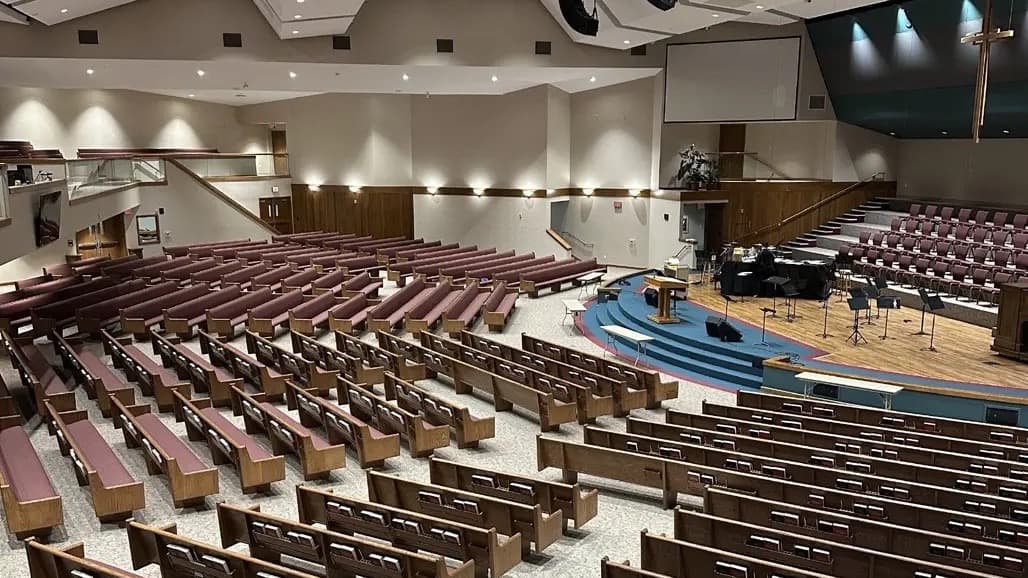
Why Irving, TX Churches Are Rethinking Their Sanctuary Lighting
Irving is home to a remarkably diverse and active faith community. From established congregations along Belt Line Road and Story Road to newer and growing churches throughout Las Colinas and the Valley Ranch neighborhoods, places of worship in this city of 240,000 residents serve thousands of families every week. Many of these sanctuaries were built — or last renovated — decades ago, when incandescent, halogen, and fluorescent lighting were the standard. Today, those same fixtures are creating real operational and financial headaches for facility managers and church administrators.
The Greater Dallas region, including communities like Coppell, Carrollton, Grand Prairie, and Farmers Branch that border Irving, has seen significant growth in faith community infrastructure. As congregations expand their programming — adding midweek services, youth events, livestreamed worship, and community outreach — the demands placed on sanctuary lighting systems have grown alongside them. Legacy lighting simply wasn't designed for this level of use, and the maintenance consequences are becoming impossible to ignore.
This article explores what's driving lighting challenges in church facilities today, what modern solutions look like in practice, and how Irving-area faith communities are approaching upgrades in a way that is responsible both financially and operationally.
The Real Cost of Deferred Sanctuary Lighting Maintenance
For many church facility managers, lighting maintenance is reactive by necessity. Bulbs burn out, scaffolding gets scheduled, and the cycle repeats — often several times per year for sanctuaries with high vaulted ceilings and elevated fixtures. What's less visible, but equally costly, is the cumulative impact of that cycle on staff time, vendor invoices, and congregant experience.
Common issues facility managers across the Irving area encounter include:
- Frequent lamp replacements in elevated fixtures — Traditional incandescent, halogen, and older fluorescent lamps have rated lives that require replacement far more often than modern alternatives. In a sanctuary with 30-foot ceilings, each replacement event requires lift equipment, labor coordination, and service disruption.
- Aging ballast failures — Fluorescent ballasts degrade over time, causing the flickering and humming that congregants notice immediately. Ballast replacements are often a short-term fix; as a ballast-driven system ages, failures accelerate.
- Uneven or insufficient illumination — Whether it's dark zones in the congregation seating area, overlighting at the altar, or hotspots that look poor on camera during livestreams, uneven light distribution is both an aesthetic and a practical problem.
- Incompatible dimming systems — Many older sanctuaries have dimmer controls that were never designed to work with retrofitted lamps, leading to flickering, reduced lamp life, and controls that don't perform as expected.
- Rising energy costs — Older lighting technology is significantly less efficient than today's LED systems. For a large sanctuary running services multiple days per week, the difference in energy consumption can be substantial over the course of a year.
Deferred maintenance doesn't reduce these costs — it compounds them. Facility leaders who understand the full lifecycle cost of their current systems are often surprised to find that a planned LED upgrade, when evaluated honestly against ongoing maintenance expenses, delivers a faster financial payback than expected.
LED Technology and What It Actually Means for a House of Worship
The conversation around LED lighting has matured considerably in recent years. Early LED products — particularly those retrofitted into existing church fixtures — sometimes disappointed facility managers with color rendering issues, incompatibility with existing dimmers, or performance that didn't match manufacturer claims. Today's LED technology is a different story, and it's worth understanding what has changed.
Color rendering and warmth — Modern LED lamps and fixtures are available across a wide range of color temperatures and with high Color Rendering Index (CRI) ratings. For sanctuaries, this matters enormously. Warm-toned LEDs (2700K–3000K) can replicate the inviting, traditional feel of incandescent lighting while consuming a fraction of the energy. High-CRI sources render skin tones, wood finishes, stained glass, and altar textiles with accuracy and richness.
Dimming compatibility — Today's LED drivers and fixtures are designed with dimming in mind. A properly specified LED system, paired with compatible controls, delivers smooth, flicker-free dimming across a wide range of levels — from full brightness during services to low ambient light during quiet prayer or special events.
Extended lamp life — Where a traditional lamp might last 1,000 to 3,000 hours, quality LED sources are rated for 50,000 hours or more. For a sanctuary with hard-to-reach fixtures, this is transformational. Instead of scheduling lifts multiple times per year, a facility team can plan for infrequent, predictable maintenance cycles.
Livestream and video compatibility — As more Irving-area congregations broadcast services — a trend that accelerated significantly in recent years and has remained part of church programming — lighting quality directly affects production value. LED systems with high CRI and appropriate color temperature eliminate the washed-out or unnatural appearance that older technology often produces on camera.
For facility managers at larger congregations, or those serving campuses with multiple worship spaces, these improvements don't just affect one room — they cascade across the entire facility's maintenance burden and operating costs.
Planning a Sanctuary Lighting Upgrade: What Irving Facilities Need to Consider
A sanctuary lighting upgrade is not simply a lamp swap. The most successful projects begin with an honest assessment of the existing infrastructure — electrical systems, dimming controls, fixture condition, ceiling access, and the congregation's specific programming needs. Here are the key planning considerations for faith communities in the Irving area:
Infrastructure assessment first. Before specifying any new fixtures or lamps, an experienced lighting contractor will evaluate the existing electrical panel capacity, wiring condition, and dimmer compatibility. In older sanctuaries — particularly those in historic buildings — this step can reveal infrastructure updates that need to be incorporated into the project scope.
Access and disruption planning. High ceilings require specialized lift equipment. In a sanctuary, scheduling that work around services, rehearsals, weddings, funerals, and community events requires careful coordination. Experienced contractors plan installations in phases or during defined downtime windows to minimize disruption to the congregation's calendar.
Historic and aesthetic constraints. Some Irving-area churches occupy architecturally significant buildings, or have interior design elements — ornate chandeliers, stained glass, carved woodwork — that require careful consideration when upgrading lighting. Modern LED technology offers solutions that can integrate with or enhance these features rather than conflict with them.
Controls and smart systems. A lighting upgrade is also an opportunity to modernize controls. Scene-based presets allow worship directors to shift lighting between service formats — traditional liturgy, contemporary worship, youth services, or livestreamed events — with a single button press. Occupancy sensors in fellowship halls, classrooms, and corridors can further reduce energy consumption beyond the sanctuary itself.
Utility incentives and rebates. Organizations in the Irving area and across the greater Dallas-Fort Worth market may have access to utility rebate programs for qualifying LED upgrades. These incentives can meaningfully offset project costs and improve the financial case for upgrading. Working with a contractor who understands how to navigate rebate programs — including documentation, pre-approval requirements, and submission timelines — is an important part of maximizing available funding. For more detail on rebate opportunities in this market, the sibling article Maximize ROI with Commercial LED Lighting Rebates in Dallas, TX in our Latest Lighting series offers helpful context.
Cooperative purchasing programs. For churches and faith-based organizations that participate in cooperative purchasing, programs such as Houston Church COOP, BuyBoard, TIPS, Sourcewell, and others may provide access to pre-negotiated pricing on qualifying lighting products and services — simplifying procurement and potentially reducing project costs for eligible organizations.
Trends Shaping Church Lighting in the Greater Dallas Region
The Dallas-Fort Worth metroplex is one of the most dynamic and fast-growing regions in the country, and that growth is reflected in its faith communities. Congregations across Irving, Las Colinas, and surrounding cities are investing in facility improvements at a meaningful pace — and lighting is consistently among the first upgrades undertaken, because it touches every aspect of the worship experience.
Several broader trends are influencing how church facility leaders approach lighting decisions today:
- Energy efficiency as stewardship. Across faith traditions, there is growing awareness of operational efficiency as a form of stewardship — using resources responsibly. LED upgrades that reduce energy consumption align with that value in a concrete, measurable way.
- Multiuse facility programming. Many congregations now use their facilities throughout the week for community programs, school partnerships, food banks, and event rentals. Lighting systems that can adapt to multiple uses — and that are easy to manage without specialized technical knowledge — are increasingly in demand.
- Livestream and hybrid worship infrastructure. The integration of broadcast-quality lighting into sanctuary design is no longer limited to megachurches. Congregations of all sizes are investing in lighting that works as well on screen as it does in person.
- Preventive maintenance planning. Facility managers are moving away from reactive maintenance and toward scheduled, planned approaches. Understanding fixture life cycles and planning replacement cycles in advance reduces emergency costs and service disruptions.
These trends don't require a congregation to be large or well-funded to benefit from them. Many of the most impactful lighting improvements are scalable — starting with the sanctuary and expanding to other spaces over time as budget allows.
Service Availability
While VOSS offers a comprehensive suite of national services, specific capabilities may vary by location. Please contact your local branch to confirm the current availability of specific services, technology solutions, or contracting capabilities in your immediate market.
Talk With VOSS About Your Irving Sanctuary Lighting
VOSS has served commercial and institutional clients — including faith communities — for more than 85 years. Our Dallas branch team works with churches and nonprofits across Irving, Coppell, Carrollton, Grand Prairie, Farmers Branch, and the broader DFW metro area, and we understand the practical realities of upgrading lighting in active, high-use facilities.
Whether you're managing a persistent maintenance problem, planning a comprehensive renovation, or simply trying to understand what a lighting upgrade would cost and deliver for your congregation, we're glad to have that conversation.
If you're exploring related topics, our Latest Lighting series also includes resources on Energy Efficient Church Lighting Upgrades, Energy Audits, Incentives, and Rebate Navigation for Businesses, and Fluorescent Tube Bans and LED Lighting Rebates — all relevant reading for church facility managers navigating today's lighting landscape.
VOSS Dallas Branch Phone: (972) 432-8367 Toll-Free: (800) 736-8677
Reach out to our Dallas team to schedule a facility consultation and discuss how modern lighting solutions can work for your congregation.