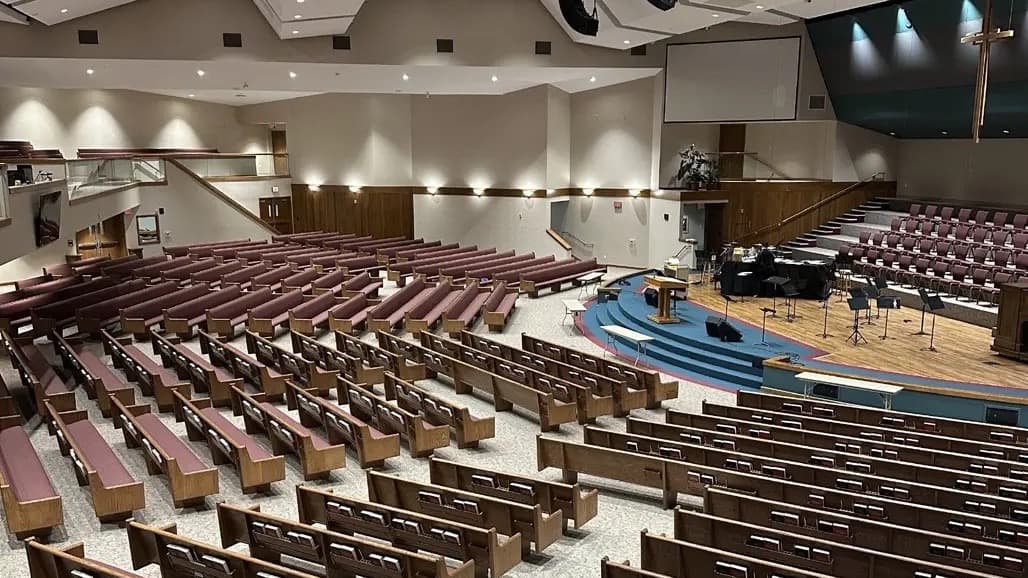
Why Sanctuary Lighting Is a Facilities Management Issue, Not Just an Aesthetics One
Walk into almost any established church in Grand Prairie, Texas, and you'll find a sanctuary built to inspire — soaring ceilings, decorative fixtures, and carefully considered architectural details. What you're less likely to find is a lighting system designed with the facility manager in mind.
For the people responsible for keeping those spaces operational, sanctuary lighting presents a unique and persistent challenge. Incandescent, halogen, and older fluorescent fixtures burn out at inconvenient times, often in fixtures mounted 20, 30, or even 40 feet overhead. Each replacement means scheduling a lift rental, coordinating access around services, and pulling staff away from other priorities. Across the Greater Dallas area — where growing congregations in Grand Prairie, Arlington, Irving, Mansfield, and DeSoto are investing in expanded programming and multi-use spaces — this maintenance burden is a real and recurring cost that rarely appears on anyone's strategic agenda until something fails mid-service.
Understanding why this happens, and what modern lighting practice looks like, is the first step toward a more manageable, mission-supporting facility.
The Anatomy of a Struggling Sanctuary Lighting System
Most sanctuary lighting problems share common roots. Recognizing them helps facility managers make the case for proactive investment rather than reactive repair.
Aging light sources with short service lives. Traditional incandescent and halogen lamps may last only 1,000–2,000 hours under typical use conditions. In a church running multiple services per week, mid-week programming, rehearsals, and community events, those hours accumulate quickly. Quality LED replacements, by contrast, are rated for 50,000 hours or more — a generational difference that fundamentally changes the maintenance calculus.
Ballast failures in fluorescent systems. Many sanctuaries installed fluorescent or metal halide systems during renovations in the 1990s and early 2000s. Those ballasts are now reaching end of life. Ballast failure produces the characteristic flickering and humming that congregants notice immediately — and that creates a poor experience for both in-person worship and increasingly common livestream and video production. Churches across the Dallas-Fort Worth Metroplex have invested heavily in media ministry infrastructure; unreliable lighting undermines that investment directly.
Dimmer compatibility problems. Sanctuary lighting almost always needs to be dimmable — for worship, presentations, and events that require different moods. Legacy dimmers were designed for incandescent loads and frequently perform poorly or fail entirely with LED or fluorescent retrofits. The result is flickering at low levels, audible buzzing, or fixtures that won't dim at all. This is a solvable engineering problem, but it requires attention to compatibility during any upgrade.
Uneven distribution and dark spots. Older fixture layouts were designed around the photometric output of lamps that may no longer be available in the same form. As facilities patch and replace over the years with whatever is available, illumination becomes inconsistent — bright at the altar, dim in the pews, or poorly lit in balconies and side sections. For congregations in Grand Prairie's growing faith communities, this affects not just worship quality but safety and accessibility for older members.
What a Modern Approach to Sanctuary Lighting Looks Like
The shift in commercial and institutional lighting practice over the past decade has been significant, and churches stand to benefit considerably. Here's what best practice looks like for sanctuary lighting management today.
Planned Retrofits Over Emergency Replacements
The most effective sanctuary lighting programs move away from reactive maintenance — replacing lamps one at a time as they fail — toward planned group relamping or wholesale retrofit projects. A group relamping strategy coordinates replacement of all lamps in a fixture type or zone on a scheduled basis, before failures occur. This reduces the frequency of lift rentals, minimizes service disruptions, and often reduces total labor costs despite the higher upfront material investment.
A full LED retrofit goes further: replacing not just the lamp but the fixture, driver, and controls in a single project. For sanctuaries with genuinely aged infrastructure, this is often the more cost-effective long-term choice, particularly when energy savings and utility rebates are factored into the analysis.
Controls That Match How Sanctuaries Actually Function
Modern lighting controls — including scene-based presets, wireless dimming systems, and daylight harvesting — have become far more accessible and affordable than they were even five years ago. For a sanctuary that transitions between Sunday morning worship, Wednesday evening programming, a Saturday wedding, and a Friday night concert, the ability to recall a preset scene with a single button press is a practical operational improvement, not a luxury.
For churches in the Grand Prairie and broader DFW area exploring smart building upgrades, sanctuary lighting controls are often a natural entry point — relatively self-contained, immediately impactful, and demonstrable to leadership and congregation alike.
Addressing the High-Ceiling Access Challenge
Access to elevated fixtures is one of the most consistent barriers to good sanctuary lighting maintenance. Every trip up a scaffold or lift represents real cost and real risk. Two strategies help reduce this burden over time.
First, selecting light sources with genuinely long rated lifespans — and understanding what that means in practice for your specific usage hours — reduces the frequency of required access. Second, some fixture configurations allow for lamp access from below using specialized tools, eliminating the need for overhead access entirely for routine maintenance. These options are worth exploring during any retrofit planning conversation.
Energy Efficiency and Incentive Opportunities in the DFW Market
Churches are often overlooked in conversations about commercial energy efficiency, but they are legitimate commercial electricity customers and frequently qualify for the same utility rebate programs available to businesses and institutions.
In the greater Dallas market, energy efficiency programs through local utilities and third-party administrators have historically offered meaningful incentives for LED retrofits and lighting controls upgrades. These programs can offset a portion of project costs and improve the financial case for upgrades that might otherwise be deferred.
Faith-based organizations that participate in cooperative purchasing programs may also find additional value through those vehicles. Houston Church COOP is specifically designed to support churches and faith-based organizations, offering pre-negotiated contract structures that can simplify procurement and reduce administrative burden. Other programs such as BuyBoard, TIPS, and Sourcewell are available to eligible organizations and can streamline the vendor selection and contracting process.
For facility managers who need to present a project to a finance committee or elder board, the combination of energy savings projections, available incentives, and extended maintenance intervals makes a compelling financial narrative — one grounded in operational reality rather than speculative returns.
For additional context on navigating utility rebates in the Dallas-Fort Worth market, see our related article on Maximizing ROI with Commercial LED Lighting Rebates in Dallas, TX. For a broader look at energy audit tools and incentive navigation, our article on Energy Audits, Incentives, and Rebate Navigation for Businesses provides useful background.
Considerations Unique to Historic and Architecturally Significant Sanctuaries
Grand Prairie and the surrounding communities — including Duncanville, Cedar Hill, and Midlothian to the south, and Grand Prairie's own historic downtown district — are home to congregations with deep roots and buildings that reflect that history. For older sanctuaries with architectural character, lighting upgrades require additional sensitivity.
Historic constraints may limit which fixtures can be modified or replaced. In some cases, the goal is to retrofit the interior components of existing decorative fixtures with modern LED sources while preserving the external appearance. In others, matching the color temperature and rendering quality of new fixtures to the architectural character of the space — warm, flattering light rather than the harsh white associated with early LED generations — is a primary design consideration.
Color Rendering Index (CRI) is a technical specification that matters enormously in worship spaces. High-CRI LED sources render skin tones, wood finishes, stained glass, and fabric colors accurately and naturally. This is not a minor aesthetic detail; it directly affects how congregants experience the space and how the environment appears on camera for media ministry.
Service Availability
While VOSS offers a comprehensive suite of national services, specific capabilities may vary by location. Please contact your local branch to confirm the current availability of specific services, technology solutions, or contracting capabilities in your immediate market.
Talk With a Lighting Specialist About Your Sanctuary
If your facility team is fielding frequent complaints about sanctuary lighting, managing an aging system through repeated emergency repairs, or exploring what a planned upgrade might look like, we'd welcome the conversation. VOSS has supported church facilities across the country with practical, low-disruption lighting solutions built around the real constraints of ministry environments.
Our Dallas branch serves Grand Prairie and the full DFW Metroplex, including communities across Tarrant and Dallas counties.
VOSS Dallas Phone: (972) 432-8367 Toll-Free: (800) 736-8677
We're happy to discuss your facility's current situation, walk through what an assessment would involve, and help you think through the options — on your timeline, at whatever level of detail is useful to you and your leadership team.