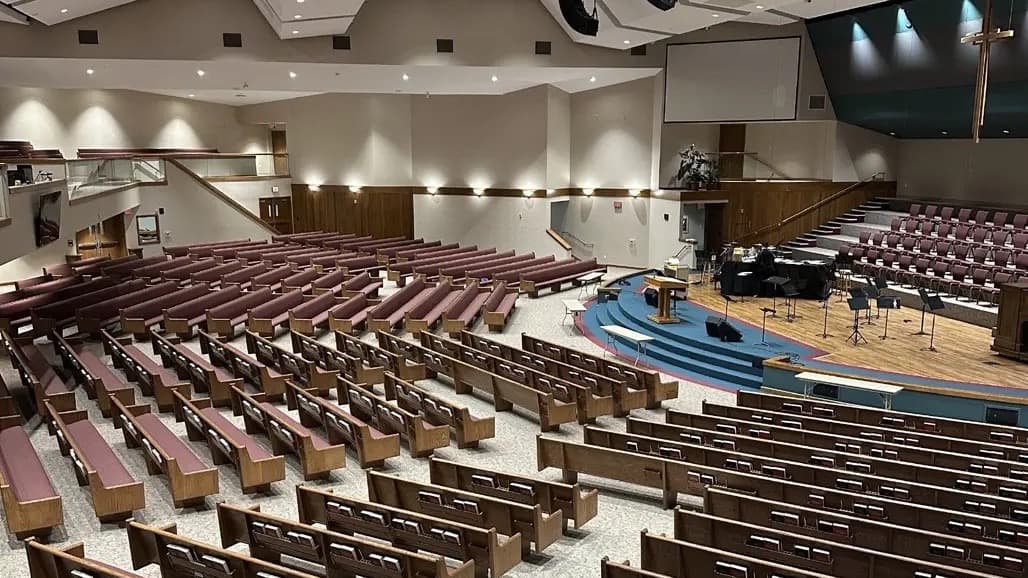
Why Frisco-Area Churches Are Rethinking Their Sanctuary Lighting
Frisco, Texas has grown into one of the fastest-expanding cities in the United States — and its faith communities have grown right along with it. With a population approaching 210,000 and new residential neighborhoods continuing to take shape from the Preston Road corridor to the PGA District, Frisco's churches are serving larger, more diverse congregations than ever before. Many sanctuaries that were built or renovated a decade or two ago are now operating well beyond their original lighting design capacity.
The result is a familiar set of challenges for facility managers: aging fluorescent or halogen fixtures in high ceilings that burn out faster than they should, dimmer systems that flicker or fail to perform consistently, and energy bills that reflect technology that has long since been surpassed. Across the greater Dallas metro — from Frisco and Allen to McKinney and Prosper — church operations leaders are beginning to recognize that sanctuary lighting is not just a maintenance issue. It's a ministry infrastructure issue.
This article explores what's driving that shift, what modern lighting solutions look like for church environments, and how facility managers can approach an upgrade strategically and cost-effectively.
The Hidden Cost of Deferred Sanctuary Lighting Maintenance
For many church facility managers, lighting maintenance feels like an ongoing, low-priority nuisance rather than a strategic concern. A bulb burns out in a 30-foot ceiling. A work order is submitted. A lift is rented. A volunteer or contractor climbs up and replaces it. Two months later, it happens again.
When you add up the cumulative cost of that cycle — lift rentals, contractor labor, lost staff time, and the fixtures themselves — the numbers become surprisingly significant. And that's before accounting for the energy consumption of outdated lamp technology.
Key operational challenges common in Frisco-area church sanctuaries include:
- High-ceiling access demands — Many sanctuaries in the North Dallas suburbs feature soaring architectural spaces that require lifts or scaffolding for even routine bulb replacement, making every maintenance event a logistical event
- Aging ballast and dimmer incompatibility — Fluorescent and incandescent-era dimming systems frequently conflict with newer lamp types, causing flickering, buzzing, and inconsistent performance across a service
- Uneven illumination — Congregants seated at the sides of a wide sanctuary, or cameras positioned for livestream capture, are especially sensitive to hot spots and dark zones that older fixture layouts tend to create
- Rising energy overhead — With Texas energy markets subject to seasonal rate volatility, churches operating older lighting technology during extended weekend and midweek programming are carrying avoidable utility costs
These are not problems unique to older buildings. Even sanctuaries built in the 2000s and early 2010s were designed around lamp technology that has since been fundamentally transformed by LED advancement.
What Modern Sanctuary Lighting Actually Looks Like
The LED revolution in commercial and institutional lighting is not new — but its application in worship environments has matured considerably in recent years. Today's LED solutions for church sanctuaries go well beyond simple bulb swaps. They represent a rethinking of how light functions within a worship space.
Tunable white lighting allows facility managers or technical directors to shift the color temperature of sanctuary lighting based on the moment — warmer tones for traditional or contemplative services, cooler tones for contemporary worship or high-production events. This is particularly valuable for churches in Frisco's diverse faith landscape, where a single campus may host multiple service styles across a weekend.
Improved dimming performance is one of the most immediate upgrades that facility managers notice. Modern LED dimming systems operate smoothly and silently across a full range, eliminating the buzzing, flickering, and minimum-threshold drop-offs that plague older analog dimmer infrastructure.
Dramatically extended lamp life is the operational benefit that facility managers tend to care about most. Quality LED fixtures in sanctuary applications can deliver 50,000 hours or more of rated life — meaning a fixture installed today could realistically outlast the next decade of ministry without a single relamping event. For high-ceiling applications in Prosper, Little Elm, or The Colony where lift access is required, that represents a genuine operational transformation.
Livestream and video production compatibility has become a meaningful consideration for North Texas churches. Many congregations in the Frisco area have invested significantly in broadcast infrastructure, and sanctuary lighting that introduces flicker artifacts, color inconsistency, or insufficient foot-candle levels directly undermines that investment. Modern LED systems designed for worship environments are engineered with camera performance in mind.
Planning a Sanctuary Lighting Upgrade: What Facility Managers Should Know
A sanctuary lighting project is meaningfully different from a standard commercial lighting retrofit, and approaching it with that awareness leads to better outcomes. Several factors deserve particular attention during the planning phase.
Schedule and disruption planning is paramount. Unlike a warehouse or office building, a church sanctuary may be in active use for programming six or seven days a week — Sunday services, midweek gatherings, rehearsals, recordings, events, and community use. A well-managed retrofit breaks work into phases that preserve usability, with the heaviest access work scheduled around the congregation's programming calendar rather than the contractor's convenience.
Historic and architectural considerations apply to some North Texas church campuses, particularly older established congregations in communities like McKinney or Frisco's original downtown area. Even for newer sanctuaries, the architectural intent of the lighting design — how fixtures interact with ceiling features, chandeliers, or decorative elements — should be preserved through the retrofit, not overridden by it.
Control system integration deserves early attention. A lighting upgrade is an opportunity to modernize the control experience alongside the fixtures themselves. Churches that invest in intuitive scene-based control systems find that volunteer AV teams and weekend operators can manage complex lighting environments with far less training — a meaningful benefit in ministry settings where staff and volunteer turnover is a reality.
Utility incentives and rebates are available in many Texas markets and can meaningfully offset project costs. VOSS has deep experience navigating utility rebate programs and helping church facility managers understand what incentives may apply to their project. For eligible organizations, cooperative purchasing programs — including Houston Church COOP, BuyBoard, TIPS, Sourcewell, and others — can provide an established procurement pathway that simplifies the contracting process and may reduce administrative burden for qualifying institutions.
The Broader Lighting Ecosystem: Connecting Sanctuary to Campus
Sanctuary lighting doesn't exist in isolation. For Frisco-area church campuses managing multiple buildings — fellowship halls, education wings, children's spaces, parking lots, and exterior signage — a sanctuary upgrade is often the moment to evaluate the broader lighting infrastructure holistically.
Our "Energy Efficient Church Lighting Upgrades" resource explores the full-campus perspective in detail, including how energy audits can identify the highest-impact opportunities across an entire property. The "Energy Audits, Incentives, and Rebate Navigation for Businesses" article in this series also provides valuable context for facility managers looking to build a financial case for a comprehensive upgrade. And for campuses managing exterior spaces, "Parking Lot and Outdoor LED Lighting Upgrades" covers the considerations specific to grounds and perimeter lighting.
A coordinated approach — beginning with the sanctuary and extending across the campus — typically delivers better long-term outcomes than addressing each space reactively as problems arise.
VOSS and the North Texas Church Community
VOSS has served commercial and institutional facilities across the greater Dallas area for decades, with a local branch team that understands the unique demands of North Texas's faith community. From Frisco and Celina in the north to Plano, Richardson, and Garland to the south, our team brings both national resources and genuine local knowledge to every project.
We approach church sanctuary work as a partnership. That means listening to how a congregation uses its space before recommending a solution, designing around ministry programming rather than construction convenience, and ensuring that the facility manager's team has what they need to operate the new system confidently after we're done.
Service Availability
While VOSS offers a comprehensive suite of national services, specific capabilities may vary by location. Please contact your local branch to confirm the current availability of specific services, technology solutions, or contracting capabilities in your immediate market.
Talk With Our Dallas Team
If your sanctuary is showing signs of aging lighting infrastructure — or if you're simply ready to understand what a modern upgrade could look like for your campus — we'd welcome the conversation. Our Dallas branch serves Frisco and communities throughout the greater North Texas region.
VOSS Dallas Branch Phone: (972) 432-8367 Toll-Free: (800) 736-8677
Reach out to schedule a consultation. We'll help you assess what your space needs, explore available incentives, and build an approach that fits your ministry's calendar and your facility's budget.