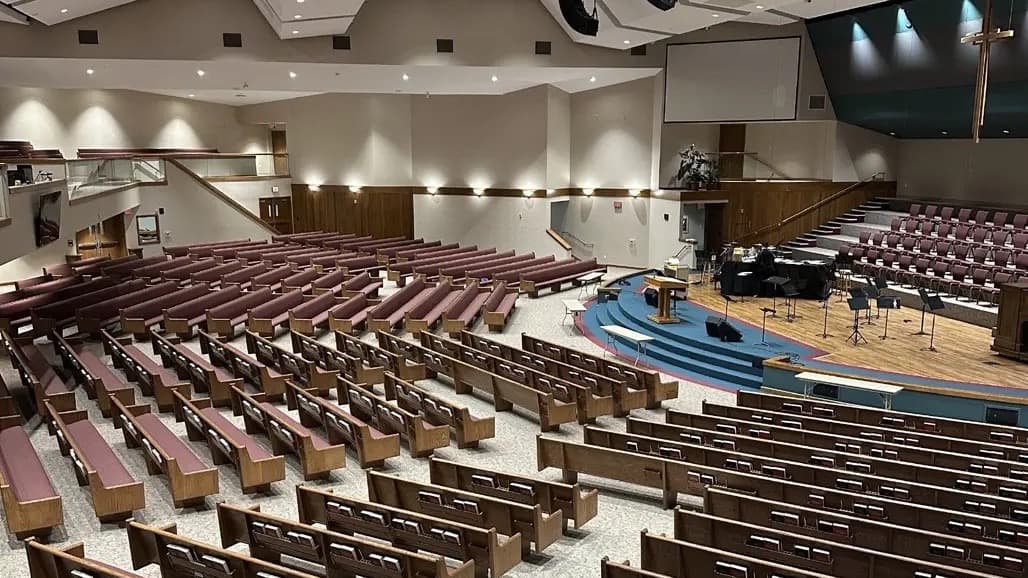
The Hidden Cost of Aging Sanctuary Lighting in Fort Worth
Fort Worth is home to one of the most vibrant and historically rooted faith communities in Texas. From the grand sanctuaries of the Near Southside and Fairmount neighborhoods to the sprawling megachurch campuses along I-35W and out toward Burleson and Crowley, houses of worship in this region span an extraordinary range of architectural styles, building ages, and congregation sizes. What many of these facilities share, however, is a common and growing challenge: aging lighting systems that are increasingly difficult and expensive to maintain.
For facility managers and maintenance supervisors overseeing church properties in Fort Worth, Haltom City, Keller, Mansfield, Benbrook, or Arlington, the problems are familiar. Incandescent, halogen, and older fluorescent fixtures installed decades ago are burning out at accelerating rates — often in fixtures mounted 30, 40, or even 60 feet overhead. Each replacement means scheduling a lift rental, coordinating volunteers or contractors, and pulling staff away from other priorities. Multiply that across a year, and the cumulative labor, equipment, and material costs become a serious budget concern.
This isn't a minor inconvenience. It's a systemic operational challenge — and one that the broader church facility management community across the Dallas–Fort Worth Metroplex is actively working to solve through thoughtful, long-term lighting upgrades.
Why Sanctuary Lighting Is Uniquely Complex
Church sanctuaries are not typical commercial spaces. They present a specific set of lighting design and maintenance challenges that general electrical contractors often underestimate — and that facility managers know all too well.
Architectural and access challenges are often the first hurdle. Historic sanctuaries, vaulted ceilings, decorative trusses, and custom chandeliers create access difficulties that require specialized lift equipment and careful coordination to avoid damaging irreplaceable architectural features. Many Fort Worth congregations occupy buildings that are 50 to 100 years old, where original wiring infrastructure adds another layer of complexity to any upgrade.
Performance expectations are high and multifaceted. Modern sanctuaries serve as worship spaces, livestream studios, event venues, and community gathering halls — sometimes all in the same week. Lighting must perform beautifully for a Sunday morning service, a Wednesday evening choir rehearsal, a wedding on Saturday afternoon, and a livestreamed sermon viewed by thousands online. Poor color rendering, uneven illumination, or visible flicker that reads badly on camera are not acceptable outcomes.
Aging components create cascading failures. Older ballasts in fluorescent fixtures don't just reduce light output — they can cause flickering, humming, and premature lamp failure. Incompatible dimmers introduce additional problems. As these systems age together, facility managers find themselves in a cycle of reactive maintenance rather than planned, predictable operations.
How LED Upgrades Are Transforming Church Facilities Across the Metroplex
The good news for church facility managers across Fort Worth and the greater DFW area is that LED technology has matured to a point where it addresses virtually every traditional sanctuary lighting challenge — and does so in ways that are both affordable and low-disruption.
Extended lamp life dramatically reduces maintenance cycles. Quality LED fixtures designed for high-bay and specialty church applications are rated for 50,000 hours or more of operation — compared to 1,000–2,000 hours for incandescent bulbs and 10,000–15,000 hours for fluorescent lamps. For a sanctuary where fixtures are used 20 hours per week, that translates to decades of service life rather than annual or semi-annual replacements.
Light quality improves in ways congregations immediately notice. Modern LED fixtures offer excellent color rendering (CRI 90+), consistent color temperature, and smooth dimming capability — all of which matter enormously in a worship environment. Skin tones look natural. Choir robes and altar elements look vibrant. Livestream and video production quality improves without additional camera or production equipment investment.
Energy savings are substantial and ongoing. LED fixtures typically consume 50–70% less energy than the incandescent or halogen fixtures they replace, and 30–50% less than older fluorescent systems. For a large sanctuary running services multiple days per week and hosting community events throughout the year, this reduction in kilowatt-hour consumption translates to meaningful savings on monthly utility bills — every month, indefinitely.
Smart lighting controls unlock additional efficiency and convenience. Programmable scene controls, occupancy sensors, and daylight harvesting systems allow facility staff to manage lighting across the entire campus from a single interface. Sanctuary presets can be saved for specific service types — worship, rehearsal, event setup, livestream — eliminating the need to manually adjust fixtures before each use. This kind of operational simplicity is particularly valuable for smaller church staffs managing large, complex facilities.
Navigating a Lighting Upgrade: What Fort Worth Church Facilities Should Know
Understanding the opportunity is one thing. Executing a successful upgrade is another — and for church facility managers in Fort Worth, Weatherford, Euless, or Grand Prairie, the implementation process raises practical questions that deserve honest answers.
Timing and disruption matter enormously. A well-managed lighting upgrade should work around your congregation's schedule, not disrupt it. For most sanctuaries, this means phased work during weekdays, careful coordination around major services and holidays, and clear communication between the electrical contractor and facility staff at every stage. Experienced contractors who regularly work in active church facilities understand this rhythm — and build it into their project planning from the start.
Retrofit vs. full replacement is a key decision. Not every sanctuary requires new fixtures from the ground up. In many cases, LED retrofit kits can be installed directly into existing housings, preserving the visual character of original fixtures while delivering modern performance and efficiency. This approach is often faster, less expensive, and less disruptive — and it's particularly well-suited to historically significant or architecturally distinctive sanctuaries where replacing original chandeliers or decorative fixtures would be undesirable.
Rebates and incentive programs can offset upgrade costs. Texas utility providers and energy efficiency programs have historically offered rebates for commercial LED lighting upgrades, and churches that qualify as commercial accounts may be eligible. Additionally, eligible faith communities and nonprofit organizations should be aware that cooperative purchasing programs — including Houston Church COOP, BuyBoard, TIPS, Sourcewell, and Omnia Partners — can provide access to pre-negotiated pricing on lighting equipment and installation services, simplifying the procurement process and potentially reducing overall project costs.
Choosing the right contractor is critical. Sanctuary lighting is not a commodity installation. The contractor you select should have demonstrated experience working in active worship facilities, an understanding of the unique performance requirements of sanctuary environments, and the capability to manage complex projects involving high-ceiling access, historic constraints, and multi-use scheduling demands.
VOSS and the Fort Worth Faith Community
VOSS has been serving commercial, institutional, and faith-based facilities across the United States for more than 85 years. Our Dallas-area team brings deep regional familiarity to every project — understanding the specific demands of DFW's built environment, the pace of growth reshaping communities from Fort Worth's Near Northside to new developments in Azle and Aledo, and the practical constraints that church facility managers navigate every day.
We approach sanctuary lighting projects as partners, not vendors. That means starting with a thorough assessment of your current system — identifying what's failing, what's salvageable, and where the highest-value opportunities lie — before recommending a path forward. It means designing solutions that fit your budget timeline and congregation schedule, not ours. And it means standing behind our work long after installation is complete.
For church facility managers across Fort Worth, Haltom City, North Richland Hills, White Settlement, Kennedale, or anywhere in Tarrant County, we're ready to have a practical, no-pressure conversation about what a lighting upgrade could mean for your facility.
Related Topics in Lighting Trends and Technology
If you're exploring lighting improvements beyond the sanctuary, VOSS has published additional thought leadership on related topics that may be relevant to your facility planning. Our article on Energy Efficient Church Lighting Upgrades provides a broader look at whole-campus energy strategies for faith communities. Our coverage of Fluorescent Tube Bans and LED Lighting Rebates is essential reading for any facility still operating legacy fluorescent systems. And our guides on Energy Audits, Incentives, and Rebate Navigation for Businesses and Maximize ROI with Commercial LED Lighting Rebates in Dallas, TX offer practical frameworks for understanding the financial case for upgrading.
Service Availability
While VOSS offers a comprehensive suite of national services, specific capabilities may vary by location. Please contact your local branch to confirm the current availability of specific services, technology solutions, or contracting capabilities in your immediate market.
Talk to Our Dallas-Area Team
If your Fort Worth sanctuary is dealing with frequent bulb failures, rising energy bills, uneven illumination, or the operational burden of high-ceiling maintenance, we'd welcome the opportunity to discuss what a thoughtful, well-managed LED upgrade could look like for your facility.
Reach our Dallas branch team at (972) 432-8367, or toll-free at (800) 736-8677. We serve faith communities throughout Fort Worth, Tarrant County, and the greater Dallas–Fort Worth Metroplex.