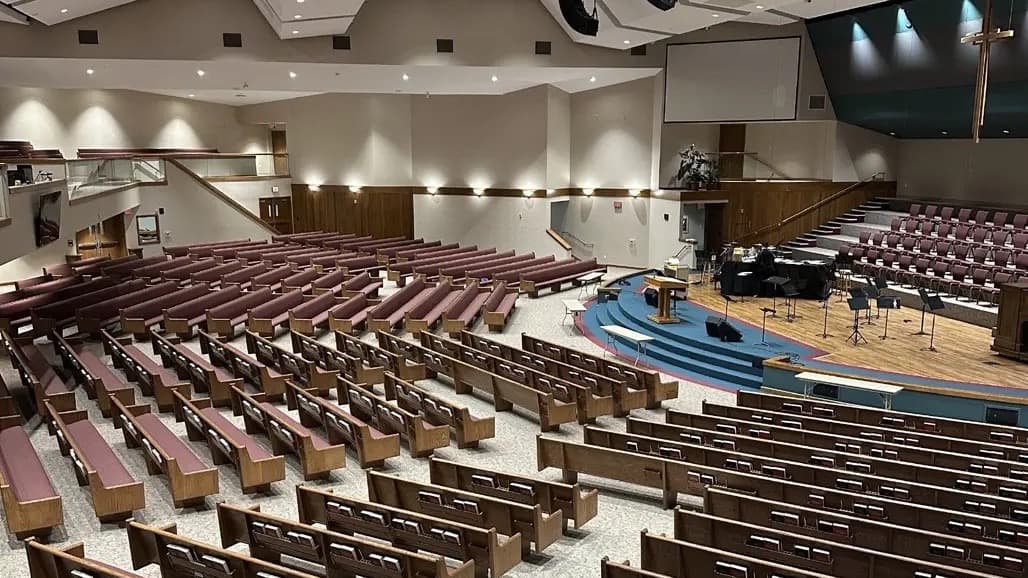
Why Arlington Churches Are Rethinking Their Sanctuary Lighting
Arlington, Texas is home to a remarkably diverse and active faith community. As one of the largest cities in the Dallas–Fort Worth Metroplex — with nearly 400,000 residents spread across neighborhoods from Pantego and Dalworthington Gardens to the areas surrounding UT Arlington — the city supports hundreds of congregations of every size and denomination. Many of those facilities were built or last renovated decades ago, and their lighting systems reflect that age.
For facility managers and operations leaders at churches across the Mid-Cities corridor, the challenge isn't philosophical — it's practical. Incandescent, halogen, and aging fluorescent systems that once seemed adequate are now creating persistent headaches: burned-out bulbs in 30-foot ceilings, flickering lights during Sunday services, uneven illumination that affects both in-person worship and the growing demand for livestream-quality video. These are the day-to-day realities that consume maintenance budgets and staff time in ways that quietly compound over years.
Understanding the landscape of available solutions — and what best practices actually look like in a facility like yours — is the first step toward making a durable, cost-effective decision.
The Real Cost of Reactive Maintenance in High-Ceiling Sanctuaries
One of the most consistent pain points in church facilities across the Arlington and broader DFW area is the sheer difficulty of accessing elevated fixtures. Sanctuaries with vaulted ceilings, decorative trusses, or chandeliers aren't designed for frequent maintenance. Every bulb replacement requires scheduling a lift, securing a contractor, and — critically — coordinating around a packed programming calendar that may include multiple weekly services, weddings, funerals, special events, and community gatherings.
When lighting systems demand repeated attention, the indirect costs add up fast:
- Labor and equipment costs for each lift rental or contractor visit
- Service disruptions when maintenance can't be scheduled around programming
- Inconsistent light quality between replacement cycles as bulbs age at different rates
- Safety risks from inadequate illumination in aisles, steps, and gathering areas
The broader trend in commercial and institutional facility management is a clear shift from reactive to proactive lighting strategies. Rather than replacing components as they fail, forward-thinking facilities are moving toward LED systems with rated lifespans of 50,000 hours or more — dramatically reducing the frequency of access-dependent maintenance. In a high-ceiling sanctuary environment, that difference in service intervals isn't just a convenience; it fundamentally changes how a facilities team operates.
This is a conversation happening across the DFW region — from large multi-campus churches in Fort Worth and Grand Prairie to smaller congregations in Mansfield, Kennedale, and Euless — and the conclusions are remarkably consistent: the labor cost savings alone often justify the transition to LED, independent of energy savings.
LED Technology and Sanctuary-Specific Considerations
Not all LED upgrades are created equal, and sanctuary lighting presents design challenges that generic commercial solutions don't always address well. Worship spaces are intentionally designed to create atmosphere — the quality, color temperature, and directionality of light matter in ways that a warehouse or office building simply don't require.
Several key considerations apply specifically to sanctuary environments:
- Color rendering index (CRI): Sanctuaries often feature rich architectural detail, stained glass, woodwork, and fabric — all of which look dramatically different under low-CRI versus high-CRI light sources. Modern LED systems with CRI ratings of 90 or above render these elements accurately and warmly, enhancing the visual experience rather than flattening it.
- Dimming compatibility: Many older sanctuaries are wired with legacy dimmer systems that are incompatible with standard LED drivers, causing flicker or limited dimming range. A quality retrofit addresses this at the system level — not just the fixture level — ensuring smooth, full-range dimming that serves both intimate services and large events.
- Historic and aesthetic constraints: Arlington and the surrounding DFW area have numerous historic or architecturally significant church buildings where preserving visual character is a priority. Retrofit solutions that modernize the light source without altering the appearance of fixtures are increasingly sophisticated and widely available.
- Livestream and video lighting: As more congregations in the Arlington area expand their digital outreach — broadcasting services online and producing media content — lighting systems must meet a higher technical bar. Consistent, flicker-free illumination with appropriate color temperature is essential for professional-quality video, and it's an often-overlooked dimension of a sanctuary lighting upgrade.
The shift in the industry over the past several years has been toward integrated systems thinking: rather than replacing bulbs, facilities are redesigning the full lighting ecosystem — fixtures, controls, dimming infrastructure, and zoning — in a single planned upgrade that eliminates recurring reactive costs for a decade or more.
Controls, Automation, and the Smarter Church Facility
One of the most significant developments in commercial lighting over the past decade has been the accessibility of smart controls technology to organizations that previously couldn't justify the investment. For churches — which often operate on constrained budgets but run complex, multi-use facilities — this represents a meaningful opportunity.
Modern lighting control systems allow facility managers to:
- Create and recall scene presets for different service types — Sunday morning worship, intimate evening services, weddings, rehearsals, and community events — with a single button or tablet interface
- Schedule automated on/off and dimming sequences that eliminate the energy waste of lights left on in unoccupied spaces
- Monitor system performance remotely, receiving alerts when a fixture underperforms before it becomes a visible problem
- Integrate with audiovisual and building management systems for a more unified facility operations approach
For a church facility manager juggling a facility that may be in use six or seven days a week across multiple programs, the operational simplification that smart controls deliver is significant. It reduces the training burden on volunteer staff, minimizes human error in lighting transitions during services, and creates a more consistent, professional worship environment.
This trend is particularly relevant for larger congregations in the DFW metro — including those with multi-building campuses across communities like Arlington, Irving, Bedford, and Hurst — where lighting consistency across spaces and buildings is a genuine operational challenge.
Energy Efficiency, Rebates, and Financial Planning for Church Leadership
Church leadership — whether that's a business administrator, elder board, or executive pastor overseeing facilities — increasingly approaches capital investments with the same financial discipline as any nonprofit or small institution. Understanding the return on investment for a lighting upgrade is essential to building a compelling internal case for approval.
The good news is that the financial picture for LED upgrades in Texas churches is genuinely favorable. The DFW region's utility providers have historically offered rebate programs for commercial and institutional LED retrofits, which can meaningfully offset project costs. While specific program terms change over time and vary by provider, the principle of rebate-informed project planning is well-established and should be part of any upgrade conversation.
For faith communities with affiliated schools, daycare facilities, or community outreach centers — a common configuration for larger Arlington-area congregations — those ancillary spaces may qualify independently for commercial efficiency programs, further expanding the financial opportunity.
Facilities leaders interested in a deeper look at rebate programs, energy audits, and incentive navigation may find related insight in our Energy Audits, Incentives, and Rebate Navigation for Businesses and Maximize ROI with Commercial LED Lighting Rebates in Dallas, TX articles, both available in the Latest Lighting section. These resources outline how the rebate landscape works and what documentation is typically required to maximize available incentives.
It's also worth noting that for churches affiliated with cooperative purchasing networks, certain procurement programs may offer pre-negotiated pricing on lighting products and related services. The Houston Church COOP is one program specifically structured for faith-based organizations, and programs such as TIPS, BuyBoard, and Sourcewell are available to eligible institutions. These pathways can simplify procurement and provide cost transparency — worth exploring with your local lighting partner.
Service Availability
While VOSS offers a comprehensive suite of national services, specific capabilities may vary by location. Please contact your local branch to confirm the current availability of specific services, technology solutions, or contracting capabilities in your immediate market.
Talk to a Lighting Specialist Who Knows the DFW Market
VOSS has served commercial, institutional, and faith-based facilities across the Dallas–Fort Worth region for decades, with deep familiarity in the unique demands of Texas church buildings — from historic sanctuaries in established neighborhoods to purpose-built modern campuses on the region's growing edges.
If your congregation in Arlington, or a neighboring community like Grand Prairie, Mansfield, Burleson, or Midlothian, is navigating questions about sanctuary lighting maintenance, an LED retrofit, or controls modernization, we're glad to have a practical, no-pressure conversation about what the options actually look like for your facility.
Our Dallas branch serves the greater Arlington and Mid-Cities area directly.
VOSS — Dallas Branch Phone: (972) 432-8367 Toll-Free: (800) 736-8677
Reach out to schedule a facility consultation. We'll help you understand what's driving your current lighting challenges and what a realistic upgrade path looks like — so your leadership team can make a well-informed decision on their own timeline.