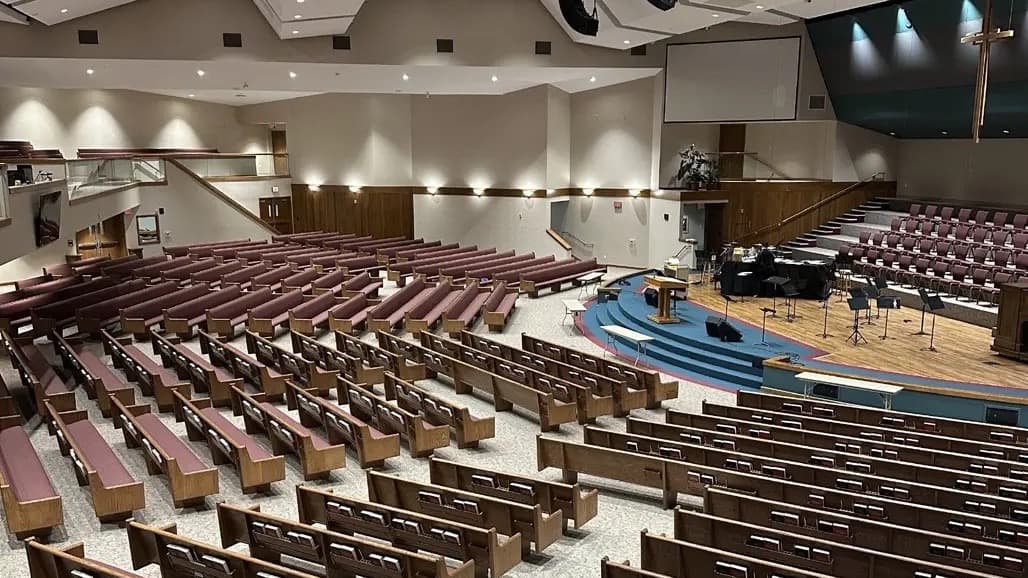
Why Charlotte-Area Churches Are Rethinking Their Sanctuary Lighting
Greater Charlotte is one of the fastest-growing metro areas in the Southeast, and its faith communities are growing with it. From established congregations in Uptown Charlotte and Myers Park to newer and expanding worship centers in Huntersville, Concord, Gastonia, Mooresville, and Indian Trail, churches across Mecklenburg, Union, Cabarrus, and Gaston counties are investing in their facilities to meet the demands of growing memberships, expanded programming, and modern worship formats.
Sanctuary lighting often sits at the center of that investment conversation — and for good reason. The quality of light in a worship space shapes how a congregation experiences everything from a Sunday morning sermon to a Christmas Eve candlelight service. Yet for many facility managers and church administrators, sanctuary lighting is also one of the most persistent and costly maintenance headaches they face.
Understanding the trends driving lighting upgrades in faith communities — and what best practices look like today — can help church leaders in the Charlotte region make smarter, more informed decisions about their facilities.
The Real Cost of Deferred Sanctuary Lighting Maintenance
Older sanctuary lighting systems — built around incandescent, halogen, or fluorescent technology — were designed for a different era of church operations. Today, they create a compounding set of challenges that go well beyond a burned-out bulb.
High-ceiling access is expensive and disruptive. Many Charlotte-area sanctuaries feature vaulted ceilings, clerestory windows, or dramatic architectural spaces that make routine bulb replacements a significant undertaking. Renting a lift or scaffolding, coordinating around worship schedules, and managing volunteer or contractor labor can make what should be routine maintenance into a multi-day, budget-straining event. When traditional lamps need replacement several times per year, those costs add up quickly.
Aging ballasts and dimmers create reliability problems. Flickering lights, delayed warm-up times, and incompatible dimmer controls are common symptoms of aging fluorescent systems. Ballast failures are often unpredictable, meaning a sanctuary can go partially dark with little warning — not an acceptable risk for a congregation that may have multiple services per weekend or mid-week events.
Light quality affects more than aesthetics. Uneven illumination, poor color rendering, and inconsistent brightness levels have practical consequences: safety concerns for congregants navigating pews, reduced visibility for musicians reading sheet music, and increasingly, inadequate light for livestreaming and video production. As more Charlotte-area churches invest in broadcast-quality media ministries, sanctuary lighting systems designed in the 1980s or 1990s simply cannot keep pace.
Energy costs are a growing budget pressure. Duke Energy Carolinas serves the majority of Greater Charlotte's faith communities, and commercial electricity rates make inefficient older fixtures a genuine line-item concern for church administrators managing tight operational budgets.
What Modern LED Sanctuary Lighting Actually Delivers
LED technology has matured significantly in recent years, and its application in worship environments has become increasingly sophisticated. This isn't simply about swapping out bulbs — it's about rethinking how a sanctuary is lit and managed.
Extended lamp life dramatically reduces maintenance cycles. Quality LED fixtures rated for 50,000 hours or more can operate for decades before requiring replacement under normal church use. For a sanctuary with 30-foot ceilings, that translates directly into fewer lift rentals, fewer disruptions to the worship calendar, and a smaller ongoing maintenance burden for facility staff.
Tunable and dimmable systems create flexible worship environments. Modern LED controls allow sanctuary lighting to be adjusted for different service types — full brightness for Sunday morning worship, warmer tones for a candlelit Christmas service, dramatic effects for youth events or theatrical productions. These scenes can be programmed, saved, and recalled with simple presets, reducing the technical knowledge required from volunteer or part-time facility staff.
Color rendering matters more than people realize. High-CRI (Color Rendering Index) LED fixtures reproduce the warm, natural tones that make sanctuary environments feel welcoming and dignified. Skin tones look more natural under high-CRI light — a detail that matters significantly for video and livestream ministries.
Retrofits can often preserve historic character. Many Charlotte-area congregations occupy buildings with significant architectural or historic value — ornate chandeliers, stained glass, and custom millwork that define the character of the space. Thoughtful LED retrofits can update the light source while preserving the fixture aesthetics that congregations value. In cases where full replacement isn't appropriate or budget-feasible, lamp and ballast retrofits within existing fixtures are a practical intermediate step.
Duke Energy Carolinas Rebates: A Meaningful Offset for Church Facility Budgets
One of the most important — and frequently underutilized — resources available to Greater Charlotte faith communities is the Duke Energy Carolinas Smart $aver Program. This commercial and institutional rebate program provides financial incentives for qualifying lighting upgrades, including LED fixture replacements and lighting control installations.
For church facility managers and administrators working within constrained operational budgets, rebate dollars can meaningfully reduce the net cost of a sanctuary lighting upgrade. The federal IRA Section 179D commercial building energy efficiency tax deduction may also offer additional financial benefit for eligible organizations — an area where it pays to consult both a lighting professional and a tax advisor.
Navigating rebate applications, documentation requirements, and utility program rules adds complexity to what might otherwise seem like a straightforward project. Working with an experienced lighting partner who understands the Duke Energy Carolinas rebate landscape — and has managed similar processes for commercial and institutional clients across the region — can make the difference between capturing available incentives and leaving money on the table.
For faith communities that qualify as nonprofit or religious organizations, understanding which programs apply and how to structure a project to maximize incentive capture is a valuable part of the planning conversation.
Procurement Options for Eligible Faith Organizations
Some faith communities — particularly those affiliated with larger denominational networks, schools, or community development organizations — may have access to cooperative purchasing programs that streamline the vendor selection process and provide access to publicly awarded contract pricing. Programs such as Houston Church COOP, Sourcewell, Omnia Partners, TIPS, and BuyBoard offer pre-negotiated contracts that can simplify procurement for eligible organizations.
These programs are worth exploring early in the planning process, as they can reduce administrative burden, satisfy governance requirements, and provide confidence that pricing reflects competitive market standards.
Lessons from the Field: What Lighting Upgrades Deliver in Practice
While every facility is different, real-world projects illustrate what thoughtful lighting upgrades can achieve. At Corewell Health in Dearborn, Michigan — a healthcare environment with similarly high expectations for light quality, reliability, and minimal disruption — a transition from aging fluorescent fixtures to uniform linear LED lighting eliminated the ongoing maintenance burden of failing ballasts and deteriorating lenses, while meaningfully improving the quality and ambiance of the space. Facilities Supervisor Luke Sandzik noted afterward: "Everything looked really good. Thank you for your hard work in getting this completed."
The parallel to church sanctuary environments is instructive: in both cases, the aesthetic and experiential quality of the space matters deeply to the people who use it, and the transition to LED delivers both practical maintenance relief and a noticeably improved environment.
Planning a Sanctuary Lighting Project: Key Considerations for Facility Managers
For church facility managers and administrators in the Charlotte area beginning to evaluate a lighting upgrade, a few guiding questions are worth working through before engaging a contractor:
- What are the primary pain points driving the project? Maintenance frequency, energy costs, light quality, and worship experience are all valid and distinct drivers — and they may point toward different solutions or sequencing.
- What is the worship schedule, and how much disruption can the facility absorb? Staging work around Sunday services, weekday programming, and seasonal events like Easter and Christmas requires careful scheduling. Experienced contractors plan installations to minimize downtime and avoid high-visibility disruptions.
- What does the congregation value about the current space? Understanding which lighting elements — chandeliers, sconces, colored glass effects, warm tones — are central to the sanctuary's character helps ensure a retrofit plan that respects the space's identity.
- What is the realistic budget, and what incentives are available? A complete picture of net project cost — after rebates and applicable tax benefits — often looks quite different from the gross equipment and installation cost.
- Is the congregation planning other facility investments? Sanctuary lighting upgrades are often most cost-effective when coordinated with other electrical, A/V, or building systems work already planned.
Service Availability
While VOSS offers a comprehensive suite of national services, specific capabilities may vary by location. Please contact your local branch to confirm the current availability of specific services, technology solutions, or contracting capabilities in your immediate market.
VOSS serves the Greater Charlotte region — including Mecklenburg, Union, Cabarrus, Gaston, Iredell, and Rowan counties — through our Raleigh branch. Our team works with congregations of all sizes and denominations across Charlotte, Concord, Gastonia, Mooresville, Kannapolis, Monroe, Huntersville, Cornelius, Matthews, and surrounding communities.
VOSS Lighting — Raleigh Branch Phone: (919) 779-8777 Toll-Free: (866) 292-0529
Let's Talk About Your Sanctuary
If your congregation is navigating aging fixtures, rising maintenance costs, or a desire to improve the worship environment in your Charlotte-area sanctuary, we'd welcome the opportunity to have a consultative conversation. There's no obligation — just a chance to share what we're seeing across the region, walk through what a project might look like for your specific facility, and help you understand what incentives and options may be available.
Reach out to our Raleigh team to schedule a facility consultation. We're here to help you make informed decisions — on your timeline and within your budget.