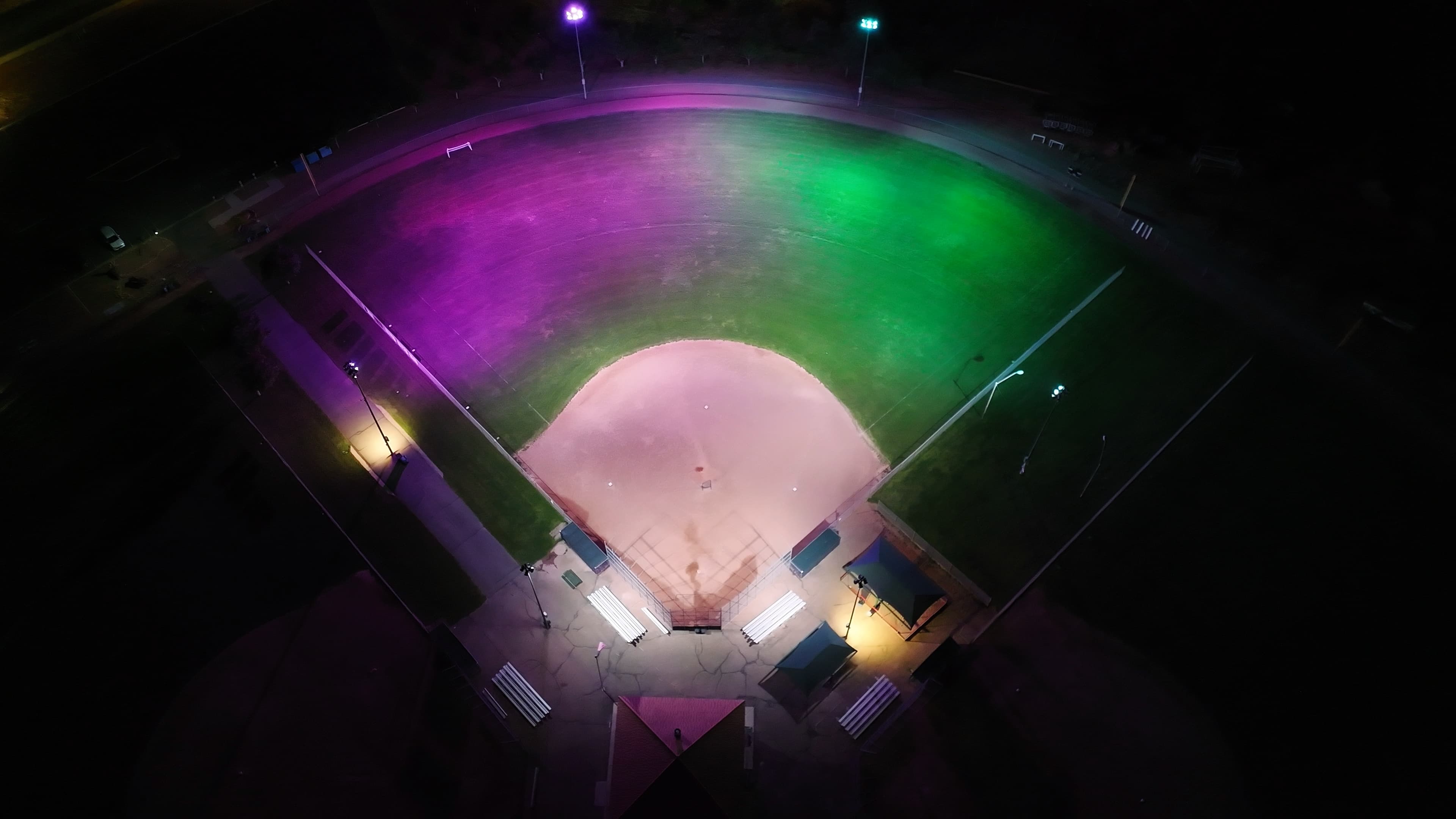
Why Charlotte's Growing Sports Community Demands Better Field Lighting
Greater Charlotte is one of the fastest-growing metro areas in the Southeast — and that growth isn't limited to the skyline. Across Mecklenburg County and into surrounding communities like Concord, Kannapolis, Gastonia, Matthews, and Huntersville, demand for quality recreational and competitive athletic infrastructure has surged alongside the region's population. Charlotte now serves nearly 925,000 residents, and that number continues to climb as corporate relocations and new residential development bring families — and their youth sports leagues — into the market.
Baseball and softball fields sit at the heart of that community investment. From Little League parks in neighborhoods like Ballantyne and Steele Creek to high school and collegiate-level facilities in the University City corridor, field operators across the Queen City are reckoning with an aging generation of metal halide and high-pressure sodium lighting systems. These legacy systems are expensive to run, difficult to maintain, and increasingly out of step with the performance standards that today's players, coaches, and fans expect. The question most facility managers and parks directors are now asking isn't whether to upgrade — it's how to do it right.
What Makes Baseball and Softball Lighting Uniquely Challenging
Not all sports lighting is created equal. Baseball and softball present some of the most technically demanding lighting environments in athletics, and understanding those demands is the first step toward a successful project.
The geometry of the game creates real engineering complexity. Unlike a rectangular soccer field or basketball court, a baseball diamond radiates outward in an asymmetric fan shape. The infield, basepaths, outfield grass, warning track, and foul territory all require different illumination intensities and angles. Batter's eye contrast, glare control for fielders tracking fly balls, and camera-friendly uniformity for broadcast-quality venues each add another layer of precision to the photometric design.
Key design considerations for baseball and softball LED systems include:
- Maintained footcandle levels that meet standards set by governing bodies such as Little League Baseball, the National Federation of State High School Associations (NFHS), NCAA, and professional league requirements — each with distinct thresholds based on level of play
- Uniformity ratios that minimize "hot spots" and dark zones, giving fielders consistent depth perception across the entire playing surface
- Glare control engineering that protects batters, fielders, and umpires without sacrificing the light levels needed for safe, high-speed play
- Spill and obtrusive light management — particularly important in Charlotte's densely developed suburban communities, where residential neighborhoods often border parks and athletic complexes
- Pole placement and mounting height optimization to achieve maximum coverage with the minimum number of structures, reducing both capital cost and long-term maintenance burden
When these factors are handled well, the result isn't just better lighting — it's a better game.
The LED Advantage: Performance, Savings, and a Duke Energy Rebate Opportunity
For facility operators and budget-conscious decision-makers in the Charlotte market, the business case for LED sports lighting has never been stronger. Modern LED systems consume dramatically less energy than the metal halide fixtures they replace — and in a market served by Duke Energy Carolinas, those savings come with an additional financial accelerant.
Duke Energy Carolinas' Smart $aver Program offers commercial and industrial customers meaningful rebates for qualifying lighting upgrades, including sports and outdoor lighting projects. For publicly operated parks departments, municipal recreation facilities, and school athletic complexes across Mecklenburg, Cabarrus, Union, and Gaston counties, these incentives can significantly offset upfront project costs. The federal IRA Section 179D commercial building energy efficiency tax deduction may also provide additional relief for eligible facilities.
Beyond utility incentives, the operational advantages of LED technology compound over time:
- Instant-on performance means no 15–20 minute warm-up delays when games start after sunset or when a rain delay breaks — a meaningful quality-of-life improvement for schedulers and fans
- Dramatically longer lamp life reduces the frequency and cost of re-lamping and bucket truck maintenance cycles, which are among the most significant ongoing expenses for outdoor sports facilities
- Dimming and controls integration allows operators to run fields at reduced output during practice sessions or early evening warmups, then ramp to full competition levels when games begin — a feature that pays dividends both in energy savings and in the experience of players transitioning to game conditions
- Reduced carbon footprint, which aligns with sustainability commitments increasingly common among Charlotte's major institutions — from the healthcare campuses of Atrium Health and Novant Health to the corporate real estate portfolios of Bank of America and Honeywell
For facility managers juggling tight operating budgets, the combination of lower energy costs, reduced maintenance, and available rebates makes a compelling total-cost-of-ownership argument.
Engineered Design, Professional Execution: What a VOSS Project Looks Like
VOSS brings 85+ years of commercial electrical contracting experience to every sports lighting engagement. Our process begins long before the first fixture is ordered. A successful baseball field lighting upgrade is the product of detailed photometric modeling, utility coordination, local permitting, and precise installation — all managed under one roof.
Our project workflow for baseball and softball lighting typically includes:
- Site assessment and existing conditions review — evaluating current pole infrastructure, electrical service capacity, and light level deficiencies
- Photometric design and layout modeling — using industry-standard software to validate that the proposed design will meet governing body standards before a single fixture is specified
- Fixture specification and procurement — sourcing high-performance LED sports luminaires engineered for the exposure conditions and maintenance expectations of outdoor athletic environments
- Controls integration — designing dimming, scheduling, and remote management capabilities that give operators granular control over energy use and field availability
- Installation, commissioning, and testing — ensuring every fixture, circuit, and control point performs exactly as designed before the project is handed off
- Rebate documentation and submission support — helping facility operators capture every available dollar from Duke Energy Carolinas and other applicable incentive programs
This end-to-end approach is the same discipline we bring to commercial lighting projects across a wide range of verticals. VOSS has applied similar expertise to healthcare environments, industrial and manufacturing facilities, and educational campuses throughout the region — the attention to performance standards, energy optimization, and long-term reliability is consistent regardless of the application.
For public sector organizations — parks departments, school districts, and municipal recreation authorities across the Charlotte metro — cooperative purchasing programs including Sourcewell, Omnia Partners, TIPS, and BuyBoard may provide a streamlined procurement path that satisfies competitive bidding requirements while reducing administrative burden.
Sports Lighting Across the Charlotte Region
VOSS serves the full geographic footprint of Greater Charlotte, including communities throughout Mecklenburg County and the surrounding region. Whether your facility is located in uptown Charlotte, the fast-growing suburbs of Cornelius, Davidson, or Mint Hill, or in communities like Monroe, Mooresville, or Rock Hill just across the state line, our team is equipped to manage your project from design through commissioning.
This article is part of a broader series on lighting innovation and energy efficiency published under our Latest Lighting resource section. Readers managing indoor athletic spaces may also find value in our content on LED Gymnasium Lighting Solutions and Pickleball LED Lighting Solutions. Facility operators with broader energy efficiency goals should explore our coverage of Energy Audits, Incentives, and Rebate Navigation for Businesses and the Duke Energy rebate landscape discussed in our Maximize ROI with Commercial LED Lighting Rebates content.
Service Availability
While VOSS offers a comprehensive suite of national services, specific capabilities may vary by location. Please contact your local branch to confirm the current availability of specific services, technology solutions, or contracting capabilities in your immediate market.
Talk to a VOSS Lighting Specialist in Charlotte
If you manage a baseball or softball facility in the Charlotte area — whether it's a community park, a high school complex, a collegiate field, or a private athletic club — we'd welcome the conversation. Our team can help you understand what a lighting upgrade would look like for your specific facility, model the energy savings and rebate opportunities available through Duke Energy Carolinas, and outline a project approach that fits your timeline and budget.
VOSS Lighting — Raleigh Branch Serving Charlotte, NC and the Greater Mecklenburg County Region
Phone: (919) 779-8777 Toll-Free: (866) 292-0529