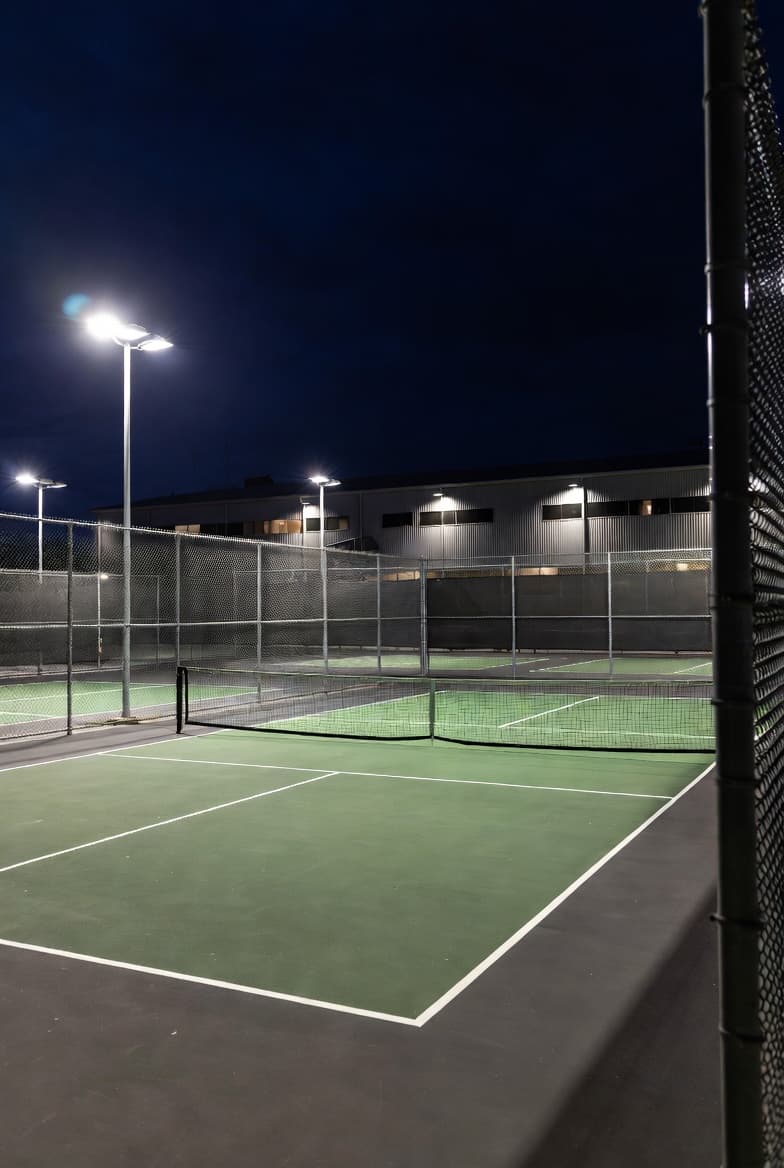
Smyrna's Pickleball Growth Is Outpacing Its Lighting Infrastructure
Pickleball has become one of the fastest-growing recreational sports in the United States — and Smyrna, Georgia is no exception. With roughly 56,000 residents and a community that spans the vibrant corridor between Cumberland, Vinings, and Marietta, Smyrna has seen growing demand for court time at public parks, private clubs, and multi-use recreational facilities across Cobb County.
But demand alone doesn't keep players on the court after sunset. As facilities in the Greater Atlanta metro stretch to accommodate more programming — evening leagues, weekend tournaments, instructional clinics — many are discovering that their existing lighting infrastructure simply wasn't built for this level of use. Metal halide and halogen fixtures that may have served a tennis court or multipurpose park space for years are now struggling to deliver the visibility, reliability, and efficiency that modern pickleball players expect.
This article examines why LED technology has become the standard for pickleball court lighting, what facility operators in the Smyrna area should understand before making an upgrade decision, and how the right lighting approach can improve both player experience and long-term operational economics.
Why Pickleball Demands More from Your Lighting System
Pickleball is a deceptively fast game. The smaller court dimensions — roughly one-quarter the area of a tennis court — combined with a lightweight polymer ball and rapid net exchanges mean players are tracking quick, low-trajectory shots in tight spaces. Poor lighting doesn't just create inconvenience; it creates safety hazards and competitive disadvantages.
The Illuminating Engineering Society (IES) recommends illumination levels typically ranging from 30 to 50 footcandles depending on the level of play, from casual recreational use to competitive match conditions. More important than raw brightness, however, is uniformity — how evenly that light is distributed across the entire playing surface, including the non-volley zone at the net and the baselines.
Older high-intensity discharge (HID) systems, including metal halide and halogen fixtures, tend to create a pattern of bright spots and dim areas. This uneven coverage is especially problematic in pickleball, where a ball can cross from a well-lit zone to a shadowed one within fractions of a second. Players also frequently cite glare as a distraction — a direct result of older fixture designs that cast light in broader, less controlled patterns.
Modern LED systems address all of these challenges simultaneously:
- Uniform coverage with excellent uniformity ratios — often 1.5:1 or better — eliminates hotspots and shadowed zones across the full court
- Glare-controlled optics direct light precisely where it's needed, reducing discomfort for players tracking overhead shots
- Instant-on performance means no warm-up delays when courts open for early morning or evening sessions
- Color rendering (CRI 70+) improves ball visibility against varied court surfaces, particularly important for the light-colored pickleballs used in competitive play
For facility managers across Smyrna, Mableton, Powder Springs, and the broader Cobb County area, these performance improvements translate directly into better programming, fewer player complaints, and more court hours available for revenue-generating use.
The Energy Economics of LED Court Lighting in Georgia
Beyond performance, LED lighting presents a compelling financial case — particularly for facilities managing multiple courts or running extended evening hours.
Traditional metal halide fixtures used commonly in sports and recreational lighting often operate at 1,000 to 1,500 watts per fixture. A facility running six to eight fixtures per court across multiple courts can easily be spending thousands of dollars annually on electricity for lighting alone. LED replacements typically operate at 50 to 75% lower wattage for equivalent or superior light output — a difference that compounds significantly over time.
The project at North Hills Middle School in Bloomfield, Michigan illustrates this well. When multiple lamp outages rendered the school's athletic field unusable for night programming, VOSS replaced sixty-eight 1,500-watt HID fixtures with 750-watt Keystone Sports Lighter LED units — cutting per-fixture wattage in half while dramatically improving illumination quality. Jacob McDermott, Director of Maintenance & Operations, described the result: "The new lights themselves are nothing short of amazing, providing brilliant and uniform illumination that dramatically enhances the field for both players and spectators." While that project involved a football field, the principles apply directly to multi-court pickleball facilities facing similar aging-infrastructure challenges.
For Smyrna-area organizations — including municipal park systems, private athletic clubs, HOA-managed communities, and YMCA or recreation center operators — the long-term math on LED upgrades is increasingly clear:
- Reduced energy consumption lowers monthly utility costs from the first month of operation
- Longer fixture lifespans (100,000+ hours is common for quality LED sports fixtures) dramatically reduce maintenance and lamp replacement labor
- Utility rebate programs available through Georgia Power and other regional providers can offset a meaningful portion of upfront project costs — making the payback period shorter than many operators expect
Public agencies and eligible nonprofit organizations in Cobb County may also have access to cooperative purchasing programs such as Sourcewell, TIPS, Omnia Partners, and BuyBoard — pre-negotiated procurement vehicles that streamline the purchasing process and can reduce administrative burden for parks departments, school districts, and municipal recreation authorities.
Indoor vs. Outdoor Courts: Different Environments, Shared Principles
The Greater Atlanta area's pickleball facilities span a wide range of environments — from dedicated outdoor courts at Smyrna's public parks to converted gymnasium spaces, dedicated indoor club facilities, and mixed-use community centers throughout the Cumberland-Galleria corridor and down toward Atlanta's northwest suburbs.
Each environment presents distinct lighting considerations, but the underlying principles remain consistent.
Outdoor courts must contend with ambient light variation, weather exposure, and often stricter requirements around light spill — particularly in residential areas like those found throughout Smyrna's established neighborhoods. LED fixtures with directional optics and appropriate mounting heights can minimize light trespass while maintaining excellent on-court illumination. Durable, weather-rated fixtures with high IP ratings are essential for Georgia's climate, which brings significant humidity, seasonal storms, and temperature swings.
Indoor courts — including converted gymnasium spaces or purpose-built indoor pickleball facilities — benefit from LED's ability to eliminate the flickering and color inconsistency associated with aging fluorescent or metal halide systems. Proper mounting height, beam angle selection, and ceiling height all factor into the photometric design. For operators running courts in shared gymnasium spaces, dimming and zoning controls allow different lighting levels for different activities, reducing energy use during non-peak hours.
If you're exploring how gymnasium-specific LED solutions are structured, our LED Gymnasium Lighting Solutions article covers that environment in greater depth. Similarly, our Tennis Court Lighting and Energy Solutions content is a natural complement for facilities managing both sports on shared or adjacent infrastructure.
What Facility Operators Should Know Before Upgrading
Whether you're managing a Smyrna Parks and Recreation facility, operating a private pickleball club near the Battery Atlanta district, or overseeing a HOA amenity complex in the Vinings or Mableton area, a few key considerations should guide your approach to a court lighting upgrade.
Start with a lighting audit. Understanding your existing fixture inventory, current energy consumption, and measurable deficiencies (footcandle levels, uniformity ratios, outage history) gives you an objective baseline. This data is essential for calculating ROI and for qualifying for utility rebate programs, which typically require documentation of existing conditions.
Commission a photometric layout. A photometric design simulates how proposed fixtures will perform across the actual dimensions of your court or facility. This step ensures you're specifying the right fixture, mounting height, and quantity to meet IES recommendations — not guessing. It also allows you to identify opportunities for controls integration (occupancy sensors, dimming, scheduling) that further reduce energy costs.
Factor in controls and smart systems. Modern LED sports lighting is increasingly integrated with automated controls — allowing courts to be programmed for specific hours, dimmed between sessions, or monitored remotely. For facilities in the Greater Atlanta metro managing multiple court locations, centralized controls can significantly reduce administrative overhead and energy waste.
Evaluate your rebate and incentive eligibility early. Georgia Power and other regional utilities offer commercial lighting rebate programs that reward energy reduction. These programs have specific requirements around fixture specifications, minimum efficiency thresholds, and application timing — meaning the rebate strategy should be part of the project design process, not an afterthought. Our Maximize ROI with Commercial LED Lighting Rebates content explores this topic in further detail for the broader Dallas market, with principles directly applicable here in Georgia.
Service Availability
While VOSS offers a comprehensive suite of national services, specific capabilities may vary by location. Please contact your local branch to confirm the current availability of specific services, technology solutions, or contracting capabilities in your immediate market.
Talk to VOSS About Your Smyrna-Area Pickleball Facility
VOSS's Atlanta branch serves facilities throughout Smyrna, Marietta, Kennesaw, Acworth, Austell, Mableton, Vinings, and across the Greater Atlanta region. With 85+ years of experience in commercial electrical and lighting solutions, we bring both the technical expertise and local market knowledge to help facility operators make confident, well-informed decisions about court lighting upgrades.
Whether you're managing an established parks system, launching a new indoor pickleball venue, or simply evaluating whether your current lighting is holding your facility back, we're here to start that conversation — no obligation, no hard sell.
VOSS — Atlanta Branch Phone: (770) 438-8557 Toll-Free: (888) 725-8897
Reach out to discuss how a lighting assessment, photometric design, or rebate analysis could apply to your courts in Smyrna or the surrounding Cobb County area. Our team is ready to help you illuminate the game — and the opportunity.