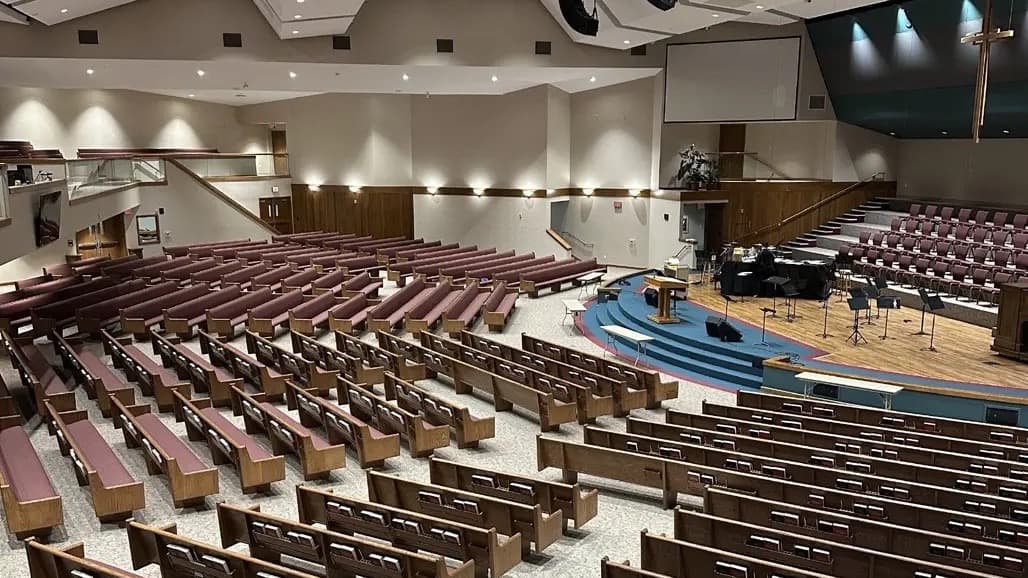
Why Sanctuary Lighting Deserves More Attention in the Greater Atlanta Area
Houses of worship across Smyrna, Marietta, Vinings, Mableton, and the broader Cobb County corridor are facing a quiet but mounting challenge: aging lighting infrastructure that simply wasn't designed for how churches operate today. Services are longer, multi-use, and increasingly captured on video for livestreams and online audiences. Sanctuaries that once needed only adequate ambient light now require consistent, flattering, controllable illumination — and many existing systems are struggling to keep up.
Greater Atlanta's church community is one of the most active in the nation. With a population of roughly 56,000 in Smyrna alone and dense concentrations of congregations spanning from Buckhead to Kennesaw, facility managers are under real pressure to maintain aging buildings while stretching every dollar. For many churches, lighting is the infrastructure issue they didn't know they needed to prioritize — until a ballast fails mid-service or scaffolding must be rented for the fourth time in a year.
This article explores the most common sanctuary lighting challenges facing church facilities in this region, emerging best practices in LED technology and controls, and practical approaches for facility teams looking to reduce maintenance burden and improve the quality of their worship environment.
The Most Common Sanctuary Lighting Challenges — and What's Behind Them
Understanding the root causes of sanctuary lighting problems is the first step toward solving them sustainably. Most issues stem from a combination of aging technology, difficult architecture, and deferred maintenance.
High-Ceiling Fixture Access Many sanctuaries in the Smyrna area — particularly older or architecturally distinctive buildings — feature vaulted ceilings, lofted choir lofts, and decorative pendants that make routine bulb replacement genuinely hazardous and expensive. Traditional incandescent, halogen, and fluorescent sources have relatively short rated lifespans, meaning facilities may need to rent lifts or scaffolding multiple times annually. Over time, this labor and equipment cost rivals or exceeds the cost of a comprehensive LED retrofit.
Ballast Failure and Flickering Flickering or dimming lights are often symptoms of aging magnetic or electronic ballasts nearing end of life. In many Greater Atlanta-area church buildings constructed in the 1970s through the 1990s, these ballasts are operating well past their design lifespan. Incompatible aftermarket replacements and mismatched dimmer systems compound the problem, creating inconsistent light quality that distracts congregants and creates poor conditions for video production.
Uneven Illumination and Video Quality As more churches in the Smyrna and Atlanta metro area invest in livestreaming and recorded ministry content, uneven sanctuary illumination has become a significant operational issue. Hot spots, dark zones, and color temperature inconsistencies that were barely noticeable to the human eye become glaring problems on camera. Proper photometric planning — mapping light distribution across the space — is increasingly recognized as a best practice rather than a premium option.
Rising Energy Costs Georgia Power serves much of the Greater Atlanta region, and commercial and institutional electricity costs have trended upward over recent years. For a mid-size church running multiple services per week, sanctuary lighting can represent a meaningful share of the monthly utility bill — particularly when fixtures are running at 400 to 1,000 watts each and the space is in use for rehearsals, events, and community programming beyond Sunday services.
LED Technology and Controls: What's Changed — and Why It Matters Now
The LED lighting market has matured significantly over the past decade, and the solutions available to church facilities today are meaningfully better than what was on the market even five years ago. For facility managers evaluating an upgrade, a few key developments are worth understanding.
Long-Life LED Sources Dramatically Reduce Maintenance Frequency Modern LED fixtures rated at 50,000 to 100,000 hours of life represent a fundamental shift in maintenance planning. A sanctuary that previously required annual re-lamping of incandescent or fluorescent sources could realistically operate for a decade or more before significant lamp maintenance is needed. For high-ceiling applications where access is difficult and costly, this is among the most compelling financial arguments for upgrading.
Dimming and Scene Control Have Become Far More Accessible Early-generation LED dimmers were notoriously problematic — flickering at low levels, humming audibly, and failing to hold settings reliably. Current-generation LED drivers and compatible dimming systems have largely solved these issues, and wireless scene-control platforms now make it practical to program sanctuary presets — worship, sermon, reception, livestream — without rewiring. For churches in areas like Smyrna's growing Cumberland District corridor and surrounding mixed-use neighborhoods, these flexible systems also support multi-purpose facility use.
Color Temperature and Color Rendering Matter More Than Wattage Facility managers accustomed to specifying fixtures by wattage are increasingly learning to evaluate color temperature (measured in Kelvin) and Color Rendering Index (CRI). For sanctuaries, warmer color temperatures (2,700K–3,000K) tend to create an inviting, reverential atmosphere, while higher CRI values (90+) ensure that skin tones, fabric colors, and decorative elements appear natural and vibrant — on-camera and in person. Getting these specifications right at the outset of a project avoids the costly experience of installing fixtures that are technically efficient but visually wrong for the space.
Lessons from Across Industries Apply Here The principles behind excellent sanctuary lighting retrofits aren't exclusive to churches. VOSS's work on lighting retrofits in healthcare environments — where consistent, maintenance-free illumination and improved visual quality are equally critical — demonstrates the value of thoughtful specification and professional photometric planning. At Corewell Health in Dearborn, Michigan, replacing aging fluorescent fixtures with uniform linear LED lighting transformed the ambiance of the space and eliminated ongoing maintenance demands. Facilities supervisors noted the improved quality of light and the dramatic visual upgrade. The parallel to a sanctuary environment is direct: the goal in both settings is consistent, high-quality light that disappears into the background and lets the space — and the people in it — take center stage.
Maintenance Strategy: Reactive vs. Proactive Approaches
Many church facilities in the Smyrna area and across Cobb County operate with small or part-time maintenance teams. For these organizations, a reactive approach to lighting maintenance — fixing things when they break — is often the default. But reactive maintenance in a sanctuary context carries real costs that aren't always visible in the budget line.
The Hidden Cost of Reactive Maintenance When a fixture fails at ceiling height during a service season, the options are limited: delay repair until a lift can be scheduled, rent emergency equipment at premium rates, or live with a darkened zone that affects safety and atmosphere. Each of these outcomes has a cost — in dollars, in staff time, or in the congregant experience. Multiply that across a dozen or more fixtures with aging sources, and the cumulative impact is substantial.
Proactive Maintenance Principles for Church Facilities A more strategic approach involves group re-lamping schedules (or, better, a transition to LED that eliminates routine re-lamping), regular inspection of dimming and control systems, and documented fixture inventories that allow for advance procurement of replacement parts. Facilities that have made the transition to LED often report that their maintenance posture shifts from reactive troubleshooting to planned, periodic inspection — a meaningful quality-of-life improvement for small teams.
Planning Around the Church Calendar One of the most practical considerations for sanctuary lighting work in any market is timing. Major upgrade or retrofit projects are best planned during lower-activity windows in the church calendar — summer months, or the period between major liturgical seasons. VOSS's experience working with religious facilities nationally includes sensitivity to these scheduling realities, with project management approaches designed to minimize disruption to regular services, rehearsals, and community events.
A Note on Cooperative Purchasing for Eligible Organizations
Some churches and affiliated nonprofit organizations may qualify for cooperative purchasing programs that streamline procurement and can deliver competitive pricing without the burden of a full public bid process. VOSS participates in several recognized cooperative purchasing programs, including Houston Church COOP — a program specifically designed for houses of worship — as well as Sourcewell, TIPS, BuyBoard, Omnia Partners, AEPA, PACE, and Nebraska ESU Co-Op. Eligible organizations in the Smyrna and Greater Atlanta area are encouraged to ask about which programs may apply to their situation.
Service Availability
While VOSS offers a comprehensive suite of national services, specific capabilities may vary by location. Please contact your local branch to confirm the current availability of specific services, technology solutions, or contracting capabilities in your immediate market.
Start a Conversation with VOSS in Smyrna and Greater Atlanta
If your sanctuary is dealing with persistent maintenance challenges, rising energy costs, or lighting quality that no longer meets your congregation's needs, VOSS's Atlanta team is ready to help you think through your options. We serve churches and religious facilities throughout Smyrna, Marietta, Vinings, Mableton, Kennesaw, Acworth, and the surrounding Cobb County communities — with the technical depth and project management experience to handle everything from a single-fixture repair assessment to a complete sanctuary lighting transformation.
This isn't about a quick fix. It's about helping your facility team spend less time managing lighting problems and more time focused on your mission.
VOSS Lighting — Atlanta Branch
Phone: (770) 438-8557 Toll-Free: (888) 725-8897
Reach out to schedule a consultative conversation with our local team. We'll start by listening — to your facility's challenges, your budget realities, and your congregation's priorities — and work from there.