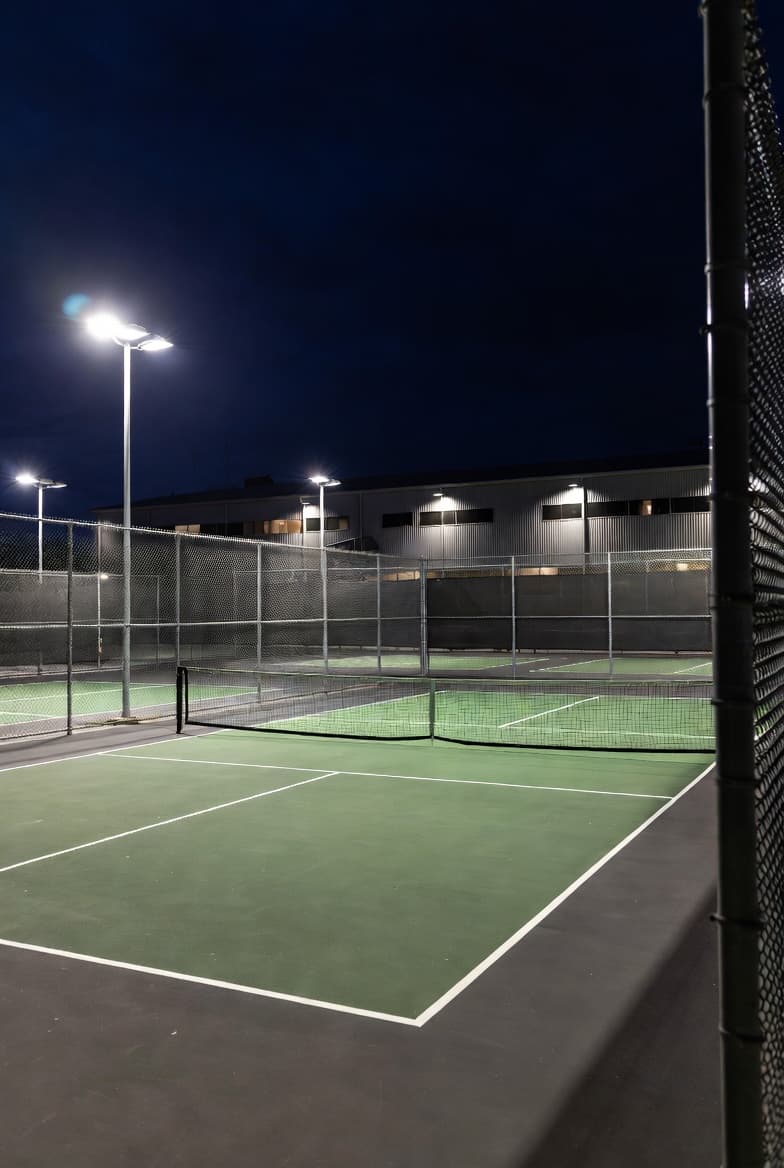
Pickleball's Explosive Growth Is Reshaping Roswell's Recreation Landscape
Pickleball has become one of the fastest-growing sports in the United States, and Roswell, Georgia is no exception. Across the city's parks, community centers, and private athletic clubs — and extending into neighboring communities like Alpharetta, Milton, Johns Creek, and Sandy Springs — demand for quality court time has surged. Municipal recreation departments, HOA amenity directors, and private club operators throughout North Fulton County are all grappling with the same challenge: how do you serve a growing player base when daylight hours are limited?
The answer, increasingly, is purpose-built LED court lighting. But not all lighting solutions are created equal — and understanding what separates high-performance pickleball LED systems from generic outdoor fixtures is essential for any facility leader making this investment.
Why Pickleball Courts Have Unique Lighting Demands
Pickleball may be played on a compact 20-by-44-foot court, but its fast ball speeds and low ball trajectory create some of the most demanding visual conditions in recreational sports. Players must track a 2.87-inch perforated ball moving at high velocity across a court that includes a non-volley zone, defined sidelines, and a low net — all while reacting in fractions of a second.
Older lighting technologies — metal halide, halogen, and even some early-generation LED retrofits — often produce uneven coverage, harsh hotspots, or glare that fatigues the eyes and impairs ball tracking. The Illuminating Engineering Society (IES) recommends illumination levels typically in the range of 30–50 footcandles for recreational to competitive play, with strong uniformity ratios to ensure consistent brightness across every inch of the court surface.
What best-in-class LED pickleball lighting delivers:
- Uniform, glare-free coverage — even illumination across the full court, including baseline and non-volley zones, with uniformity ratios often at 1.5:1 or better
- Instant-on performance — no warm-up delays, and lights that hold full output across the lifespan of the fixture
- Reduced spill and light trespass — directional optics that keep light on the court and minimize impact on adjacent residential properties, a practical concern in Roswell's mixed-use neighborhoods
- Energy efficiency — LED systems typically achieve 50–75% reductions in energy consumption compared to legacy HID or halogen systems
- Long-term durability — quality LED sports fixtures carry lifespans exceeding 100,000 hours, dramatically reducing maintenance interventions and lamp replacement costs
For facilities in the Atlanta metro area subject to Georgia Power's rate structures, the operational savings from LED conversion can be substantial — and rebate programs can further offset upfront capital costs.
From Darkness to Playability: Lessons from Real LED Sports Retrofits
The challenges facing Roswell-area pickleball facility operators are well-illustrated by what sports facility managers encounter nationwide. At North Hills Middle School in Bloomfield, Michigan, VOSS addressed a situation that will resonate with any recreation director who has dealt with aging field lighting: multiple lamp outages had rendered the athletic field unusable for evening events, costing the school lost rental revenue and disrupting athletic programming.
The VOSS team replaced sixty-eight 1,500-watt HID fixtures with 750-watt Keystone Sports Lighter LED units, developed a full photometric lighting layout to ensure IES-compliant coverage, and delivered a complete turnkey solution. The outcome was a fully functional, brilliantly lit field that restored evening use for athletic teams and community renters alike.
As Jacob McDermott, Director of Maintenance & Operations, put it: "The results are truly outstanding. The project unfolded seamlessly from start to finish, with Voss Lighting demonstrating professionalism and efficiency throughout the process. The new lights themselves are nothing short of amazing, providing brilliant and uniform illumination that dramatically enhances the field for both players and spectators."
While that project involved a football field, the principles translate directly to pickleball: aging fixtures create dark spots and safety hazards, LED retrofits deliver measurable performance improvements, and the right partner handles design, procurement, and installation as a unified process.
What Roswell Facility Leaders Should Know Before Investing
Whether you manage a municipal park in Roswell, a private club near GA-400, an HOA amenity complex in East Roswell, or a recreational facility serving the broader North Fulton County corridor, a few key considerations should shape your approach to pickleball court lighting:
Photometric design matters. Court lighting should begin with a formal photometric layout — a computer-modeled light distribution analysis — rather than a guess about fixture placement. This ensures you meet IES standards, avoid dark zones, and don't over-illuminate, which wastes energy and creates glare.
Fixture specification is not one-size-fits-all. Outdoor courts in Georgia's climate face humidity, heat, and occasional severe weather. Fixtures should carry appropriate IP ratings for weather resistance and be evaluated for thermal performance in high-ambient-temperature environments common to Atlanta summers.
Controls add strategic value. Dimming controls, occupancy-based scheduling, and remote management systems allow facility operators to adjust lighting levels for recreational versus competitive play, reduce energy use during off-peak hours, and monitor system performance — all without on-site intervention. For Roswell Parks and Recreation facilities, this kind of intelligent management can meaningfully reduce operational overhead.
Rebates can change the financial equation. Georgia Power's commercial rebate programs, as well as national utility incentive structures, may apply to qualifying LED installations. Navigating these programs — understanding which fixtures qualify, what documentation is required, and how to maximize the rebate value — is a specialized skill. For public-sector facilities, cooperative purchasing programs such as Sourcewell, TIPS, BuyBoard, and Omnia Partners can also streamline procurement and ensure compliance with public bidding requirements.
Connecting Pickleball Lighting to the Broader Roswell Recreation Vision
Roswell's parks and recreation infrastructure serves a community of approximately 92,000 residents, with active programming that spans seasonal sports leagues, senior fitness initiatives, and community events that regularly extend into evening hours. As pickleball courts are added or upgraded across facilities like Roswell Area Park and community centers throughout the city, lighting infrastructure becomes a foundational investment — not an afterthought.
This topic connects naturally to a broader conversation about sports and recreation lighting across the Greater Atlanta region. If your organization is also evaluating LED gymnasium lighting, tennis court lighting, or outdoor parking and site lighting, those considerations often intersect at the facility planning level and benefit from a coordinated approach. The economics of combining multiple lighting upgrades — leveraging shared photometric design work, bundled fixture procurement, and a single installation mobilization — frequently produce better outcomes than addressing each system in isolation.
Service Availability
While VOSS offers a comprehensive suite of national services, specific capabilities may vary by location. Please contact your local branch to confirm the current availability of specific services, technology solutions, or contracting capabilities in your immediate market.
Talk to VOSS About Your Roswell Pickleball Facility
If you're evaluating LED lighting for a pickleball facility in Roswell or the surrounding communities of Alpharetta, Milton, Johns Creek, Marietta, or Dunwoody, VOSS's Atlanta branch team is ready to help you think through the right approach — from photometric design and fixture specification to rebate navigation and installation planning.
We bring 85+ years of commercial electrical and lighting expertise to every project, and we're familiar with the operational realities facing facility managers, parks directors, and private club operators in this market.
VOSS Atlanta Branch Phone: (770) 438-8557 Toll-Free: (888) 725-8897
Reach out to start a conversation about how LED pickleball court lighting can extend playing hours, improve player experience, and reduce long-term operating costs at your facility.