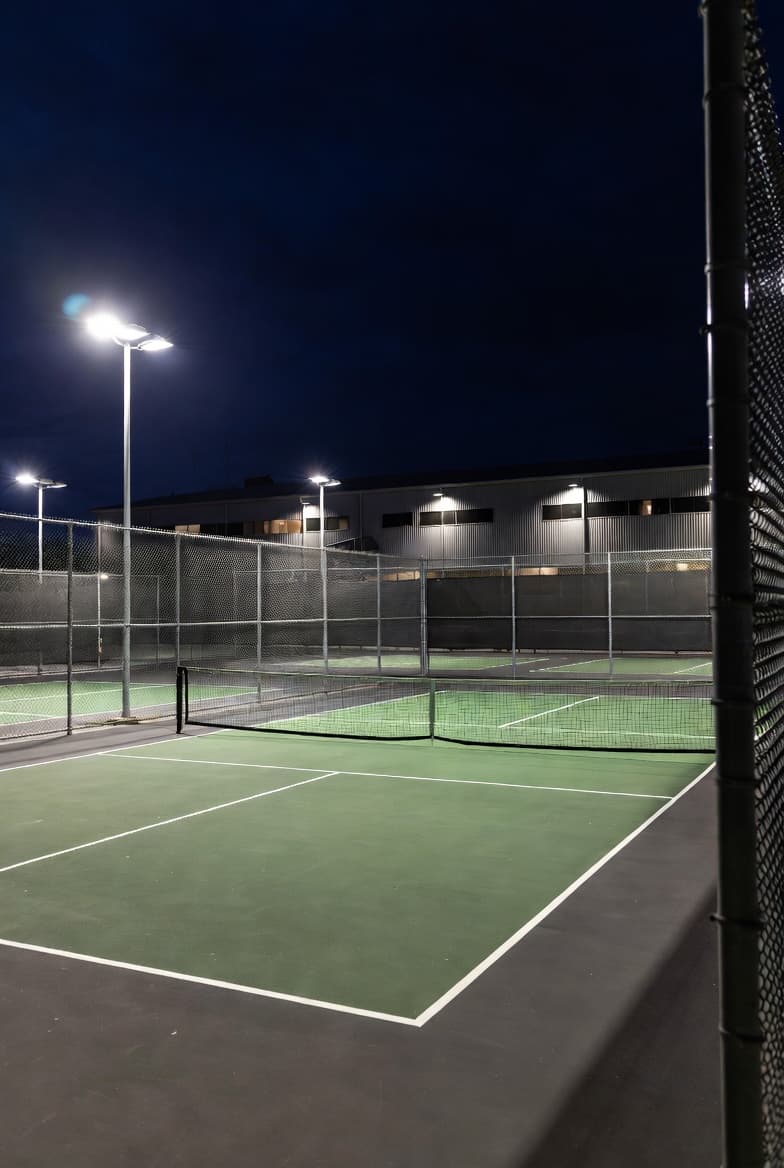
Pickleball Is Booming in Peachtree Corners — and Lighting Is at the Center of It
Pickleball has become one of the fastest-growing recreational sports in the United States, and communities across the Greater Atlanta area are feeling that momentum directly. Peachtree Corners, with its active and engaged population of approximately 42,000 residents, sits at the heart of this trend. From Technology Park Atlanta to the Town Center district and surrounding neighborhoods in Gwinnett County, parks and recreation operators, private clubs, HOA facilities, and multi-use sports complexes are all grappling with the same question: how do we meet growing demand for court time, especially after dark?
The answer increasingly comes down to lighting. Inadequate or outdated lighting is one of the most common barriers preventing facilities from offering evening play — and it is a solvable problem. Understanding what modern LED court lighting makes possible is the first step toward making smarter infrastructure decisions.
Why Legacy Lighting Systems Fall Short on the Pickleball Court
Many courts in the Peachtree Corners area and across surrounding communities like Duluth, Norcross, Johns Creek, and Alpharetta were built with metal halide or halogen fixtures designed for general outdoor use — not specifically for fast-paced racquet sports. These older systems create several compounding problems for pickleball play.
Uneven illumination is perhaps the most noticeable issue. Pickleball's smaller court dimensions (20 by 44 feet compared to a standard tennis court) require precise, uniform coverage across every zone — including the critical non-volley zone near the net and the baselines where fast, low shots are tracked. Hotspots and dark patches are not just annoying; they create genuine safety concerns when players lose sight of a ball moving at speed.
Glare is another persistent challenge with legacy technology. Traditional fixtures emit unfocused, omnidirectional light that bounces off court surfaces and into players' line of sight. In a sport where reaction time and ball tracking are paramount, glare translates directly to degraded play quality and increased injury risk.
Energy and maintenance costs compound over time. Metal halide systems consume significantly more wattage per fixture than modern LED equivalents, require warm-up time before reaching full output, and demand frequent lamp replacements — often at inconvenient times, as the North Hills Middle School Football Field LED Retrofit in Bloomfield, Michigan illustrated. That project documented how multiple lamp outages in an HID system rendered an athletic field entirely unusable for night events, costing the facility in both operations and revenue. The same dynamic plays out at pickleball courts across Georgia when aging lamps go dark mid-season.
What Modern LED Technology Delivers for Court Operators
The transition to purpose-built LED pickleball court lighting is not simply a like-for-like fixture swap — it represents a fundamental improvement in how a facility can serve its users and manage its infrastructure.
Uniform, glare-free illumination is the defining characteristic of well-designed LED court lighting. Industry recommendations from the Illuminating Engineering Society (IES) typically target 30 to 50 footcandles for recreational through competitive play, with uniformity ratios of 1.5:1 or better. Achieving those metrics consistently requires thoughtful photometric layout design, not just fixture quantity — a distinction that separates a well-executed LED project from a disappointing one.
Energy efficiency gains are substantial and measurable. LED systems typically consume 50 to 75 percent less energy than the metal halide or halogen systems they replace. For a municipality managing multiple courts across a park system — or a private club running courts five to seven nights a week — that reduction in kilowatt-hour consumption translates into meaningful operating savings over a system's lifespan. Georgia Power and utility providers serving Gwinnett County have historically offered rebate and incentive programs tied to qualifying LED upgrades, which can meaningfully offset project costs for eligible organizations. Facilities should investigate available incentives as part of any planning process.
Longevity and reduced maintenance burden are equally important operational benefits. Modern LED fixtures carry rated lifespans often exceeding 100,000 hours, operate at full brightness instantly without warm-up periods, and are engineered for weather resistance in the humid Georgia climate. For facilities in Peachtree Corners and surrounding areas that experience hot summers, seasonal storms, and year-round outdoor use, durability is not a nice-to-have — it is a core infrastructure requirement.
Expanded revenue potential is the business case that resonates with facility operators and parks directors alike. Courts that are dark after 7 or 8 p.m. are courts that cannot generate reservations, memberships, or rental income. Reliable, high-quality evening lighting directly expands usable court hours and, by extension, the facility's capacity to serve its community and meet its financial goals.
Sports Lighting Design: What Facility Managers Should Know
Lighting a pickleball court well requires more than selecting a fixture with a high lumen output. The design process matters as much as the hardware — a point that holds true whether the facility is a two-court recreational park in Peachtree Corners or a multi-court club complex serving players across Gwinnett and Fulton Counties.
Photometric planning is the foundation of any credible LED sports lighting project. A complete photometric layout models how light will distribute across the court surface given specific fixture types, mounting heights, aiming angles, and pole placement. This analysis predicts real-world footcandle levels and uniformity ratios before a single fixture is installed — eliminating guesswork and ensuring the finished project actually meets IES standards and player expectations.
When VOSS completed the North Hills Middle School Football Field LED Retrofit, the team developed a full photometric layout for the proposed installation, replacing sixty-eight 1,500-watt HID fixtures with 750-watt LED equivalents. The resulting illumination was described by the school's Director of Maintenance and Operations as "brilliant and uniform illumination that dramatically enhances the field for both players and spectators." That same design discipline applies directly to pickleball court projects, regardless of scale.
Mounting height and pole configuration affect both performance and aesthetics. Indoor facilities — including recreation centers and community gyms in Peachtree Corners and across northern Gwinnett County — face different constraints than outdoor courts. Indoor ceiling heights, structural attachment points, and glare control toward adjacent seating areas all factor into fixture selection and layout. Outdoor courts must account for wind load, setback from property lines, and light trespass onto neighboring parcels.
Controls and smart systems are an emerging consideration for forward-thinking operators. Dimming controls, occupancy-based scheduling, and remote monitoring capabilities are increasingly available on commercial LED sports lighting platforms. A parks department managing courts across Peachtree Corners, Berkeley Lake, and Norcross, for example, could benefit from centralized scheduling that adjusts light levels based on reservation data — reducing energy consumption during off-peak hours without manual intervention.
Considerations for Public Parks, Recreation Departments, and Private Operators
The pickleball lighting conversation looks slightly different depending on who is operating the facility, and understanding those differences helps decision-makers ask the right questions.
Municipal parks and recreation departments in Peachtree Corners and across Gwinnett County typically approach infrastructure upgrades through a public procurement process. For eligible public agencies, cooperative purchasing programs such as Sourcewell, Omnia Partners, BuyBoard, and TIPS offer pre-negotiated contracts that can streamline the procurement of lighting equipment and installation services — reducing administrative burden while maintaining compliance with public purchasing requirements.
Private clubs, HOAs, and multi-family communities operate with more procurement flexibility but face their own considerations around return on investment, member satisfaction, and capital planning. For these operators, the business case for LED court lighting often centers on court utilization rates, membership retention, and the ability to attract competitive play events that generate additional revenue.
Schools and educational institutions in the Greater Atlanta area — including those in the Gwinnett County Public Schools system — may find that upgraded athletic facility lighting serves multiple programs, from pickleball and tennis to general outdoor events. The experience at North Hills Middle School demonstrated how resolving a lighting deficiency can restore full use of an athletic asset that had effectively gone offline. For schools eligible through cooperative purchasing programs including AEPA and Sourcewell, accessing quality lighting solutions through pre-competed contracts is a practical and efficient path forward.
Regardless of the operator type, the planning process benefits from an early-stage lighting audit and analysis. Understanding what the existing system delivers — and where it falls short against current IES recommendations — creates a factual baseline for scoping a project and making the case for investment.
Service Availability
While VOSS offers a comprehensive suite of national services, specific capabilities may vary by location. Please contact your local branch to confirm the current availability of specific services, technology solutions, or contracting capabilities in your immediate market.
Connect with VOSS in the Greater Atlanta Region
Peachtree Corners and the surrounding communities of Gwinnett County represent a growing, active market where demand for quality recreational infrastructure is rising alongside the local population. VOSS's Atlanta branch has served the Greater Atlanta region for decades, bringing the depth of an 85-year national organization with the familiarity of a locally rooted team.
If you are evaluating a court lighting upgrade — whether for a municipal park, private club, school athletic facility, or HOA amenity — we welcome the conversation. Our team can discuss your facility's current conditions, review applicable incentive programs, and outline what a photometric-driven LED upgrade could mean for your specific situation.
VOSS Atlanta Branch Phone: (770) 438-8557 Toll-Free: (888) 725-8897
To explore related topics in our Latest Lighting resource series, we also recommend reviewing our articles on Tennis Court Lighting and Energy Solutions, LED Gymnasium Lighting Solutions, and our guide to Maximizing ROI with Commercial LED Lighting Rebates in Dallas, TX — which illustrates rebate strategies applicable across many utility markets, including Georgia.