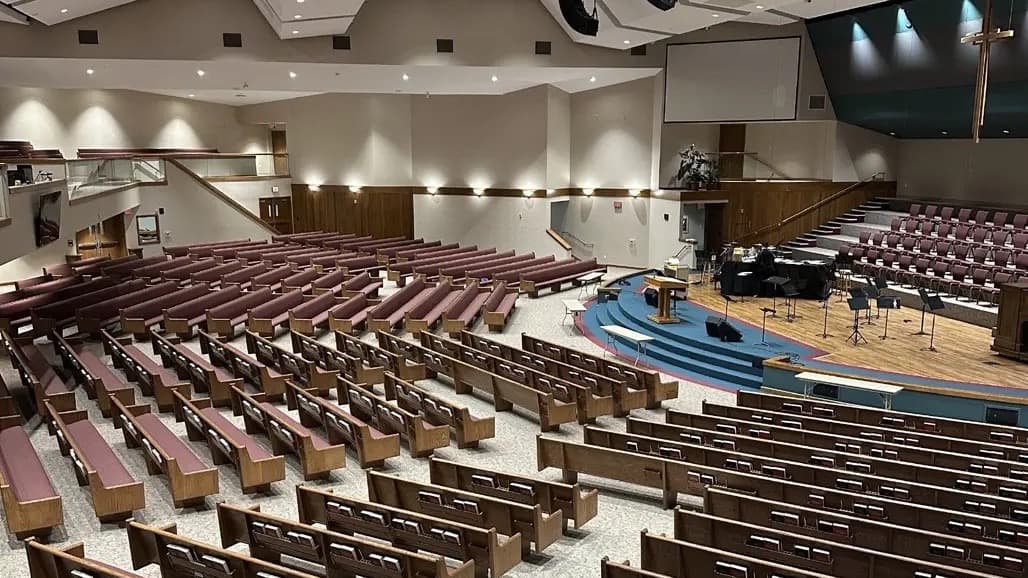
Why Sanctuary Lighting Is a Growing Priority for Georgia Churches
Houses of worship across Peachtree Corners, Norcross, Johns Creek, and the broader Gwinnett County corridor are quietly confronting a shared facility challenge: sanctuary lighting systems that were designed for a different era. Many of these buildings — ranging from small congregational chapels to large multi-campus churches that are hallmarks of the Atlanta suburban faith community — still rely on incandescent, halogen, or fluorescent fixtures installed decades ago.
The consequences are familiar to anyone who manages a church facility. Bulbs burn out in high vaulted ceilings, requiring scaffolding or lifts that disrupt midweek programming. Aging ballasts cause flickering during Sunday services. Energy bills climb year after year. And for congregations that livestream worship — an expectation that has grown significantly since 2020 — poor or uneven illumination directly affects video quality and the reach of their ministry.
This isn't just a maintenance nuisance. It's a stewardship issue. Understanding the landscape of modern sanctuary lighting helps facility managers and church leadership make better, longer-lasting decisions for their buildings and their congregations.
The Unique Lighting Challenges of Church Sanctuaries
Church buildings present a combination of factors that make lighting maintenance more complex than a typical commercial facility. Recognizing these challenges is the first step toward solving them effectively.
Architectural constraints and access difficulties. Sanctuaries often feature soaring ceilings, ornate woodwork, stained glass, and historic finishes. Replacing a single bulb can require equipment rentals, specialized access rigging, and coordination around service schedules. In traditional or historic church buildings common throughout the Atlanta metro — including communities like Duluth, Suwanee, and Alpharetta — these access challenges multiply the cost and disruption of routine maintenance.
Aging infrastructure and compatibility issues. Fluorescent fixtures with aging ballasts are a primary source of flickering and dimming complaints. When dimmer controls aren't compatible with the installed fixtures, the result is inconsistent light that undermines the atmosphere of worship. In many cases, piecemeal repairs over the years have created mixed-technology systems that are increasingly difficult and expensive to manage.
Energy inefficiency at scale. A sanctuary with dozens of 150-watt or 300-watt incandescent PAR fixtures running three to five days per week accumulates significant energy cost over time. As Georgia Power rates continue to evolve, facilities operating on fixed or donor-dependent budgets feel this pressure acutely.
Livestream and media quality demands. Many congregations in the Peachtree Corners area and surrounding communities have invested in video production capabilities. Lighting that creates hotspots, deep shadows, or inconsistent color rendering can undermine thousands of dollars of media infrastructure — a concern that resonates strongly with church communications and technology staff.
What Modern LED Retrofits Actually Deliver for Church Facilities
The shift to LED technology in sanctuary environments has matured considerably over the past decade. Early LED retrofits in worship spaces often fell short — color rendering was poor, dimming was choppy, or the light felt clinical rather than warm and reverent. Today's solutions are a different proposition entirely.
Dramatically reduced maintenance cycles. Quality LED fixtures rated at 50,000 hours or more can run for decades before requiring replacement. For a sanctuary that holds multiple services per week, this means facility teams spend far less time on ladders and lifts — and far more time focused on ministry support.
Improved light quality and atmosphere. Modern LED systems designed for worship environments offer high color rendering index (CRI) ratings, smooth dimming curves, and color temperature options that can be tuned to match the warmth of traditional worship settings or the brighter, more contemporary feel of modern sanctuary designs.
Meaningful energy savings. LED fixtures typically consume 50–75% less energy than the incandescent or halogen sources they replace. For larger congregations with multiple services, midweek programming, and event rentals, those savings accumulate meaningfully over the life of the system.
Better outcomes for livestream and broadcast. Consistent, high-CRI illumination across the platform, choir loft, and congregation area makes a measurable difference in camera performance — reducing the need for post-production correction and presenting a more professional image to online viewers.
The experience VOSS gained through projects like the Corewell Health Lighting Retrofit in Dearborn, Michigan — where replacing aging fluorescent fixtures with uniform LED lighting transformed both the visual quality and the long-term maintenance burden of the space — reflects principles that translate directly to sanctuary environments. In that project, the facility team described the result as "virtually maintenance-free lighting," a benchmark that church facility managers should hold as a realistic expectation from a well-executed LED retrofit.
Key Considerations When Planning a Sanctuary Lighting Upgrade
For facility managers and church administrators in Peachtree Corners and the greater Atlanta region evaluating a sanctuary lighting project, the planning process matters as much as the product selection. Here are the considerations that experienced practitioners prioritize:
- Photometric analysis before fixture selection. A proper lighting design begins with understanding the current light levels, distribution patterns, and deficiencies in the space. A photometric layout — the same approach VOSS used in the North Hills Middle School Football Field LED Retrofit in Bloomfield, Michigan, where a full photometric plan guided fixture placement across the field — ensures that the new system delivers uniform, code-appropriate illumination rather than a simple one-for-one swap that may not resolve existing problems.
- Dimming system compatibility. Sanctuary lighting almost always requires smooth, wide-range dimming. Specifying fixtures and controls that are verified compatible with one another prevents the flickering and drop-out issues that plague mismatched systems.
- Phased implementation to manage budget and disruption. Many congregations choose to address the sanctuary in phases — perhaps beginning with platform and chancel lighting before moving to the nave and balcony. A thoughtful phasing plan maintains worship continuity while spreading capital expenditure over time.
- Historic and aesthetic sensitivity. In sanctuaries with traditional architecture, fixture selection should complement the existing aesthetic. LED retrofit lamps that fit within existing decorative fixtures, or fixtures designed with period-appropriate profiles, preserve the visual character of the space while delivering modern performance.
- Controls and smart systems integration. Scene-based lighting control systems allow a single sanctuary space to support Sunday morning worship, Wednesday evening Bible study, a wedding, and a concert — each with lighting presets optimized for that use. For congregations with active programming calendars, this flexibility adds genuine operational value.
A Practical Note on Procurement for Eligible Organizations
For church organizations and faith-based institutions that qualify for cooperative purchasing programs, this pathway can simplify the procurement process and provide access to pre-negotiated pricing. VOSS participates in several cooperative purchasing programs — including Houston Church COOP, Sourcewell, TIPS, BuyBoard, AEPA, and Omnia Partners — that may be available to eligible organizations. If your congregation or faith-based organization is exploring whether cooperative purchasing applies to your situation, your VOSS representative can help you navigate those options.
Service Availability
While VOSS offers a comprehensive suite of national services, specific capabilities may vary by location. Please contact your local branch to confirm the current availability of specific services, technology solutions, or contracting capabilities in your immediate market.
Talk with a Local Lighting Specialist
For congregations in Peachtree Corners, Norcross, Duluth, Johns Creek, Alpharetta, and across Gwinnett and Fulton counties, VOSS's Atlanta branch brings both local market knowledge and the depth of an 85-year national firm to every project. Whether you're troubleshooting a persistent flickering problem, planning a full sanctuary LED retrofit, or simply trying to understand what a lighting upgrade might realistically cost and deliver for your facility, we're here to help you think it through.
This conversation starts with your facility — not a sales script. Reach out to the VOSS Atlanta team to schedule a consultation or facility assessment.
VOSS — Atlanta Branch Phone: (770) 438-8557 Toll-Free: (888) 725-8897
For further reading on related topics, explore our articles on Energy Efficient Church Lighting Upgrades, Commercial LED Lighting Fixtures, and Energy Audits, Incentives, and Rebate Navigation for Businesses — all part of the VOSS Latest Lighting resource series.