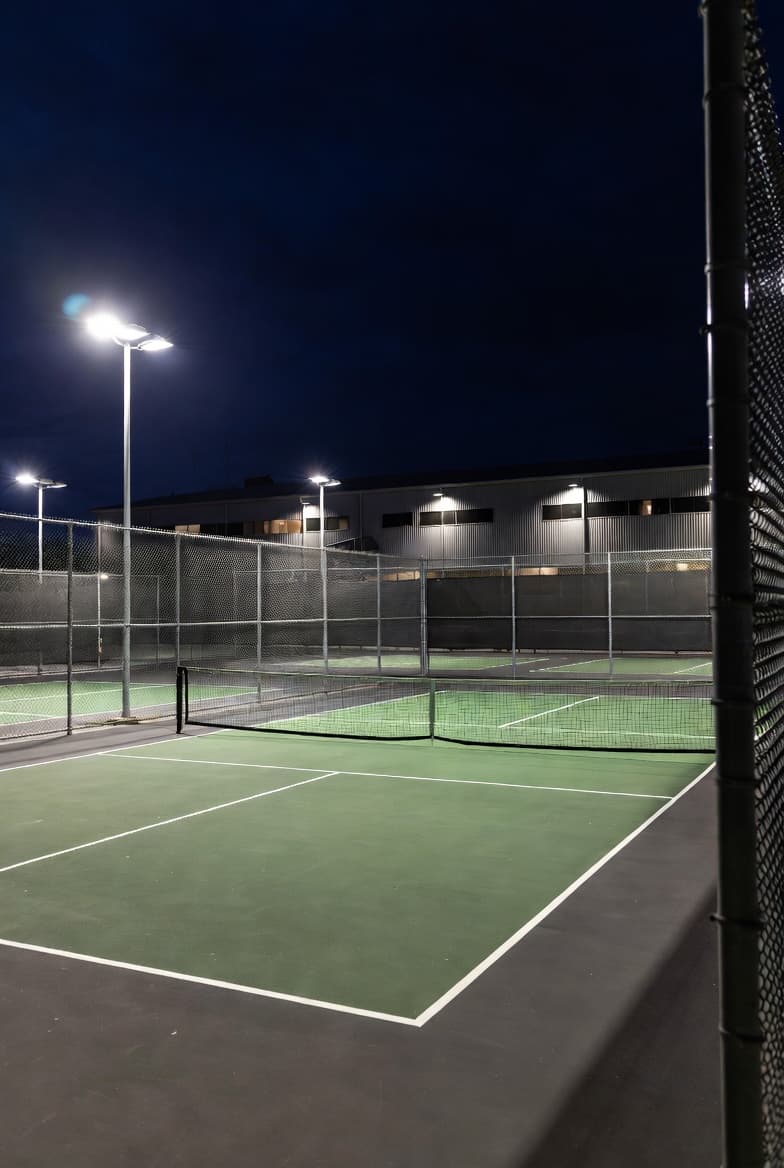
Atlanta's Pickleball Boom Is Outpacing Its Lighting Infrastructure
Greater Atlanta has become one of the most active pickleball markets in the Southeast. From dedicated clubs in Alpharetta and Roswell to municipal courts in Decatur, Marietta, and Peachtree City, and growing recreational facilities across Johns Creek, Smyrna, and Sandy Springs — the demand for court time is surging across every corner of the metro. Nationally, pickleball participation has grown by tens of millions of players over the last decade, and Georgia consistently ranks among the top states for new court construction and club formation.
But growth brings a problem many facility operators in the Atlanta area are only now recognizing: the lighting infrastructure on most existing courts was never designed for pickleball. Courts repurposed from tennis or basketball often inherit aging metal halide or halogen fixtures that produce glare, uneven coverage, and high energy consumption — conditions that make it genuinely difficult to track a fast-moving pickleball, particularly at night. For parks departments in Gwinnett County or DeKalb County, for private clubs in Buckhead or Vinings, and for community recreation centers throughout the region, this gap between court capacity and lighting quality is limiting both player experience and facility revenue.
Understanding why LED technology has become the standard for modern pickleball court lighting — and what it takes to implement it well — is a conversation every Atlanta-area facility operator should be having right now.
What Makes Pickleball Lighting Uniquely Challenging
Pickleball is not simply a scaled-down version of tennis. The court is smaller (20 by 44 feet), the ball moves differently, and the non-volley zone — the "kitchen" — demands a level of visual precision that forgives little in the way of shadows or inconsistent light levels. These distinctions have real implications for how a court should be lit.
The Illuminating Engineering Society (IES) recommends light levels typically ranging from 30 footcandles for recreational play up to 50 footcandles or more for competitive and tournament-level play. Equally important is uniformity: the ratio between the brightest and darkest areas of the court should ideally be 1.5:1 or better. Legacy HID systems — the kind still found on many Atlanta-area courts — routinely fail this standard.
Key performance challenges that older systems create include:
- Glare and visual fatigue — High-intensity discharge fixtures cast harsh, directional light that creates glare directly in players' sightlines, especially on overhead shots
- Hot spots and dark corners — Inconsistent beam distribution leaves baselines and sidelines underlit relative to the center of the court
- Delayed warm-up — Metal halide fixtures require several minutes to reach full brightness and cannot be instantly restarted after a power interruption
- High operating costs — Older systems consume significantly more energy per lumen delivered, which matters considerably in a climate like Atlanta's, where outdoor courts may be in use for eight or more months of the year
Modern LED systems engineered specifically for sports court applications address each of these issues by design — not as a workaround, but as a foundational performance standard.
LED Technology: What the Data Actually Shows
The performance case for LED pickleball court lighting is well-documented and increasingly reflected in the specifications of new court construction and renovation projects across the country. A few of the benchmarks that matter most to facility operators and decision-makers:
- Energy reduction of 50–75% compared to equivalent metal halide or halogen systems — a meaningful figure for any Atlanta-area parks department managing utility budgets across dozens of facilities, or for a private club operator trying to improve margin on court rental revenue
- Lifespan exceeding 100,000 hours under rated conditions, compared to roughly 15,000–20,000 hours for typical HID lamps — reducing both lamp replacement frequency and the labor costs associated with accessing elevated fixture positions
- Instant-on and dimming capability — LED fixtures reach full output immediately and can be integrated with occupancy sensors, timers, and remote management systems to ensure courts are lit only when in use
- Improved Color Rendering Index (CRI) — Higher CRI values (typically 70–90+) make the yellow-green pickleball significantly easier to track against a variety of backgrounds, improving both player experience and safety
The parallel with other sports lighting upgrades is instructive. When VOSS completed a LED retrofit for North Hills Middle School's football field in Michigan — replacing sixty-eight 1,500-watt HID fixtures with 750-watt LED equivalents — the results demonstrated not just energy savings but a qualitative transformation in the playing environment. As Jacob McDermott, Director of Maintenance & Operations, described it: "The new lights themselves are nothing short of amazing, providing brilliant and uniform illumination that dramatically enhances the field for both players and spectators." The same principles of uniform, high-quality illumination apply directly to pickleball courts, where consistent light coverage is equally critical to the playing experience.
Considerations for Atlanta-Area Facilities: Outdoor, Indoor, and Mixed-Use Courts
Greater Atlanta's climate creates a specific set of considerations for outdoor pickleball court lighting. Facilities in communities like Cumming, Woodstock, and McDonough benefit from a long outdoor playing season — but that also means extended UV exposure, seasonal humidity, and the occasional severe storm. LED fixtures selected for outdoor court applications in this region should carry robust IP ratings (IP65 or higher) and be rated for the temperature ranges common to the Atlanta metro.
For indoor facilities — including recreation centers, health clubs, and multi-sport venues throughout Midtown Atlanta, Dunwoody, Tucker, and beyond — the priorities shift somewhat. Ceiling height, existing electrical infrastructure, glare control for adjacent activities, and acoustic considerations all influence fixture selection and layout. LED solutions for indoor courts typically incorporate precision optical design to deliver the required footcandle levels without spillover into adjacent spaces.
Mixed-use facilities — where courts may serve pickleball, tennis, or basketball depending on the day — benefit particularly from LED systems with programmable dimming and scene control, allowing operators to set lighting profiles by sport and activity type without manual reconfiguration.
Photometric design is not optional. A properly engineered lighting layout, developed before any fixture is ordered or installed, is what separates a system that meets IES standards from one that simply looks adequate at first glance. Facilities that skip this step often discover uniformity problems, glare complaints, or insufficient coverage only after installation — at significant cost to correct.
Energy Rebates and Incentive Programs in the Atlanta Market
One factor that meaningfully improves the financial case for LED court lighting upgrades in Greater Atlanta is the availability of utility and state-level incentive programs. Georgia Power, which serves a substantial portion of the metro area including facilities in Atlanta proper, Gwinnett County, Cherokee County, and beyond, has historically offered commercial and institutional customers rebates tied to qualifying LED upgrades. Incentive structures and eligibility requirements change periodically, so engaging an experienced energy solutions partner who can audit current programs and navigate the application process is often the most effective path to capturing available savings.
For public parks departments, municipal recreation facilities, and school districts across Fulton, Cobb, Clayton, and surrounding counties, cooperative purchasing programs can significantly streamline procurement. VOSS works with organizations eligible under programs including Sourcewell, Omnia Partners, BuyBoard, TIPS, and AEPA — allowing qualifying entities to access pre-vetted pricing and contract structures without a separate competitive bid process. This is particularly relevant for Georgia municipalities and school systems looking to move efficiently on court lighting projects within budget cycles.
For those interested in the broader energy and rebate landscape across the region, the sibling article Maximize ROI with Commercial LED Lighting Rebates in Dallas, TX in our Latest Lighting series offers useful context on how utility rebate programs function in practice — even for readers in Atlanta, the structural approach to identifying and stacking incentives translates directly.
Trends Shaping the Future of Pickleball Facility Lighting
Several emerging trends are worth tracking for facility operators planning court lighting investments over the next three to five years:
- Smart controls integration — The convergence of LED fixtures with IoT-enabled control systems allows facilities to manage court lighting remotely, schedule auto-dimming during off-peak hours, and generate energy reporting data for sustainability and budget purposes
- Tournament-grade specifications going mainstream — As pickleball's competitive circuit grows — with Atlanta regularly hosting regional and national-level tournaments — the lighting standards associated with sanctioned competition are increasingly becoming the baseline expectation for serious recreational facilities
- Revenue-driven lighting design — Facilities in communities like Peachtree Corners, Kennesaw, and Lawrenceville are recognizing that extended evening hours, enabled by quality lighting, directly translate to increased court rental revenue and membership value — a theme explored in greater depth in the companion article Transform Your Court into an Electrifying, Revenue-Generating Arena
- Photovoltaic integration — For outdoor facilities with roof or canopy access, combining LED court lighting upgrades with solar generation is an increasingly viable strategy for further reducing net energy costs, a topic covered in the related piece Navigating Solar Infrastructure for DFW Parks
Service Availability
While VOSS offers a comprehensive suite of national services, specific capabilities may vary by location. Please contact your local branch to confirm the current availability of specific services, technology solutions, or contracting capabilities in your immediate market.
Talk With VOSS About Your Atlanta-Area Court Lighting Project
Whether you operate a dedicated pickleball club in Alpharetta, manage a municipal parks portfolio across DeKalb County, or are developing a new multi-sport facility in the southern suburbs of Fayette or Henry County, VOSS brings the technical expertise, photometric design capability, and hands-on installation experience to help you implement a court lighting solution that performs — and pays for itself.
Our Atlanta branch team works with facility managers, parks directors, athletic directors, and operations leaders throughout Greater Atlanta and the surrounding region. We welcome the conversation at the early planning stage — before decisions are made — because that is where good lighting design has the most impact.
VOSS — Atlanta Branch Phone: (770) 438-8557 Toll-Free: (888) 725-8897
Reach out to schedule a consultation, request a photometric analysis for your existing courts, or discuss how current rebate and incentive programs in the Georgia market apply to your project.