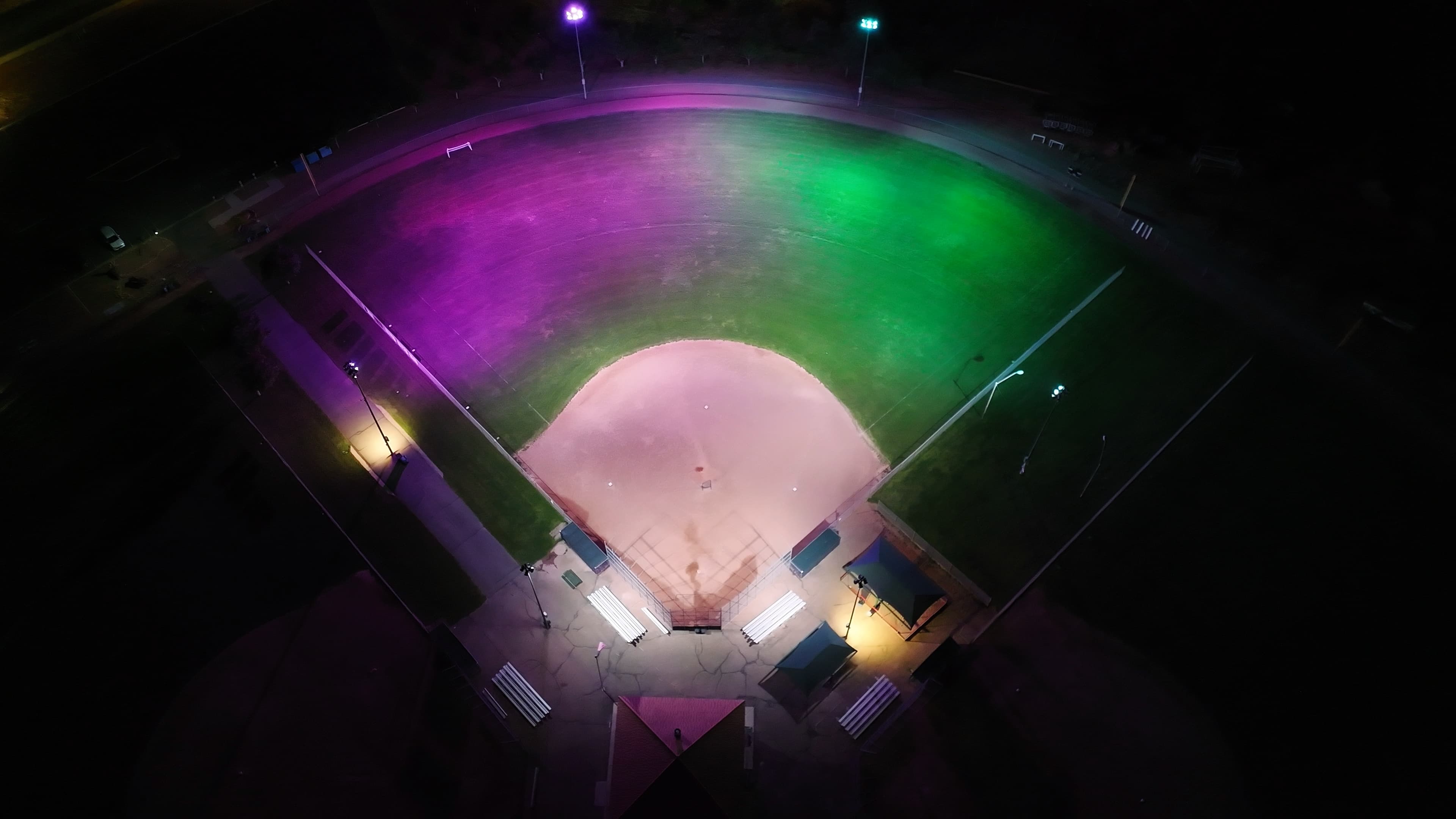
Why Atlanta-Area Baseball Facilities Are Making the Switch to LED
Greater Atlanta is one of the most sports-active metros in the Southeast. From the youth travel ball complexes lining the suburbs of Gwinnett County and Cherokee County to the high school stadiums of Cobb, DeKalb, and Fulton County, baseball and softball lighting is serious business here. And as energy costs rise and league standards become more demanding, facility operators across the region — municipal parks departments, school athletic directors, private club operators, and stadium managers — are finding that aging metal halide and high-pressure sodium (HPS) lighting systems simply can't keep up.
The shift to LED sports lighting isn't just a trend — it's becoming the operational standard. The question for most Atlanta-area facilities is no longer whether to upgrade, but when and how to do it right.
The Hidden Costs of Outdated Field Lighting
Traditional HID (high-intensity discharge) fixtures — the metal halide and HPS systems installed in most Atlanta-area ballparks over the past two to three decades — were the best available technology at the time. But they come with real operational liabilities that compound over the years:
- Energy inefficiency — Metal halide systems typically consume 1,000 to 1,500 watts per fixture. LED replacements deliver equivalent or superior light output at 50–60% of that energy draw, a meaningful reduction for facilities running lights multiple nights per week across a full spring and fall season
- Lamp outages and uneven light — As HID lamps age, their lumen output degrades and color shifts. Fielders and batters lose depth perception. Umpires struggle with inconsistent shadows. Fans and broadcast cameras see a dimmer, patchier field
- Long restrike times — Metal halide fixtures can take 15–20 minutes to reach full brightness — and if they're interrupted during a rain delay, they can't simply be switched back on. LED systems are instant-on, every time
- Maintenance burden — Replacing lamps in pole-mounted field fixtures requires bucket trucks, crew time, and field closures. LED systems dramatically extend replacement intervals, reducing that operational drag
For school athletic directors in communities like Roswell, Smyrna, or Peachtree City — managing tight maintenance budgets while keeping fields available for games, rentals, and community programs — these are not abstract problems. Every outage is a canceled game, a lost rental booking, or a safety concern.
A real-world example from VOSS' project history illustrates the stakes well. At North Hills Middle School in Bloomfield, Michigan, multiple lamp outages had rendered the football field unusable for night events, costing the school field rental revenue and disrupting athletic programming. VOSS replaced sixty-eight 1,500-watt HID fixtures with 750-watt Keystone Sports Lighter LED fixtures — cutting energy consumption in half — and developed a full photometric layout to ensure uniform, compliant illumination across the field. The result was immediate: a fully functional, brilliantly lit facility that the school's Director of Maintenance & Operations described as "truly outstanding," noting that the project "unfolded seamlessly from start to finish." While that project was a football field, the principles translate directly to baseball and softball facilities of comparable scale — and VOSS applies the same engineered approach to every diamond it lights.
What Good Baseball Field Lighting Actually Requires
Not all sports lighting projects are equal — and baseball and softball present unique design challenges that distinguish them from football, soccer, or other field sports. A well-designed baseball lighting system must account for:
Pole Placement and Aiming Geometry Baseball fields have no fixed rectangular boundary. The arc of foul territory, the varying depths of different outfield configurations, and the need to avoid glare in the batter's eye zone all require careful photometric modeling before a single pole is set. Poor placement decisions made early in the design process can result in hotspots, dark zones near the warning track, or glare conditions that create safety risks for batters and fielders.
Uniformity Ratios Governing bodies including Little League Baseball, USSSA, NFHS (for high school play), the NCAA, and MLB each publish recommended illuminance levels and uniformity ratios for their respective levels of competition. A recreational youth field has different requirements than a varsity high school diamond, which in turn differs from a collegiate or professional venue. VOSS designs to the specific standard applicable to each facility's use case — not a one-size-fits-all specification.
Glare Control Glare is not just a comfort issue — it's a player safety concern. An LED system that floods the field with raw lumens without proper optical control can create blinding conditions for outfielders tracking fly balls. Modern LED sports fixtures from manufacturers like Musco incorporate precision optical engineering to direct light where it's needed and eliminate spill into the sky or into adjacent properties — a growing concern in the denser suburban communities surrounding Atlanta.
Controls Integration Today's LED sports lighting systems can be integrated with wireless controls platforms that allow facility managers to schedule lighting by field, by event type, or by time of day — all from a smartphone or web dashboard. For a parks and recreation department managing a complex of six or eight fields in a community like Kennesaw, Duluth, or Woodstock, that kind of operational control represents real labor savings and the ability to respond dynamically to schedule changes.
The Atlanta Market: Why This Matters Here
Greater Atlanta's sports infrastructure is among the most active in the country. The metro area's population of more than six million — spread across a sprawling network of counties including Fulton, Cobb, Gwinnett, Cherokee, Forsyth, Hall, and Henry — supports thousands of youth and adult athletic programs. The Georgia High School Association (GHSA) sanctions hundreds of member schools with active baseball and softball programs, many operating aging field lighting systems that predate the LED era.
At the same time, Atlanta has emerged as a hub for travel baseball and softball organizations, with major tournament complexes drawing teams from across the Southeast to facilities in communities like Cartersville, Canton, Gainesville, and McDonough. These venues compete on facility quality — and lighting is one of the most visible differentiators for players, parents, and tournament organizers evaluating venues.
Municipal parks departments across the region are also facing pressure to modernize aging infrastructure while managing constrained capital budgets. For public-sector organizations — including city and county parks departments and school districts — cooperative purchasing programs such as Sourcewell, BuyBoard, TIPS, and AEPA can simplify procurement and accelerate project timelines by eliminating the need for competitive bid cycles on pre-approved contracts. VOSS works with eligible organizations to navigate these programs efficiently.
Georgia Power's commercial and industrial incentive programs provide additional financial leverage for facilities pursuing LED upgrades. Energy efficiency rebates can meaningfully offset project costs — and VOSS' team helps clients identify and capture available incentives as part of the project scoping process. For readers interested in the broader landscape of rebate programs in this market, our article on Atlanta LED Lighting Rebates covers that topic in depth.
Designing for Every Level of Play
VOSS approaches baseball and softball lighting projects with a process built around the specific requirements of each facility — not a templated spec applied universally. That means:
- Photometric modeling conducted prior to design finalization, verifying that proposed layouts will meet the applicable illuminance and uniformity standards for the venue's level of play
- Fixture selection matched to the physical dimensions of the field, the mounting height of existing or planned poles, and the optical performance requirements of the sport
- Controls strategy developed in concert with the facility's operational needs — whether that's a simple scheduled timer or a fully integrated wireless platform with remote monitoring and diagnostics
- Permit coordination and installation managed by VOSS' licensed electrical crews, with experience navigating local jurisdictions across the Atlanta metro and surrounding counties
- Commissioning and documentation to verify performance against design targets and provide the facility with the records needed for utility rebate applications
This same disciplined approach applies whether VOSS is lighting a two-field youth complex in Acworth or a multi-field tournament venue in Lawrenceville. For facilities interested in exploring how these principles extend to indoor athletic spaces, our LED Gymnasium Lighting Solutions article covers the gymnasium environment in detail. Similarly, those managing multi-sport parks may find relevant parallels in our content on Pickleball LED Lighting Solutions and Tennis Court Lighting and Energy Solutions.
Service Availability
While VOSS offers a comprehensive suite of national services, specific capabilities may vary by location. Please contact your local branch to confirm the current availability of specific services, technology solutions, or contracting capabilities in your immediate market.
Talk to VOSS About Your Atlanta-Area Baseball Facility
Whether you're managing a single community field in Marietta or overseeing a regional tournament complex in Gwinnett County, VOSS is ready to help you think through what a lighting upgrade could mean for your facility — operationally, financially, and for the players and fans who use it.
Our Atlanta team brings both the technical expertise to design a system that performs at the highest level and the project management experience to deliver it on schedule.
VOSS — Atlanta Branch
Phone: (770) 438-8557 Toll-Free: (888) 725-8897
Contact us to schedule a consultation and learn how professional LED lighting can elevate your baseball or softball facility.