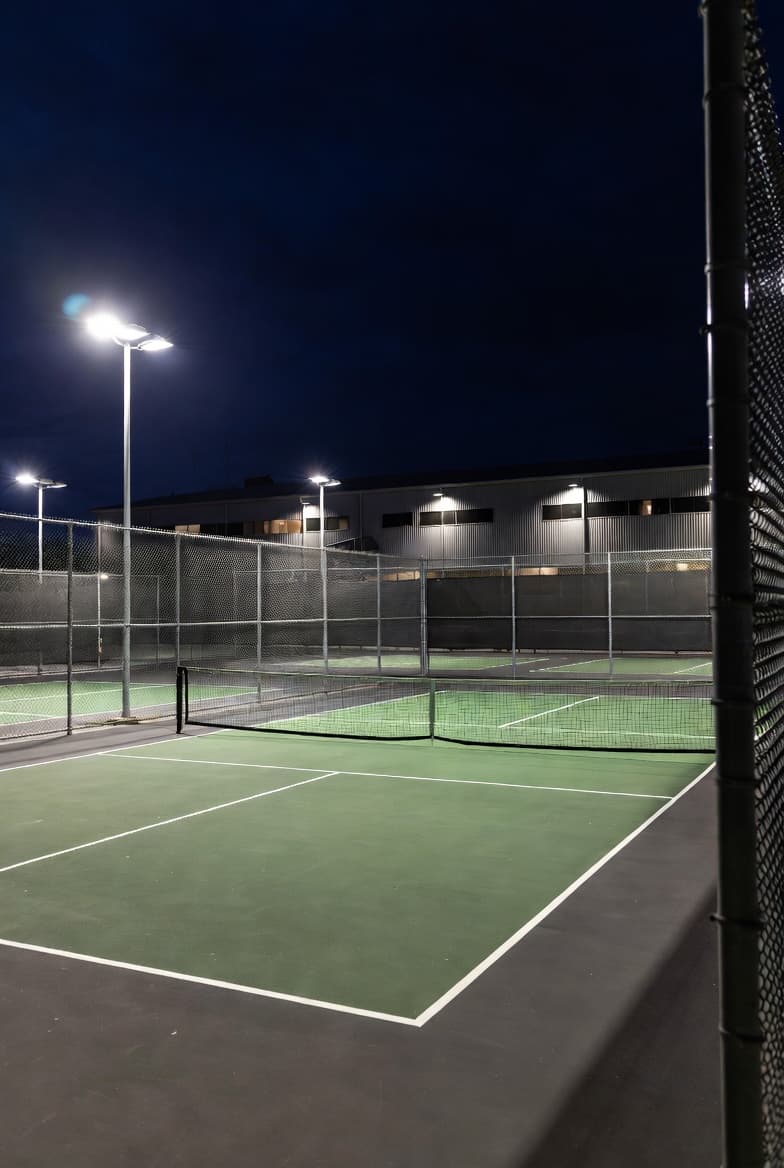
Pickleball's Surge in Johns Creek — And Why Lighting Is a Critical Infrastructure Decision
Pickleball has become one of the fastest-growing recreational sports in the United States, and Johns Creek is no exception. With a population of approximately 81,000 and a community profile built around active lifestyles, family amenity expectations are high. From Newtown Park to private fitness clubs and HOA community centers, demand for quality pickleball facilities is intensifying across Johns Creek and neighboring communities like Alpharetta, Duluth, Suwanee, and Cumming.
But building or expanding pickleball courts is only half the equation. Inadequate lighting — or the complete absence of it — limits courts to daylight hours, frustrates players, and leaves revenue and community engagement on the table. For parks and recreation directors, club operators, and HOA facility managers, the lighting decision is no longer a minor detail. It's a strategic infrastructure choice.
The core question isn't whether to light a pickleball court. It's how to do it right — and how to make the investment work financially over time.
Why Older Lighting Technologies Fall Short on Pickleball Courts
Pickleball is a uniquely demanding sport from a visual standpoint. The court is smaller than a tennis court, the ball moves fast at unpredictable angles, and the non-volley zone ("the kitchen") requires precise spatial awareness from players. Lighting that produces glare, hotspots, or uneven coverage doesn't just inconvenience players — it creates genuine safety concerns and detracts from the quality of play that keeps members and patrons coming back.
Traditional metal halide and halogen fixtures — still common at many parks and older recreation centers across Fulton County and Gwinnett County — were never designed for this sport's demands. They present a range of operational problems that are increasingly difficult to justify:
- Uneven illumination creates shadows at baselines and corners, making it harder to track the ball during fast exchanges
- Significant warm-up delays (often 15–20 minutes) make quick court scheduling impractical
- High energy consumption drives up utility costs month over month, straining parks department budgets
- Short fixture lifespans and frequent re-lamping needs demand maintenance labor that recreation staff often can't sustain
- Glare from poorly aimed or outdated fixtures causes eye strain and affects depth perception — a real problem for the sport's growing population of older adult players
These aren't abstract concerns. They translate directly into reduced court utilization, lower membership satisfaction, and operational costs that compound over time.
What Modern LED Pickleball Court Lighting Actually Delivers
Contemporary LED systems engineered specifically for pickleball courts represent a meaningful leap forward in both performance and economics. Understanding the practical differences helps facility decision-makers evaluate investments accurately.
Illumination Quality That Matches the Sport
LED pickleball court lighting is designed to meet or exceed IES (Illuminating Engineering Society) recommendations — typically 30 footcandles for recreational play and up to 50 footcandles for competitive or league play. More importantly, modern systems achieve uniformity ratios of 1.5:1 or better, meaning the brightest and darkest spots on the court are closely matched. For players, this translates to consistent visibility across every square foot of the surface — from the service boxes to the non-volley zone lines.
Glare control is equally important. LED optics can be precisely aimed and shielded to direct light where it's needed and away from players' eyes — a significant improvement over the broad, uncontrolled spread of older HID fixtures.
Energy and Operational Savings That Matter to Budget-Conscious Operators
LED systems typically consume 50–75% less energy than the metal halide or halogen fixtures they replace. For a multi-court outdoor facility running evening hours across Georgia's long recreational season, that reduction translates into meaningful utility cost relief — and it compounds annually.
Lifespans exceeding 100,000 hours mean that a well-specified LED system installed today may not require relamping for a decade or more. For parks departments managing deferred maintenance backlogs, or HOA boards trying to contain operational expenses, that reduction in lifecycle cost is a genuine financial advantage.
LED fixtures are also instant-on — no warm-up period, no restrike delay. Courts can be scheduled, opened, and closed on demand, which matters operationally for reservation-based systems and evening programming.
Controls and Scheduling: The Underutilized Advantage
Many facility operators don't fully leverage the controls capabilities that modern LED systems enable. Programmable timers, occupancy-based dimming, and remote management platforms allow courts to be lit only when in use, automatically reducing consumption during off-peak hours. For Johns Creek parks facilities or fitness clubs with fluctuating utilization patterns, this level of control can meaningfully extend the financial ROI of the lighting investment.
From Sports Fields to Pickleball Courts: Lessons From the Field
The principles driving LED adoption in pickleball are well established across broader sports lighting applications. At North Hills Middle School in Bloomfield, Michigan, VOSS replaced sixty-eight 1,500-watt HID fixtures with 750-watt Keystone Sports Lighter LED fixtures — a retrofit that cut energy use dramatically while delivering dramatically improved field illumination. Jacob McDermott, Director of Maintenance and Operations, described the results: "The new lights themselves are nothing short of amazing, providing brilliant and uniform illumination that dramatically enhances the field for both players and spectators."
The underlying story there — aging HID fixtures creating outages, lost scheduling opportunities, and deferred maintenance burdens — is a pattern that mirrors what many pickleball facility operators in Johns Creek and across the Greater Atlanta metro are navigating today. The technology and the outcomes translate directly.
The Opportunity for Johns Creek Parks, Clubs, and Community Facilities
Johns Creek's demographics and community character make it a particularly strong market for investment in quality recreational infrastructure. The city's highly engaged resident base, its proximity to Alpharetta's growing fitness and wellness economy, and its established parks system create a real case for upgrading court lighting — whether the goal is extending programming hours, improving player retention, or adding new courts to meet growing demand.
For parks and recreation directors, LED lighting makes evening programming financially sustainable and operationally straightforward. For HOA facility managers, it's a quality-of-life amenity that directly affects resident satisfaction and property value perception. For private club and fitness center operators, it's a competitive differentiator in a market where members compare facilities carefully.
Public-sector organizations and eligible institutions in Johns Creek and across Fulton and Gwinnett counties may also benefit from cooperative purchasing programs — including Sourcewell, TIPS, Omnia Partners, and BuyBoard — that streamline procurement and support compliance with public bidding requirements. These programs can significantly reduce the administrative burden of moving a lighting upgrade project forward.
It's also worth noting that Georgia utilities and the state's energy efficiency programs periodically offer rebates and incentives for LED retrofits at commercial and institutional facilities. Our related resources on commercial LED lighting rebates in the Dallas and Atlanta markets — covered in depth in sibling articles within this section — illustrate the types of incentive structures available. Facilities in the Greater Atlanta area, including Johns Creek, Roswell, and Peachtree Corners, should evaluate applicable programs before finalizing project budgets. Our article on Atlanta LED Lighting Rebates is a useful companion resource for this planning.
Service Availability
While VOSS offers a comprehensive suite of national services, specific capabilities may vary by location. Please contact your local branch to confirm the current availability of specific services, technology solutions, or contracting capabilities in your immediate market.
Connect With VOSS in the Greater Atlanta Area
Whether you're evaluating a new court lighting installation, planning an LED retrofit of existing fixtures, or simply trying to understand what the right specification looks like for your facility's needs and budget, our Atlanta team is available to discuss your project in detail.
VOSS — Atlanta Branch
Phone: (770) 438-8557 Toll-Free: (888) 725-8897
We serve Johns Creek and the surrounding communities of Alpharetta, Duluth, Suwanee, Cumming, Roswell, Peachtree Corners, and the broader Greater Atlanta metro. Reach out to start a conversation about what the right pickleball lighting solution looks like for your facility.