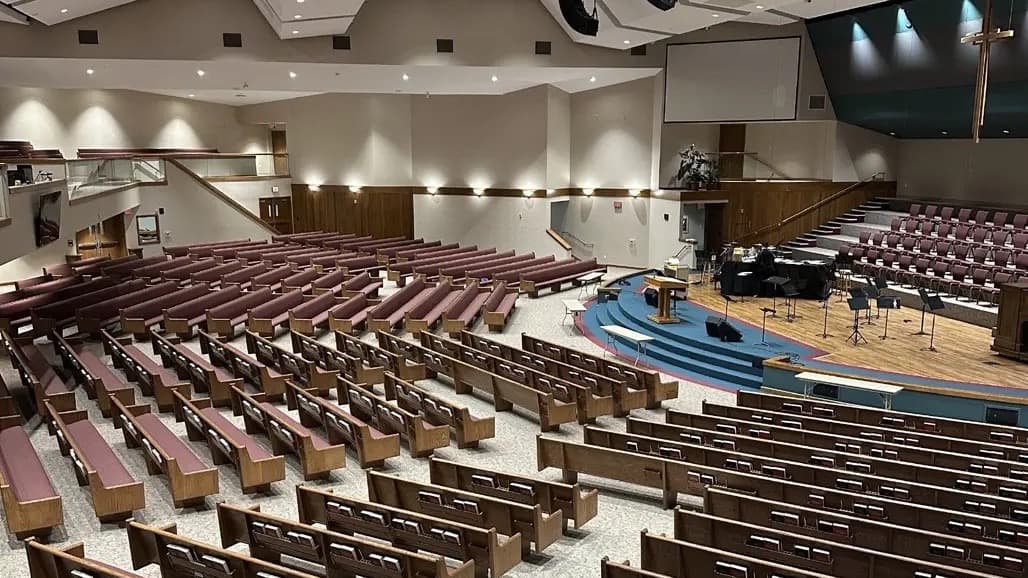
Why Sanctuary Lighting Is a Growing Concern for Johns Creek Churches
Johns Creek is one of the most actively churched communities in the Greater Atlanta region. With a population of approximately 81,000 residents spread across a prosperous, tight-knit suburban corridor — bordered by Alpharetta, Duluth, Suwanee, and Peachtree Corners — the city is home to a wide range of congregations, from intimate neighborhood churches to large multi-campus facilities. Many of these sanctuaries were built or last renovated during an era when incandescent, halogen, and metal halide lighting were the standard — technologies that are increasingly costly and difficult to maintain.
For facility managers and operations leaders at these churches, aging lighting infrastructure has quietly become one of the most persistent sources of budget strain and operational disruption. The conversation is no longer just about aesthetics — it's about stewardship, sustainability, and keeping facilities functional for the communities they serve.
The Real Maintenance Burden Behind Sanctuary Lighting
Sanctuaries present a unique set of challenges that most commercial lighting professionals don't encounter in office buildings or retail spaces. High vaulted ceilings, ornate architectural details, and historic construction methods all complicate what should be straightforward maintenance tasks.
Consider the compounding costs that church facility managers across the Johns Creek area navigate regularly:
- High-ceiling fixture access requires scaffolding, aerial lifts, or contracted labor every time a bulb fails — often multiple times per year with traditional light sources
- Aging ballasts in fluorescent and HID fixtures cause flickering, delayed start-up, and inconsistent color rendering that diminishes the quality of worship services and live-stream video
- Uneven illumination creates both safety concerns for congregants navigating dimly lit aisles and visibility problems for musicians, speakers, and audiovisual teams
- Energy inefficiency from legacy fixtures drives up utility costs month after month — costs that come directly out of ministry budgets
- Dimmer incompatibility between older fixtures and modern control systems limits a congregation's ability to create appropriate atmosphere for different service types
These aren't abstract problems. They're the day-to-day reality for maintenance supervisors who are often managing large facilities with small teams and limited capital budgets. Understanding how modern lighting technology addresses each of these pain points — and what a thoughtful upgrade strategy looks like — is the first step toward making a well-informed decision.
LED Technology and What It Actually Means for Church Facilities
The shift from traditional light sources to LED technology has been one of the most significant developments in commercial lighting over the past decade — and its implications for houses of worship are particularly meaningful. LED fixtures designed for sanctuary applications now deliver:
- Dramatically longer service life, often 50,000 hours or more, which translates to years — sometimes a full decade or longer — between lamp replacements in typical church use patterns
- Significant energy reduction, with quality LED fixtures commonly consuming 50–70% less energy than the incandescent, halogen, or fluorescent sources they replace
- Consistent, high-quality color rendering that makes wood finishes, stained glass, and architectural details appear as intended — a meaningful improvement over the flat or yellowed output of aging fluorescent or HID sources
- Compatibility with modern dimming and control systems, enabling congregations to set and recall scene presets for Sunday morning worship, midweek services, special events, or livestreaming
For churches in Johns Creek that host multiple weekly services, community events, or broadcast ministry, these capabilities represent a fundamental quality-of-life improvement — not just an energy upgrade.
The experience from comparable projects reinforces this point. When VOSS completed a lighting retrofit at Corewell Health in Dearborn, Michigan — a facility with similarly demanding environmental requirements and a need for consistent, high-quality illumination — the result was not only improved ambiance but virtually maintenance-free lighting that reduced the ongoing burden on the facilities team. While a healthcare facility differs from a sanctuary in many ways, the underlying principle is the same: the right LED system pays dividends in reduced maintenance hours, improved light quality, and long-term cost control.
Navigating the Unique Challenges of Church Lighting Projects
What separates a successful church lighting upgrade from a disruptive one is planning. Church facilities operate on a rhythm that doesn't pause for construction — Sunday services, Wednesday programming, weddings, funerals, holiday productions, and community gatherings all create a calendar that leaves very little room for extended shutdowns.
Experienced commercial lighting contractors understand that sanctuary projects require:
- Phased installation planning that works around the worship calendar, minimizing disruption to active services
- Photometric design analysis to ensure new fixtures deliver the right illumination levels across all areas of the sanctuary — from the front pews to the balcony, from the chancel to the narthex
- Assessment of existing wiring and dimming infrastructure before specifying new fixtures, avoiding compatibility issues that can emerge when mixing new LED technology with older control systems
- Sensitivity to architectural and historic constraints, particularly in older sanctuaries where ceiling attachments, conduit routing, or fixture mounting must be handled with care
Churches near Johns Creek in communities like Cumming, Lawrenceville, and Norcross face similar dynamics, and the planning approach that works well in one North Atlanta suburban sanctuary tends to translate effectively across this region. The Greater Atlanta market has a long track record of successful LED sanctuary retrofits, and that accumulated knowledge informs smarter project delivery.
Cooperative Purchasing: A Practical Path for Eligible Congregations
For churches affiliated with denominations, associations, or networks that participate in cooperative purchasing programs, there is an often-overlooked avenue for simplifying procurement. VOSS is an approved vendor through several cooperative purchasing programs — including the Houston Church COOP and Sourcewell, among others — that can make the procurement process more straightforward for eligible organizations.
These programs allow qualifying congregations to access pre-negotiated contracts, which can streamline the approval process, reduce administrative burden, and in some cases provide more competitive pricing than a standard bid process. If your church or its parent organization participates in any cooperative purchasing structure, it is worth asking whether those agreements extend to lighting and electrical services.
Making the Case for Proactive Lighting Investment
One of the most common barriers to sanctuary lighting upgrades is the perception that the timing isn't right — that the current system is "good enough" or that the capital expense can be deferred. But the true cost of deferred maintenance is rarely captured in a single line item.
Every service call to replace a bulb in a 30-foot ceiling carries labor, lift rental, and time costs. Every month of operating inefficient fixtures carries an energy cost. Every flickering ballast carries a congregant experience cost. And every year of delay is a year in which available utility rebates — programs offered through Georgia Power and other providers to incentivize commercial LED adoption — may go uncaptured.
For facility managers and finance leaders evaluating the timing of a sanctuary upgrade, a formal lighting audit is typically the best starting point. An audit quantifies existing energy consumption, identifies the fixtures most in need of replacement, maps out rebate eligibility, and provides the data needed to build a business case for leadership and board approval. It transforms a vague sense that "the lighting needs work" into a specific, actionable investment proposal.
Related articles in our Latest Lighting series — including our guides on Energy Efficient Church Lighting Upgrades, Energy Audits, Incentives, and Rebate Navigation for Businesses, and Maximize ROI with Commercial LED Lighting Rebates in Dallas, TX — explore these financial dimensions in greater depth and are recommended reading for any facilities or finance leader beginning this evaluation.
Service Availability
While VOSS offers a comprehensive suite of national services, specific capabilities may vary by location. Please contact your local branch to confirm the current availability of specific services, technology solutions, or contracting capabilities in your immediate market.
Connect with VOSS's Atlanta Team
VOSS serves churches and faith-based organizations throughout Johns Creek, Alpharetta, Duluth, Suwanee, Peachtree Corners, Cumming, and the broader North Atlanta region from our Atlanta branch. Whether you're dealing with a specific fixture failure, planning a full sanctuary renovation, or simply trying to understand your options, we welcome the opportunity to bring our expertise to your facility.
Our team can help you assess your current system, identify the right upgrade path for your budget and worship calendar, and navigate available rebate programs that can offset project costs.
VOSS — Atlanta Branch Phone: (770) 438-8557 Toll-Free: (888) 725-8897
Reach out to start a conversation about how modern lighting strategies can serve your congregation — and your facility team — better.