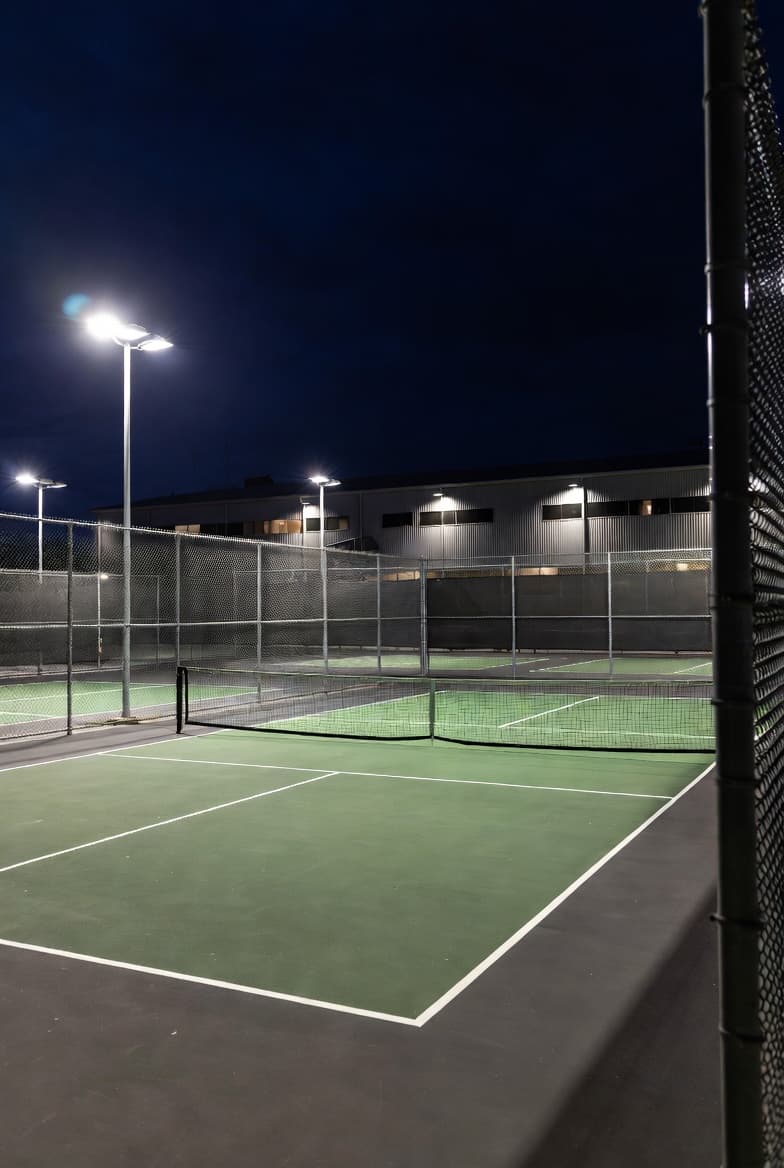
The Pickleball Boom Is Reshaping How Georgia Facilities Think About Lighting
Pickleball is no longer a niche pastime — it is now one of the fastest-growing sports in the United States, and communities across the Greater Atlanta region are feeling the surge firsthand. In Brookhaven, Dunwoody, Chamblee, and Tucker, parks and recreation departments are fielding growing requests for dedicated court access, night play, and expanded programming. Private clubs, HOAs, and fitness centers from Buckhead to Decatur are adding or converting courts at a pace few anticipated just five years ago.
That growth is putting serious pressure on facilities infrastructure — especially lighting. Many existing courts in DeKalb County and the surrounding area were built with older metal halide or halogen fixtures originally designed for general park use, not the fast-paced, precision demands of competitive or recreational pickleball. The result is uneven coverage, high glare, excessive energy consumption, and frequent maintenance headaches that limit both the player experience and a facility's ability to generate revenue from after-dark programming.
Understanding what modern LED court lighting can do — and what it means for a Brookhaven facility specifically — is the starting point for any organization evaluating an upgrade.
What Makes Pickleball Lighting Technically Different from General Sports Lighting
Pickleball courts present a unique set of photometric challenges that facility managers and parks directors should understand before specifying any lighting system. The court is smaller and faster than tennis, and the ball — typically a bright yellow or white perforated sphere — moves at speeds that demand consistent, shadow-free visibility across every zone of the playing surface.
The Illuminating Engineering Society (IES) recommends approximately 30 footcandles for recreational play and up to 50 footcandles for competitive or tournament-level play. Meeting those thresholds is only part of the equation. Equally critical is uniformity — the ratio of maximum to minimum light levels across the court. Poorly designed systems produce bright spots near the net and dark zones near the baselines, exactly where players need reliable visibility most.
Key lighting performance metrics that matter for pickleball courts include:
- Uniformity Ratio — A ratio of 1.5:1 or better (max-to-min illuminance) ensures the entire court surface is consistently lit, from the kitchen line to the back boundary
- Glare Control — High-angle glare from poorly aimed or over-lamped fixtures creates visual fatigue and tracking errors, particularly on lob shots and serves
- Color Rendering Index (CRI) — A CRI of 70 or higher helps players distinguish ball color and court markings clearly, even under artificial light
- Vertical Illuminance — Adequate light in the vertical plane (not just at ground level) is essential for tracking an airborne ball against a dark sky or ceiling
Older HID systems frequently fail on multiple fronts simultaneously. LED systems, when properly designed with site-specific photometric modeling, address all of these factors together — and do so with dramatically lower energy consumption.
Energy Efficiency and the Financial Case for Upgrading in the Atlanta Market
For facility managers and administrators in Brookhaven and across the Atlanta metro, the financial justification for LED conversion is increasingly straightforward. Modern LED sports lighting typically delivers 50–75% reductions in energy consumption compared to legacy metal halide systems. For a multi-court outdoor pickleball facility running evening programming several nights per week, that translates into meaningful utility savings over the life of the system.
Georgia Power serves a significant portion of the commercial and municipal customer base throughout DeKalb and Fulton counties, and eligible organizations should explore current rebate and incentive programs that can offset upfront capital costs. The combination of reduced operating expenses, lower maintenance costs (LED systems carry lifespans exceeding 100,000 hours), and available incentives means that the total cost of ownership for an LED upgrade often compares favorably — sometimes dramatically so — to continuing to operate and repair aging systems.
For parks and recreation departments, community centers, and public schools across Brookhaven, Chamblee, and Doraville that qualify as public-sector organizations, cooperative purchasing programs such as Sourcewell, BuyBoard, TIPS, and Omnia Partners can streamline procurement and eliminate the need for a standalone competitive bid process. These pre-negotiated vehicles are designed specifically to help government and education entities move projects forward efficiently and compliantly.
VOSS's Atlanta branch works routinely with DeKalb and Fulton County organizations to navigate both utility incentive programs and cooperative procurement pathways — ensuring eligible facilities capture every available dollar before a project begins.
VOSS has a demonstrated track record in high-performance sports lighting across multiple venue types. At North Hills Middle School in Bloomfield, Michigan, VOSS replaced sixty-eight aging 1,500-watt HID fixtures with 750-watt Keystone Sports Lighter LED fixtures across the football field — cutting energy consumption nearly in half while delivering dramatically improved uniformity and reliability. The school had been losing field rental revenue due to lamp outages that rendered the facility unusable after dark.
The outcome speaks for itself. Jacob McDermott, Director of Maintenance & Operations, described the results: "The results are truly outstanding. The project unfolded seamlessly from start to finish, with Voss Lighting demonstrating professionalism and efficiency throughout the process. The new lights themselves are nothing short of amazing, providing brilliant and uniform illumination that dramatically enhances the field for both players and spectators."
The parallels to pickleball court lighting challenges in Brookhaven are direct. Whether it is a school district managing athletic fields in the Cross Keys or Chamblee cluster, a private club near Peachtree Road, or a parks department overseeing facilities along the Nancy Creek greenway corridor, the core challenge is the same: aging systems that underperform, cost more to maintain, and limit after-hours programming potential.
For those also managing indoor gymnasium or multi-sport court environments, VOSS's LED Gymnasium Lighting Solutions and Tennis Court Lighting and Energy Solutions pages in the Latest Lighting section offer additional context on how lighting specifications shift across different athletic environments. The principles of photometric design, energy efficiency, and IES compliance apply across all of them.
What a Modern Pickleball Lighting Project Looks Like End-to-End
Facility managers considering an LED court lighting upgrade often have questions about the project process itself. What does a professional engagement actually involve, and how disruptive will it be to daily operations? A well-structured project follows a clear sequence:
- Site Assessment & Lighting Audit — A qualified lighting engineer evaluates existing fixture types, pole heights, wiring infrastructure, and current light levels against IES standards. This establishes a documented baseline and identifies gaps.
- Photometric Design & Modeling — Using industry-standard software, a custom lighting layout is modeled for the specific court dimensions, mounting heights, and performance targets of your facility. This is where uniformity ratios, footcandle levels, and glare angles are engineered in — not guessed at.
- Incentive & Rebate Analysis — Before procurement, eligible rebates and cooperative purchasing options are identified to maximize financial outcomes for the organization.
- Fixture Procurement & Supply — VOSS sources from a broad portfolio of commercial-grade LED sports lighting manufacturers, selecting products appropriate for the project's performance requirements and budget parameters.
- Installation & Commissioning — Licensed electrical crews handle all wiring, mounting, aiming, and verification against the photometric design. Projects are coordinated to minimize court downtime.
- Post-Installation Verification — Illuminance readings confirm that installed light levels meet the designed performance targets before the project is closed out.
This full-service approach — from audit through commissioning — is what distinguishes a professionally managed lighting upgrade from a simple fixture swap. For facilities in Brookhaven and across the Greater Atlanta market, it is the difference between a system that truly performs and one that merely replaces what was there before.
Service Availability
While VOSS offers a comprehensive suite of national services, specific capabilities may vary by location. Please contact your local branch to confirm the current availability of specific services, technology solutions, or contracting capabilities in your immediate market.
Talk to VOSS About Your Brookhaven Court Lighting Project
Whether you are managing a multi-court recreational facility in Brookhaven, overseeing parks programming for a DeKalb County community, or planning a new pickleball amenity for a private club or HOA in the Atlanta metro, VOSS is ready to help you think through what a modern LED lighting system could mean for your courts.
Our Atlanta branch serves Brookhaven, Dunwoody, Sandy Springs, Chamblee, Doraville, Tucker, Decatur, and communities throughout the Greater Atlanta region. We bring both local market knowledge and national resources to every engagement.
VOSS — Atlanta Branch Phone: (770) 438-8557 Toll-Free: (888) 725-8897
Reach out to start a conversation about your facility's lighting needs. We are glad to walk through the specifics of your courts, your goals, and the options that make the most sense for your organization.