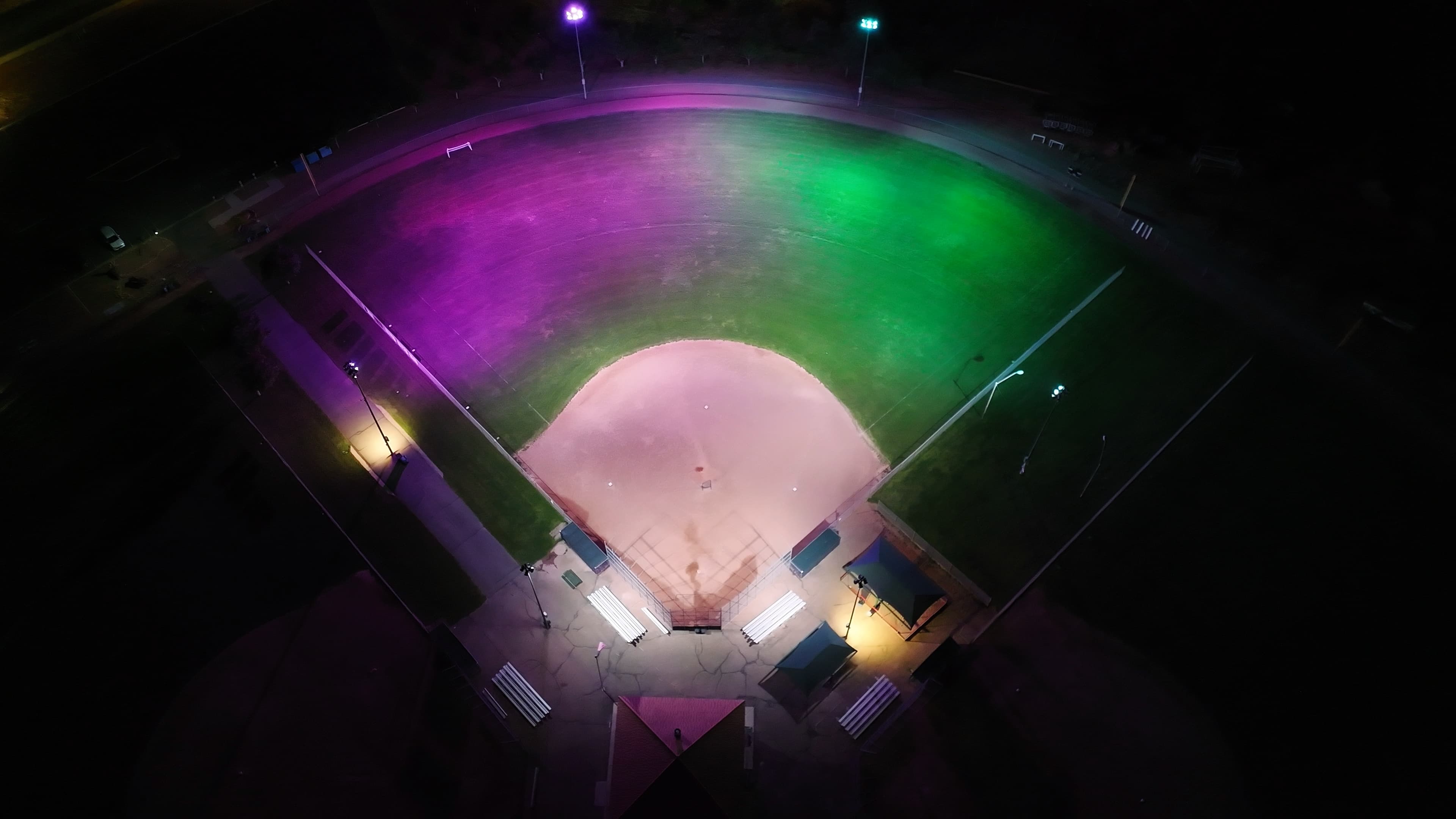
Why Baseball Lighting Is Having Its LED Moment in Greater Atlanta
Across Brookhaven and the broader metro Atlanta area — from Chamblee and Dunwoody to Tucker and Decatur — athletic fields are undergoing a quiet transformation. The metal halide and high-pressure sodium systems that lit generations of night games are aging out, and facility owners are discovering that the replacement isn't just a maintenance decision. It's a strategic one.
LED technology has matured to the point where it's now the clear standard for baseball and softball lighting at every level — from Little League complexes in community parks to NCAA programs and professional venues. The reasons go beyond energy efficiency. Modern LED systems offer tighter optical control, dramatically improved uniformity across the playing surface, and instant on/off capability that's simply not possible with older HID technology. For a community like Brookhaven, where recreational leagues, school athletics, and park programming all compete for field time into the evening hours, that reliability matters.
This article explores what facility owners, parks directors, school athletic administrators, and operations leaders in the Greater Atlanta region should understand about the current state of baseball LED lighting — and what separates a well-executed upgrade from one that falls short.
The Science Behind Sport-Specific Lighting Design
Not all LED upgrades are created equal, and baseball presents some of the most demanding lighting geometry challenges in all of sports. Unlike a rectangular court or a football field, a baseball diamond creates asymmetrical lighting zones — the infield requires a different illumination approach than the outfield, and the warning track, bullpen areas, and spectator zones each have their own demands.
A properly engineered baseball lighting system addresses several critical variables:
- Photometric layout and pole placement — The number, height, and positioning of poles must be calculated to deliver uniform foot-candle levels across every zone of play, minimizing shadows that can cause tracking errors for fielders and batters
- Glare control — Poorly aimed fixtures create direct glare that impairs a batter's ability to track a pitch or a fielder's ability to judge a fly ball; precision optics and aiming strategies are essential
- Maintained illuminance — LED systems maintain consistent lumen output over their rated lifespan far better than metal halide, meaning the field looks as good in year eight as it did in year one
- Compliance with governing body standards — Little League, high school associations, the NFHS, and college governing bodies each publish recommended foot-candle levels; professional and broadcast venues have additional requirements for camera and media performance
When any of these variables are miscalculated, the result isn't just suboptimal — it can affect player safety, game quality, and regulatory compliance. This is why lighting design for athletic fields demands a full photometric analysis before a single fixture is specified, not after.
From Brookhaven Parks to Metro Atlanta Campuses: Real Stakes, Real Decisions
Brookhaven's roughly 55,000 residents support a robust network of recreational facilities and school athletics, and the city sits within one of the most active youth and amateur sports markets in the Southeast. Fields serving communities in this corridor — whether maintained by DeKalb County Parks, individual municipalities, or private clubs — face the same operational pressures: aging infrastructure, rising utility costs, and increasing demand for nighttime programming.
For parks and recreation directors, the calculation is straightforward. Older HID systems burn through energy at rates that modern LED alternatives can cut by 50% or more, and their maintenance burden — frequent relamping cycles, ballast replacements, long warm-up periods — adds up quickly. A field that goes dark mid-season because a lamp bank fails doesn't just create a safety issue; it disrupts league schedules, disappoints families, and can mean lost rental revenue.
For school athletic programs across the Greater Atlanta region — whether at high schools in Brookhaven, Doraville, or Stone Mountain — the lighting system is often one of the oldest and most overlooked pieces of athletic infrastructure. A project VOSS completed at North Hills Middle School in Bloomfield, Michigan illustrates what's possible when aging HID fixtures are replaced with a purpose-built LED solution. The school's athletic director had been contending with multiple lamp outages that rendered the field unusable for night games and cost the program field rental income. VOSS replaced 68 high-wattage HID fixtures with modern 750-watt LED sports lighters, backed by a full photometric layout. The result was a fully functional, uniformly lit field that the school could rely on — described by the Director of Maintenance & Operations as providing "brilliant and uniform illumination that dramatically enhances the field for both players and spectators."
That kind of outcome — predictable, high-performance, maintenance-free — is what organizations across Greater Atlanta can expect from a well-executed LED retrofit.
Controls Integration: Unlocking the Full Value of LED
One of the advantages that often goes underutilized in sports lighting projects is controls integration. LED systems are inherently compatible with sophisticated lighting controls — and for baseball facilities that host multiple user groups across varying schedules, this capability pays real dividends.
A well-integrated controls package allows facility managers to:
- Program zone-by-zone dimming for warm-up periods, practice sessions, and different levels of competitive play
- Schedule automated on/off cycles tied to league schedules, reducing the risk of lights being left on unintentionally overnight
- Enable remote monitoring and override so operations staff can manage field lighting without being physically on-site
- Support broadcast and media requirements by maintaining consistent, flicker-free output at the color temperatures cameras require
For facilities that share fields across youth leagues, adult recreational leagues, and school programs — common throughout Brookhaven and DeKalb County — controls flexibility means the same physical infrastructure can serve very different needs without compromise. This topic is explored further in related resources on sports lighting controls and energy-efficient outdoor lighting upgrades.
Parks departments, municipal governments, and school districts that are planning capital improvements should also be aware that eligible public-sector organizations may have access to cooperative purchasing programs — including Sourcewell, BuyBoard, TIPS, Omnia Partners, and AEPA — that streamline procurement and eliminate the need for a full competitive bid process. These vehicles can meaningfully accelerate project timelines and simplify contracting for qualifying agencies across Georgia.
What to Look for in a Sports Lighting Partner
The Greater Atlanta market has no shortage of electrical contractors, but sports lighting at the level baseball demands — from photometric modeling through commissioning and long-term support — requires a partner with specific expertise. There are a few questions worth asking before committing to a project:
- Does the contractor perform a full photometric analysis before specifying fixtures? If the design process starts with a product recommendation rather than a lighting study, that's a warning sign.
- Can they demonstrate experience with sport-specific layouts? Baseball's asymmetric geometry is not forgiving of generic approaches. The contractor should be able to show prior sports lighting work at comparable scale.
- Do they manage the full project lifecycle? Procurement, installation, commissioning, and ongoing service support should all be within scope — not handed off to third parties at each stage.
- Are they familiar with utility rebate programs in Georgia? Energy-efficient athletic lighting upgrades may qualify for incentives through Georgia Power or other programs; a knowledgeable contractor will identify and help capture those savings as part of the project.
VOSS brings 85+ years of experience as a full-service commercial electrical contractor, with a local Atlanta branch serving Brookhaven, Dunwoody, Sandy Springs, Decatur, and communities throughout the metro region. Our approach to every sports lighting project begins with engineered design and ends with a facility that performs — night after night, season after season. For readers interested in related applications, our resources on LED gymnasium lighting solutions, pickleball LED lighting, tennis court lighting, and LED football stadium lighting offer further perspective on how these principles apply across athletic facility types.
Service Availability
While VOSS offers a comprehensive suite of national services, specific capabilities may vary by location. Please contact your local branch to confirm the current availability of specific services, technology solutions, or contracting capabilities in your immediate market.
Talk to VOSS About Your Brookhaven or Greater Atlanta Facility
Whether you're managing a community park complex in Brookhaven, overseeing athletics for a DeKalb County school, or planning a capital upgrade for a private club or university program in the metro Atlanta area, we'd welcome the opportunity to discuss how a purpose-built LED lighting solution can serve your specific field, budget, and operational goals.
Our Atlanta branch team is available to walk through your project, answer design questions, and help you understand what a well-executed baseball lighting upgrade looks like from start to finish — no pressure, just expertise.
VOSS — Atlanta Branch
Phone: (770) 438-8557 Toll-Free: (888) 725-8897