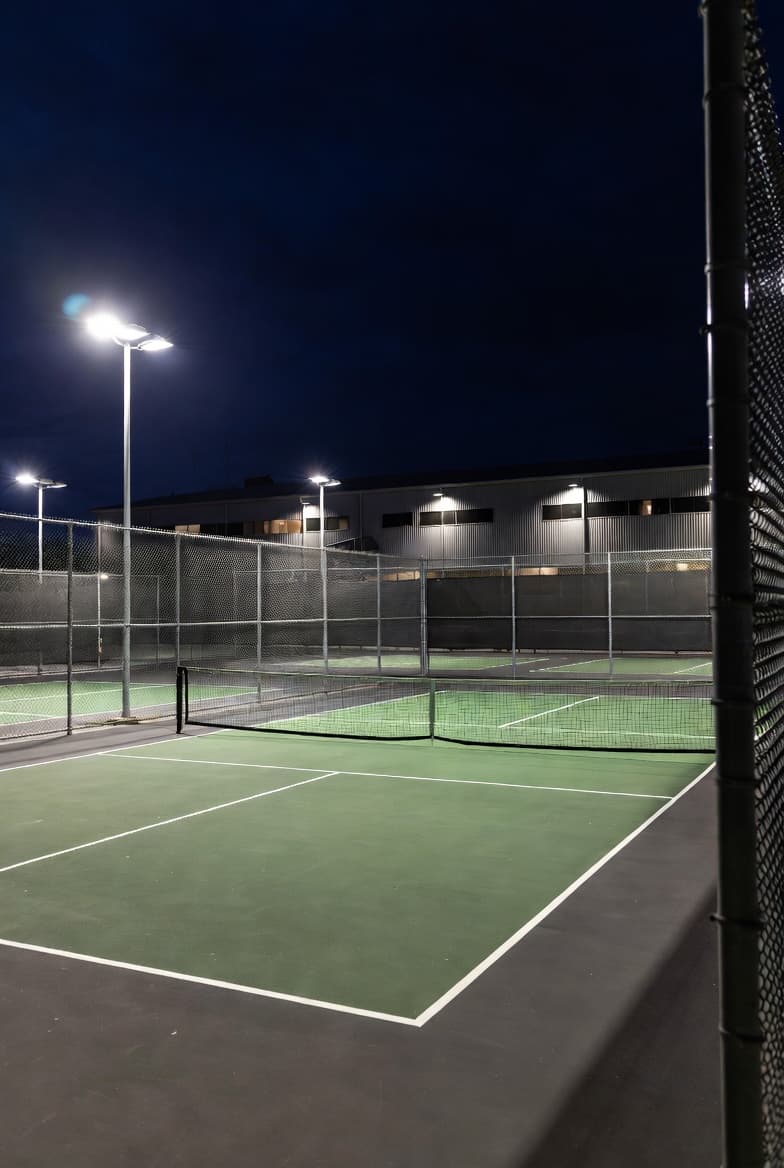
Alpharetta's Pickleball Surge — and What It Means for Facility Lighting
Pickleball is no longer a niche pastime. It's the fastest-growing sport in the United States, and Alpharetta, Georgia is feeling that momentum in a significant way. With a population of approximately 67,000 and one of the fastest-growing corridors in the Greater Atlanta metro, Alpharetta has seen rapid expansion in recreational infrastructure — from the greenways of Wills Park and Big Creek Greenway to private club developments and community recreation centers throughout North Fulton County.
Neighboring communities like Roswell, Milton, Johns Creek, and Cumming are experiencing the same surge in demand for dedicated pickleball courts. As facilities across this corridor race to meet player demand, one challenge is emerging as a critical bottleneck: lighting. Outdated metal halide, halogen, or fluorescent systems simply weren't designed for pickleball's unique demands — fast ball speeds, a compact court footprint, and the need for sharp, uniform visibility across the non-volley zone, kitchen line, and baselines.
For facility managers and parks directors across the Alpharetta area, the question is no longer whether to upgrade court lighting — it's how to do it right.
Why Pickleball Courts Have Unique Lighting Demands
Not all sports lighting is created equal, and pickleball presents a distinct set of requirements that differ meaningfully from tennis, basketball, or general recreational lighting. The court is smaller — 20 feet by 44 feet — but the game is faster and more reactive than many players expect. A plastic wiffle-style ball traveling at speed across a poorly lit court creates visibility challenges that directly affect player safety and enjoyment.
The Illuminating Engineering Society (IES) recommends illuminance levels of roughly 30 footcandles for recreational play and up to 50 footcandles or more for competitive and tournament-level play. Equally important is uniformity — the ratio between the brightest and dimmest points on the court. Poor uniformity creates hot spots and shadow zones that make it difficult to track the ball, particularly during overhead shots and fast exchanges at the net.
Legacy HID systems — the metal halide fixtures common in older parks and recreation facilities — tend to struggle on both counts. They produce inconsistent color temperature as they age, require a warm-up period before reaching full output, and generate glare that fatigues players over extended sessions. For Alpharetta parks facilities and recreation centers that are seeing courts booked from early morning through evening, these limitations translate directly into player complaints and reduced court utilization.
Key performance benchmarks that modern LED systems address:
- Uniformity ratios of 1.5:1 or better — ensuring consistent ball visibility from baseline to net
- Color rendering index (CRI) of 70 or higher — improving the contrast between the ball and court surface
- Instant-on performance — no warm-up delays when courts are activated for evening play
- Glare control optics — reducing spill light onto adjacent courts, pathways, and neighboring properties
The LED Advantage: Energy, Longevity, and Operational Control
Beyond performance on the court, facility operators in Alpharetta and across North Fulton County are weighing a practical business case for LED upgrades. The numbers are compelling.
Modern LED sports lighting systems typically deliver a 50–75% reduction in energy consumption compared to legacy HID systems. For a multi-court facility running lights several hours per evening — particularly one that's expanded its hours to meet demand — that efficiency gain translates into meaningful utility cost reduction year over year. Georgia Power serves much of the Greater Atlanta region including Alpharetta, and eligible commercial and institutional customers may have access to utility incentive programs that can reduce the upfront cost of qualifying LED upgrades. Organizations are strongly encouraged to consult with their utility representative and a qualified lighting contractor to understand current program availability and eligibility requirements.
Longevity is the other major operational story. Quality LED sports fixtures are rated for 100,000 hours or more of useful life — a figure that dwarfs the lifespan of metal halide alternatives. For parks departments and recreation directors already managing lean maintenance budgets, fewer lamp replacements mean fewer emergency work orders, fewer court closures, and more predictable capital planning.
VOSS has seen this dynamic play out across a wide range of sports and recreation facility upgrades. At North Hills Middle School in Bloomfield, Michigan, our team replaced sixty-eight 1,500-watt HID fixtures with 750-watt Keystone Sports Lighter LED fixtures — cutting wattage in half while delivering dramatically improved field illumination. Jacob McDermott, Director of Maintenance and Operations, described the results as "truly outstanding," noting that the project unfolded seamlessly and that the new lights provide "brilliant and uniform illumination that dramatically enhances the field for both players and spectators." While that project involved a football field, the core engineering principles — uniform photometric design, right-sized fixture wattage, and quality LED optics — apply directly to pickleball court lighting projects.
What facility operators across the Alpharetta area should evaluate:
- Current fixture type and age — Metal halide systems more than 10 years old are strong candidates for replacement
- Court hours of operation — Facilities with evening or extended-hours programming will see the fastest payback
- Number of courts — Multi-court complexes benefit disproportionately from LED efficiency at scale
- Neighbor and community impact — LED optics with precise beam control reduce light trespass onto adjacent residential areas, a meaningful consideration in Alpharetta's mixed-use development landscape
Trends Shaping Court Lighting in the Greater Atlanta Region
The Greater Atlanta metro is not just growing in population — it's growing in sophistication around how recreational facilities are designed, operated, and funded. Several trends are converging that make this a pivotal moment for Alpharetta-area facilities thinking about court lighting.
Smart controls and scheduling are increasingly being integrated with LED sports lighting systems. Occupancy-based dimming, scheduled on/off programming, and remote monitoring allow facility managers to reduce energy consumption during off-peak hours without manual intervention. For a facility operator managing multiple amenities across a parks system — courts, fields, trails, parking areas — centralized control represents a meaningful operational improvement.
Tournament and revenue programming is another accelerating trend. Alpharetta and the surrounding North Fulton corridor host a growing number of organized athletic events, and proper lighting is a prerequisite for evening tournament play. Facilities that can credibly host sanctioned pickleball events — whether through USA Pickleball-affiliated clubs or local recreation leagues — generate incremental revenue and community engagement that justifies the capital investment in upgraded lighting infrastructure.
Fluorescent and HID phase-outs are also creating a practical urgency. As covered in related articles in our Latest Lighting series — including our guides on fluorescent tube bans and LED lighting rebates — regulatory and supply chain pressures are accelerating the timeline for facilities still relying on legacy lighting technologies. Waiting for a system to fail entirely before planning an upgrade is increasingly risky from both a reliability and procurement standpoint.
Considerations for Public Parks, Recreation Centers, and Private Clubs
The Alpharetta pickleball market spans a wide range of facility types, each with its own decision-making context.
Municipal parks and recreation departments in Alpharetta, Roswell, Milton, and surrounding Fulton and Forsyth County jurisdictions are typically navigating capital budget cycles, public procurement requirements, and community stakeholder expectations. For eligible public-sector organizations, cooperative purchasing programs such as Sourcewell, BuyBoard, TIPS, Omnia Partners, and AEPA can streamline the procurement process — reducing the administrative burden of competitive bidding while ensuring pricing transparency. VOSS is experienced in supporting public-sector clients through cooperative contract vehicles.
Private clubs and fitness facilities along the GA-400 corridor and surrounding communities like Windward, Avalon-area developments, and Halcyon have more flexibility in procurement but face competitive pressure to deliver a premium player experience. Lighting quality directly affects member satisfaction and retention — and in a market where new pickleball-dedicated clubs are opening regularly, the gap between a well-lit facility and a poorly lit one is increasingly visible to prospective members.
Schools and educational institutions — including the many private academies and public schools across the Alpharetta, Johns Creek, and Milton attendance zones — are adding or expanding multi-use court facilities. These organizations benefit from the same energy efficiency and low-maintenance advantages as any other facility type, with the added consideration that outdoor lighting upgrades often intersect with broader campus safety and security goals.
Service Availability
While VOSS offers a comprehensive suite of national services, specific capabilities may vary by location. Please contact your local branch to confirm the current availability of specific services, technology solutions, or contracting capabilities in your immediate market.
VOSS serves the Alpharetta area and the broader Greater Atlanta region from our Atlanta branch. Our team brings deep expertise in sports and recreational lighting design, photometric analysis, fixture procurement, and exterior installation — and we work closely with facility operators to understand operational goals before recommending a lighting approach.
VOSS Atlanta Branch Phone: (770) 438-8557 Toll-Free: (888) 725-8897
Let's Talk About Your Courts
Whether you're managing a city parks system in North Fulton County, operating a private club near GA-400, or overseeing a school campus with multi-use athletic courts, we'd welcome the opportunity to discuss how current LED lighting technology applies to your specific facility and goals. Our team can walk through a lighting audit, review photometric design options, and help you understand available utility incentives and procurement pathways.
Reach out to the VOSS Atlanta branch to start the conversation — no obligation, just practical guidance from a team that has been supporting facilities across the country for more than 85 years.