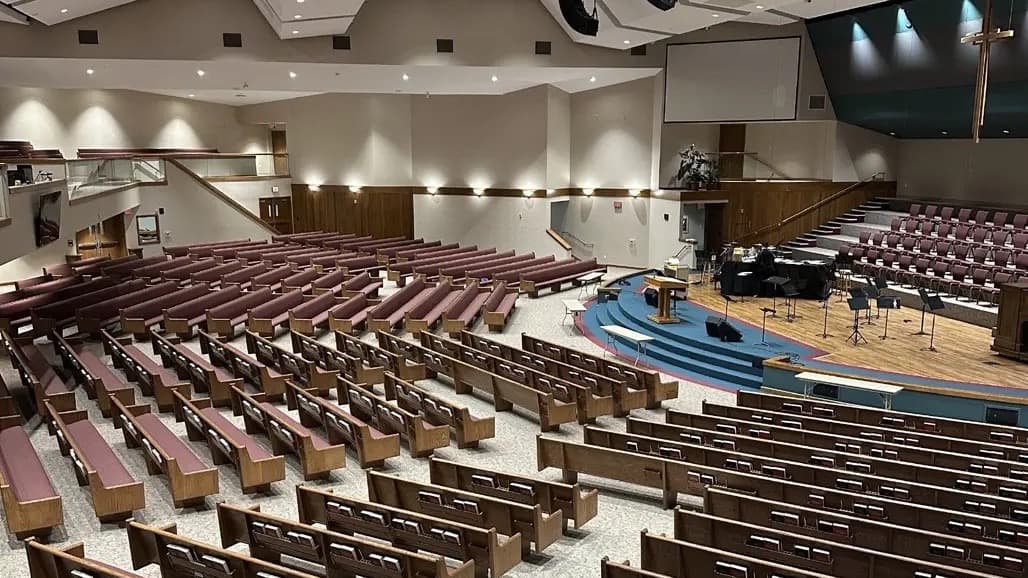
Why Sanctuary Lighting Is a Growing Priority for Alpharetta-Area Churches
Alpharetta, Georgia has experienced remarkable growth over the past two decades — and with that growth has come an expanding, diverse faith community. From large megachurches along the GA-400 corridor to historic congregations tucked into neighborhoods near Johns Creek, Roswell, and Milton, the greater Alpharetta area is home to a wide variety of worship facilities, each with its own lighting challenges.
For many of these churches, the lighting infrastructure hasn't kept pace with the congregation's growth. Sanctuaries built or last renovated in the 1990s and early 2000s were designed around incandescent, halogen, or fluorescent technology — fixtures that are increasingly difficult to source, expensive to maintain, and inadequate for the demands of modern worship, including live streaming and broadcast production.
What was once a background operational concern has become a front-line facilities priority. When lights flicker during a sermon, when scaffolding must be erected mid-week to replace burned-out bulbs in a 40-foot ceiling, or when uneven illumination leaves portions of the sanctuary dim and unwelcoming, the impact is felt by every person in the room — and by every viewer watching remotely.
The Unique Maintenance Challenges of Church Sanctuaries
Church sanctuaries present a distinct set of facility management challenges that differ meaningfully from standard commercial buildings. Understanding these challenges is the first step toward addressing them effectively.
Elevated Fixture Access Many sanctuaries feature vaulted ceilings, choir lofts, and architectural niches that place fixtures well out of routine reach. Replacing a single lamp may require renting a lift, coordinating with volunteers or staff, and scheduling work around services, rehearsals, and events. When traditional bulbs burn out every few months, this cycle becomes a significant burden on maintenance teams.
Aging Ballasts and Dimming Incompatibilities Fluorescent and older HID fixtures rely on ballasts that degrade over time, causing the flickering, humming, and inconsistent output that many facility managers know all too well. When these systems are paired with legacy dimmer controls — which were not designed for modern LED drivers — the problems compound. The result is a lighting environment that frustrates both staff and congregants.
The Live Streaming and Video Production Factor Across the Atlanta metropolitan area, including communities like Alpharetta, Cumming, and Duluth, churches have invested significantly in audio-visual technology to extend their reach beyond physical walls. However, camera systems are highly sensitive to color rendering inconsistency, flicker, and uneven light levels. Sanctuaries still running outdated fixtures often struggle to produce broadcast-quality video, regardless of how advanced their camera equipment may be.
Historic and Architectural Constraints Some congregations occupy older or architecturally significant buildings where preserving aesthetic character is a priority. Upgrading lighting in these environments requires sensitivity to design intent — matching fixture styles, preserving decorative elements, and ensuring that the warmth and ambiance of the space are enhanced, not diminished, by modern technology.
How LED Retrofits and Modern Controls Transform the Worship Environment
The transition from legacy lighting to LED-based systems is not simply a maintenance decision — it is a strategic investment in the long-term quality of the worship experience and the operational efficiency of the facility.
Extended Lamp Life Reduces Maintenance Cycles Modern LED fixtures are rated for tens of thousands of hours of operation, compared to the relatively short lifespan of traditional incandescent or halogen sources. For a sanctuary with high ceilings and difficult access, this means years between replacements rather than multiple service calls per year. The reduction in labor, lift rentals, and material costs adds up quickly.
Consistent, High-Quality Light Output LED technology delivers uniform illumination across the sanctuary floor — eliminating the hot spots and shadow zones that aging fixtures create. High Color Rendering Index (CRI) LEDs also reproduce colors more faithfully, which matters for everything from the appearance of choir robes and altar linens to the quality of recorded video.
Dimming and Controls Integration Contemporary LED systems are designed from the ground up to work with modern dimming controls and scene-setting technology. This means worship leaders can create distinct lighting environments for Sunday morning services, intimate evening gatherings, weddings, funerals, and special events — all from a single control interface, without the flickering or incompatibility issues associated with older systems.
Energy Efficiency and Cost Reduction LED fixtures consume a fraction of the energy of traditional sources. For churches running multiple services per week, operating throughout the day for community programs, and hosting events year-round, the energy savings are meaningful. This is particularly relevant in the Georgia market, where utility costs have trended upward and where Georgia Power offers energy efficiency programs that may be applicable to qualifying upgrades.
A parallel can be drawn from VOSS's work at Corewell Health in Dearborn, Michigan, where aging fluorescent fixtures with deteriorating lenses were replaced with uniform linear LED lighting. The result was a dramatically improved visual environment and virtually maintenance-free operation — outcomes that translate directly to the sanctuary setting.
What to Look for in a Church Lighting Partner
Not every electrical contractor is equipped to handle the nuances of a sanctuary environment. Church facility managers in Alpharetta — and across surrounding communities like Woodstock, Canton, and Marietta — should evaluate potential partners on several dimensions.
Experience with Complex Access and Low-Disruption Scheduling A qualified contractor understands that a church cannot simply shut down for a week of installation work. Retrofits must be phased and scheduled around the congregation's calendar — often working early mornings, weekdays, or late evenings to minimize disruption to services and programming.
Photometric Design Capability Before any fixture is installed, a lighting professional should model the proposed layout using photometric analysis software. This ensures that light levels, uniformity ratios, and color performance meet the sanctuary's specific needs — not just the general specifications of a product data sheet. VOSS demonstrated this capability in a sports lighting project at North Hills Middle School in Bloomfield, Michigan, where a full photometric layout was developed prior to installation, resulting in brilliant, uniform illumination that the facilities director described as "nothing short of amazing."
Fixture Selection Expertise The LED market is large and varied, and not all products perform equally in a sanctuary environment. Choosing fixtures with appropriate beam angles, color temperatures, dimming compatibility, and aesthetic profiles requires both product knowledge and design experience.
Turnkey Project Management From audit and design through procurement, installation, and commissioning, a full-service contractor keeps the project on track and ensures accountability at every phase.
Cooperative Purchasing: A Practical Path for Eligible Congregations
Some churches — particularly those affiliated with school systems, government-adjacent nonprofits, or faith-based institutions with public funding relationships — may be eligible to access cooperative purchasing programs that streamline procurement and reduce administrative burden.
VOSS is an approved vendor through several cooperative purchasing programs, including Houston Church COOP, Sourcewell, TIPS, BuyBoard, Omnia Partners, AEPA, PACE, and Nebraska ESU Co-Op. Eligible organizations can leverage these agreements to simplify the contracting process and move forward with lighting projects more efficiently.
If your congregation is unsure about eligibility, our Atlanta team can help you explore the options that may apply to your facility.
Service Availability
While VOSS offers a comprehensive suite of national services, specific capabilities may vary by location. Please contact your local branch to confirm the current availability of specific services, technology solutions, or contracting capabilities in your immediate market.
Further Reading in the Latest Lighting Series
If you found this article helpful, we encourage you to explore related topics in our Latest Lighting series. Our article on Energy Efficient Church Lighting Upgrades takes a deeper look at the energy and financial dimensions of faith facility modernization. For broader context on the rebate landscape in Georgia, our Atlanta LED Lighting Rebates page outlines available incentive programs that may apply to your project. And if your facility includes outdoor parking, walkways, or grounds lighting, our Parking Lot and Outdoor LED Lighting Upgrades article addresses those considerations as well.
Let's Talk About Your Sanctuary
Every congregation is different, and the right lighting solution for a 200-seat chapel in Alpharetta looks very different from what's needed for a 2,000-seat worship center off GA-400. VOSS brings 85+ years of electrical and lighting experience to every project — and our Atlanta branch team has the local knowledge to understand the specific context of your facility, your budget cycle, and your community's needs.
We invite facility managers, operations directors, and church leadership across Alpharetta, Roswell, Johns Creek, Milton, Cumming, and the broader Greater Atlanta area to reach out for a consultative conversation. There's no obligation — just an honest discussion about where your sanctuary lighting stands today and what a realistic path forward could look like.
VOSS — Atlanta Branch Phone: (770) 438-8557 Toll-Free: (888) 725-8897