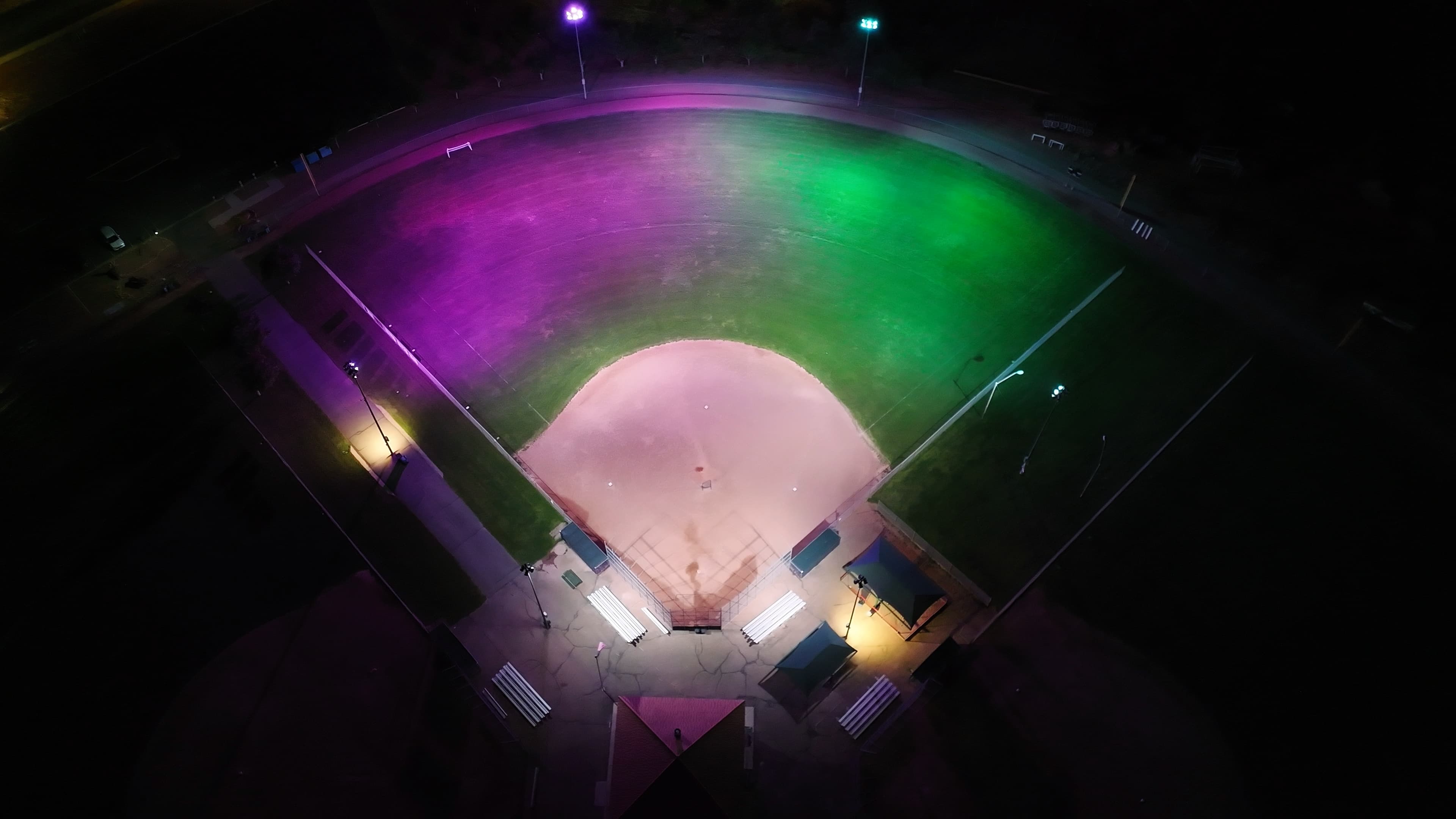
Why Baseball Lighting Is a Critical Investment in Alpharetta's Sports Landscape
Alpharetta, Georgia has become one of the most athletically active communities in the greater Atlanta region. With a population of approximately 67,000 and a surrounding corridor that includes Johns Creek, Roswell, Milton, and Cumming, the North Fulton area hosts a dense network of youth leagues, travel ball programs, high school varsity teams, and recreational adult leagues — all competing for quality field time from dusk onward.
That demand for night play puts enormous pressure on aging field lighting infrastructure. Across the region, many baseball and softball facilities still operate with metal halide or high-pressure sodium (HPS) fixtures that are decades old, energy-intensive, and increasingly difficult to maintain. When lamps fail — or when entire poles go dark mid-season — the consequences are immediate: canceled games, lost rental revenue, and frustrated athletes and families.
The good news is that LED technology has matured to the point where it sets the standard for sports lighting at every level of play, from Little League to NCAA. Understanding what drives a successful baseball LED lighting project is the first step toward making a smart, long-lasting investment for any facility in the Alpharetta area.
What Makes Baseball Lighting Different — and Demanding
Not all sports lighting challenges are equal. Baseball and softball present a unique set of optical and photometric demands that distinguish them from courts, tracks, or multi-use fields covered in related articles in this series, such as our pieces on pickleball LED lighting solutions, tennis court lighting, and LED gymnasium lighting solutions.
The geometry of the game creates complexity. A baseball diamond requires consistent illumination across multiple distinct zones — the infield, the outfield, the warning track, and the foul territory — each with different depth and distance characteristics. Batters need light that supports depth perception on a pitched ball traveling over 60 miles per hour. Outfielders must track fly balls against a dark night sky without glare interfering with their sight lines. Umpires need shadow-free visibility across the entire field of play.
Key technical considerations for any baseball or softball lighting project include:
- Pole placement and mounting height — Incorrect pole positioning creates shadows, hot spots, or direct glare into players' eyes. Engineered photometric modeling is essential before a single fixture is selected.
- Foot-candle levels by field class — Governing bodies including Little League Baseball, NFHS, NCAA, and MLB each publish minimum maintained horizontal and vertical illuminance requirements. Designs must account for light depreciation over time, not just initial output.
- Uniformity ratios — The ratio of maximum to minimum foot-candles across a playing surface directly affects how consistently players see the ball. Poor uniformity is one of the most common deficiencies in older systems.
- Glare control — Fixture optics must direct light onto the field while minimizing spill light that bleeds into adjacent residential areas — a particularly relevant concern in Alpharetta's densely developed neighborhoods near parks like Wills Park, Cogburn Road Park, and Webb Bridge Park.
- Broadcast and HD readiness — Facilities that host recorded or streamed games increasingly need high Color Rendering Index (CRI) values and flicker-free performance to support modern camera technology.
The LED Advantage: What Facility Operators in North Fulton Are Seeing
The shift to LED sports lighting is not a future trend in Alpharetta and the broader Atlanta metro — it is already well underway, and the results are demonstrably positive for facilities that have made the transition.
Energy and operational savings are substantial. Traditional metal halide systems common in older parks draw enormous amounts of power and require significant maintenance due to lamp burnout, ballast failure, and re-lamping cycles. LED systems operating at roughly half the wattage of equivalent HID fixtures reduce both energy consumption and maintenance labor — two of the largest ongoing costs for parks and recreation departments and school athletic programs.
The North Hills Middle School Football Field LED Retrofit in Bloomfield, Michigan offers a directly relevant lesson. In that project, VOSS replaced sixty-eight 1,500-watt HID fixtures with 750-watt Keystone Sports Lighter LED fixtures — cutting fixture wattage by 50% while producing a superior result. The Athletic Director had been dealing with multiple lamp outages that rendered the field unusable for night games, causing the school to lose field rental revenue. After VOSS completed a full photometric layout and executed the installation, the outcome was transformative. In the words of Jacob McDermott, Director of Maintenance and Operations: "The results are truly outstanding. The project unfolded seamlessly from start to finish, with VOSS demonstrating professionalism and efficiency throughout the process. The new lights themselves are nothing short of amazing, providing brilliant and uniform illumination that dramatically enhances the field for both players and spectators."
That experience — a school athletic program losing revenue to aging, failing infrastructure, then recovering full field functionality through a well-executed LED retrofit — mirrors situations faced by many Alpharetta-area facilities managing aging parks and recreation assets.
Beyond energy, LED unlocks operational flexibility. Unlike metal halide systems that require a 15–20 minute warm-up period to reach full brightness, LED fixtures provide instant-on performance. For facilities managing multiple games per evening, or dealing with weather delays, this means no more waiting — and no more partial re-illumination during a rain delay. When integrated with lighting controls, field operators can dim, schedule, or remotely manage fixtures, reducing energy waste during practice sessions or low-attendance events.
Designing to Standard: What League Compliance Actually Requires
One of the most important and least-discussed aspects of baseball LED lighting is league and governing body compliance. For facility operators in Alpharetta — whether managing a Fulton County park, a private sports complex along GA-400, or a high school campus in the Alpharetta High School or Milton High School feeder zone — understanding the standards that govern your field class matters.
Little League and recreational fields typically require maintained horizontal illuminance in the range of 30–50 foot-candles on the infield and 20–30 foot-candles in the outfield, depending on field class and league level. These standards are achievable with relatively modest LED systems, but proper pole placement and photometric design are still non-negotiable.
High school varsity and travel ball facilities are governed by NFHS standards and typically require higher maintained illuminance levels, stricter uniformity ratios, and in some cases, vertical illuminance compliance to support multi-camera broadcast coverage.
Collegiate and professional venues — including facilities serving the Atlanta metro's growing collegiate baseball programs — require full compliance with NCAA or MLB standards, including rigorous vertical illuminance testing, glare control documentation, and often LEED or sustainability reporting.
VOSS approaches every project with a photometric-first methodology: before recommending fixture types, pole counts, or system components, our team models the specific field geometry, surrounding environment, and target standards to produce a design that performs correctly from day one. This approach is consistent whether we are working on a two-field community park in Alpharetta or a larger multi-diamond complex serving communities throughout the North Fulton corridor.
A Note on Controls Integration and Long-Term Value
For facilities in Alpharetta and across the greater Atlanta area investing in new baseball LED systems, the lighting fixture itself is only part of the story. Intelligent controls integration — scheduling, zoning, dimming, and remote monitoring — can extend the life and efficiency of a lighting investment significantly.
Controls allow facility managers to program field lighting schedules around league calendars, automatically shut off lights after games, and monitor system health remotely. For parks and recreation departments managing multiple facilities across Alpharetta, Roswell, Johns Creek, and Milton, centralized controls visibility can reduce staff burden and catch maintenance issues before they result in field closures.
This is a topic we explore in greater depth in related articles in this series, including our coverage of sports lighting controls and energy audit and incentive programs that can offset project costs.
For public agencies and school districts in the Alpharetta area, cooperative purchasing programs including Sourcewell, TIPS, BuyBoard, AEPA, and Omnia Partners offer pre-negotiated contract vehicles that can streamline procurement, reduce administrative burden, and accelerate project timelines — all while ensuring full compliance with public bidding requirements.
Service Availability
While VOSS offers a comprehensive suite of national services, specific capabilities may vary by location. Please contact your local branch to confirm the current availability of specific services, technology solutions, or contracting capabilities in your immediate market.
Connect With VOSS in Alpharetta and Greater Atlanta
VOSS's Atlanta branch serves Alpharetta and the full North Fulton County corridor, including Roswell, Milton, Johns Creek, Cumming, and communities throughout the greater Atlanta metropolitan area. Whether you are managing a city parks renovation, a school athletic upgrade, or a private sports complex expansion, our team is ready to walk through the specifics of your facility, your league requirements, and your budget timeline.
We invite facility managers, athletic directors, parks and recreation directors, and private sports venue operators to reach out for a consultative conversation — not a sales call. The right baseball LED lighting solution starts with understanding your field, your players, and your goals.
VOSS — Atlanta Branch Phone: (770) 438-8557 Toll-Free: (888) 725-8897