Why Baseball Lighting Is a Bigger Deal Than You Might Think in the Triangle
Greater Raleigh is one of the fastest-growing metro areas in the United States — and that growth is showing up on the diamond. From youth recreation leagues in Wake Forest and Apex to travel ball complexes in Morrisville and Garner, and from high school programs across Wake and Durham Counties to collegiate competition at NC State, the demand for high-quality athletic facilities in this region has never been higher. Communities across the Triangle are investing in parks, fields, and multi-use sports complexes to keep pace with population growth and to attract tournaments that generate meaningful local economic activity.
At the center of many of these investments is one often-overlooked element: the lighting. Outdated metal halide or high-pressure sodium field lighting — still found on a surprising number of local fields — creates real problems for players, facility operators, and local budgets alike. Slow warm-up times, inconsistent light distribution, high energy consumption, and steep maintenance costs are challenges that LED technology has largely solved. Understanding how modern sports lighting works — and what separates a well-engineered installation from a basic fixture swap — is essential knowledge for anyone responsible for managing or upgrading a baseball or softball facility in this region.
The Science Behind Sport-Specific LED Lighting Design
Not all LED upgrades are created equal, and baseball is one of the most technically demanding sports to light correctly. Unlike a parking lot or a warehouse, a baseball field requires lighting that accounts for multiple planes of play simultaneously — the infield skin, the grass diamond, the outfield, the warning track, and the vertical plane through which a pitched or batted ball travels at high speed.
A properly engineered baseball lighting system addresses several interconnected challenges:
- Uniformity ratios — Light must be distributed evenly across the entire playing surface to eliminate hot spots and dark zones that impair depth perception for batters and fielders
- Vertical illuminance — Players need to track a ball in three dimensions; vertical foot-candle levels matter just as much as horizontal readings at ground level
- Glare control — Poorly aimed or over-lamped fixtures create glare that affects players' ability to track fly balls and line drives; fixture optics and pole placement are critical design variables
- Spill and obtrusive light — In dense suburban communities like those throughout the Triangle, minimizing light trespass onto neighboring properties and roadways is both a courtesy and a code requirement
- Pole placement and height — The geometry of pole locations relative to field orientation, batter's eye sightlines, and outfield dimensions determines whether a system performs as designed or creates avoidable visual interference
League and governing body standards — including those established by the Illuminating Engineering Society (IES) and guidelines from organizations like USA Baseball, the NCAA, and Little League International — define minimum foot-candle levels for different levels of play. A well-designed system meets or exceeds those thresholds while distributing light in a way that serves the actual visual demands of the game.
What LED Technology Has Changed for Facility Operators
For facilities managers and parks and recreation directors across communities like Raleigh, Durham, Chapel Hill, Fuquay-Varina, and Holly Springs, the operational case for transitioning to LED has become increasingly clear over the past decade. The performance gap between modern LED systems and legacy metal halide installations has widened considerably, and the financial math has shifted in LED's favor — particularly as utility rates in the Duke Energy Carolinas and Duke Energy Progress service territories have continued to rise.
Several developments are worth understanding:
Energy consumption — Modern LED sports lighting systems use significantly less energy than the metal halide or high-pressure sodium fixtures they replace. For a multi-field complex running evening games several nights a week across a full season, the cumulative energy savings are substantial and can be quantified through photometric modeling before a project even begins.
Maintenance reduction — Metal halide lamps degrade in output over time (a phenomenon called lumen depreciation) and require periodic group relamping to maintain adequate light levels. LED fixtures maintain a much higher percentage of their initial output over their rated life, and individual fixture failures are far less common — a meaningful advantage for facilities with limited maintenance staff.
Instant on/off capability — LED systems reach full brightness immediately, with no warm-up period. This matters during rain delays, between games in tournament play, and in any situation where field conditions require rapid lighting changes. It also allows facilities to implement smarter scheduling and occupancy-based controls.
Controls integration — Modern LED sports lighting can be integrated with wireless controls platforms that allow facility managers to schedule lighting by field, adjust brightness levels for different events (practice versus game versus broadcast), and monitor system performance remotely. For parks and recreation departments managing multiple fields across a large municipality, this kind of centralized visibility is a meaningful operational upgrade.
Broadcast and video readiness — Fields used for livestreaming, broadcast coverage, or even high-quality amateur video production benefit from LED systems designed with appropriate color rendering index (CRI) values and flicker-free performance at video frame rates. As youth and amateur sports video content has grown, this has become a relevant consideration even at the recreational level.
Public Sector and Institutional Considerations for Triangle Communities
Many of the baseball and softball facilities in the Greater Raleigh area are owned and operated by municipalities, counties, school districts, or universities — organizations that face a distinct set of constraints when it comes to capital projects and procurement.
For public agencies and educational institutions in North Carolina, the procurement process for lighting projects must comply with state competitive bidding requirements. Cooperative purchasing programs — including Sourcewell, Omnia Partners, TIPS, BuyBoard, and AEPA — offer a legally compliant alternative to traditional bid processes, allowing eligible organizations to access pre-competed contracts for lighting equipment and installation services. These programs can meaningfully accelerate project timelines and reduce the administrative burden on staff who may not manage major capital projects on a regular basis.
VOSS has direct experience navigating cooperative purchasing on behalf of institutional clients. In Iowa, for example, we worked with Lewis Central Community Schools — a district that needed to demonstrate responsible stewardship of public funds — to structure a lighting upgrade that could be funded from within the existing operating budget rather than requiring a bond referendum. We also helped the district's legal team understand that Omnia Partners met the state's competitive bidding requirements, clearing the path for the project to move forward. That kind of procurement expertise is something VOSS brings to public-sector clients across every market we serve, including North Carolina.
Wake County Public School System, Johnston County Schools, Durham Public Schools, and the many municipal parks and recreation departments throughout the Triangle region may all find that cooperative purchasing programs simplify the path to upgrading aging athletic lighting systems.
A Proof Point: What Engineered LED Sports Lighting Delivers
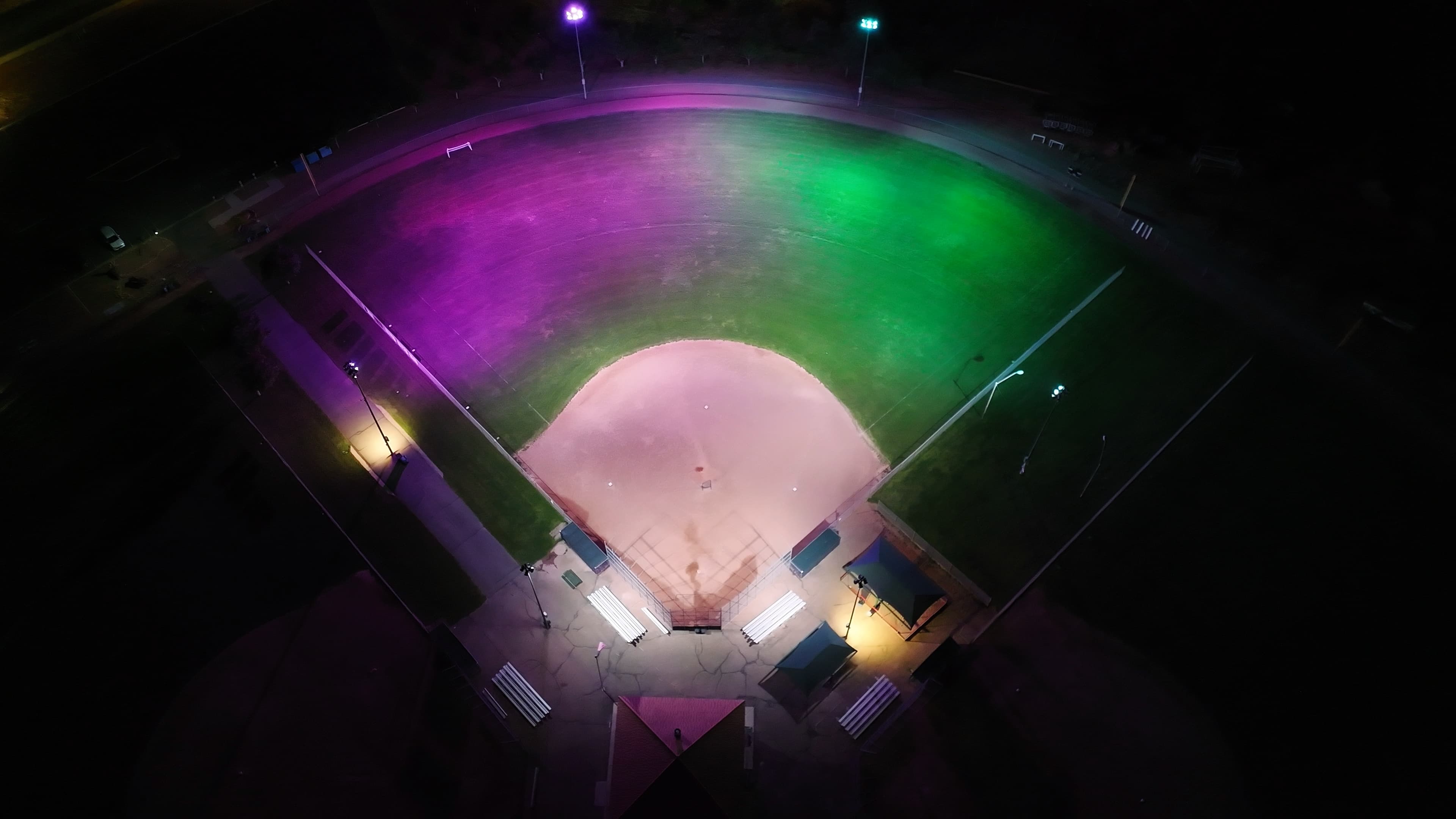
VOSS has completed sports lighting projects at facilities ranging from community recreation fields to professional and collegiate venues. One example from our project history that illustrates the scope of what's possible: a baseball lighting installation in Page, Arizona, where VOSS delivered a professionally engineered LED system designed to meet the specific illumination requirements of competitive play. Projects like this reflect our ability to manage the full lifecycle of a sports lighting engagement — from initial photometric design and utility coordination through structural analysis, installation, commissioning, and post-project support.
For facilities in the Raleigh metro area — whether a four-field youth complex in Knightdale, a high school stadium in Cary, or a collegiate facility in the Research Triangle Park corridor — that same end-to-end project management capability applies.
Related Topics in the VOSS Latest Lighting Series
Baseball and softball lighting is one piece of a broader conversation about athletic facility electrification and energy performance. If your organization is also evaluating other sports venues, our articles on LED Gymnasium Lighting Solutions, Pickleball LED Lighting Solutions, Tennis Court Lighting and Energy Solutions, and LED Football Stadium Lights and Sports Field Lighting Solutions cover adjacent topics in depth. For organizations considering the financial side of LED investments, our content on Energy Audits, Incentives, and Rebate Navigation for Businesses and Utility Lighting Rebates in Raleigh, NC provides practical guidance on identifying and capturing available incentives.
Service Availability
While VOSS offers a comprehensive suite of national services, specific capabilities may vary by location. Please contact your local branch to confirm the current availability of specific services, technology solutions, or contracting capabilities in your immediate market.
Talk to a Sports Lighting Expert in Raleigh
Whether you're managing a single community field or overseeing a regional sports complex, the decisions you make about lighting design have long-term consequences for energy costs, player safety, and the overall quality of your facility. VOSS welcomes the opportunity to discuss your project — even if you're still in the early stages of planning or budgeting.
Our Raleigh team serves communities throughout the Triangle and beyond, including Durham, Chapel Hill, Cary, Apex, Wake Forest, Morrisville, Garner, Clayton, Fuquay-Varina, Holly Springs, Knightdale, and surrounding areas across Wake, Durham, Johnston, and Chatham Counties.
VOSS — Raleigh Branch
Phone: (919) 779-8777 Toll-Free: (866) 292-0529
Reach out to start a conversation about what a well-engineered LED lighting system could mean for your baseball or softball facility.