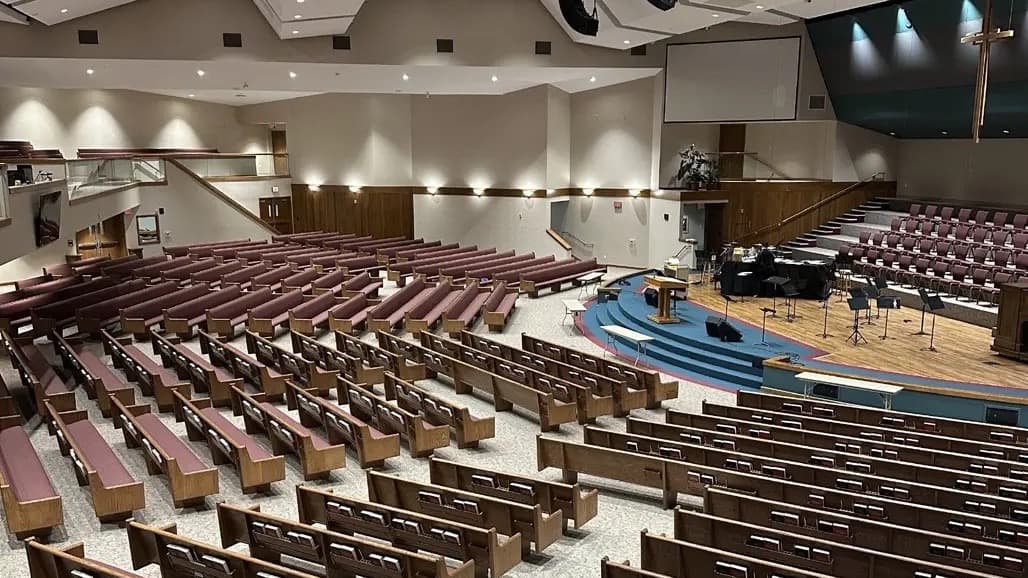
Why Sanctuary Lighting Deserves More Attention in High Point Churches
High Point sits at the heart of the Piedmont Triad — a region shaped by deep community roots, strong faith traditions, and a built environment that spans historic downtown sanctuaries, mid-century suburban churches, and newer multi-use worship campuses. Whether your congregation gathers near the furniture market district, in the surrounding communities of Jamestown, Archdale, or Trinity, or across the broader Guilford and Randolph County corridors, the lighting systems inside your sanctuary carry a weight that goes beyond simple utility.
Sanctuary lighting shapes how your congregation experiences worship — how clearly a reader at the pulpit can be seen, how comfortable elderly members feel navigating the nave, and increasingly, how your services appear on livestream or broadcast. Yet for many church facility managers and maintenance teams across the greater Raleigh and Piedmont region, sanctuary lighting remains a reactive concern — addressed only when a bulb burns out, a ballast fails, or a complaint surfaces. That reactive posture is worth reconsidering, and this article explains why.
The Hidden Costs of Aging Sanctuary Lighting Systems
Many High Point-area churches still operate lighting systems installed decades ago — incandescent, halogen, or fluorescent fixtures that were state-of-the-art at the time but now represent a significant and growing operational burden. Understanding these costs in concrete terms is the first step toward building a case for modernization.
Frequent lamp replacement in difficult-to-reach fixtures is one of the most persistent pain points for church facilities teams. Sanctuaries with soaring vaulted ceilings, ornate architectural features, or traditional A-frame designs often require scaffolding or aerial lifts every few months simply to replace burned-out bulbs. The labor cost — whether paid to staff or a contractor — typically far exceeds the cost of the lamps themselves.
Aging ballasts and incompatible dimmer systems are another common culprit behind flickering lights and inconsistent illumination. Fluorescent and older HID ballasts degrade over time, producing the kind of inconsistent light output that is both visually distracting during services and technically problematic for video production. For churches that livestream services — a practice that expanded dramatically post-2020 and has become a permanent expectation for many congregations — uneven or flickering light is not a minor annoyance. It directly affects the quality of your digital ministry.
Energy consumption is a third, often underestimated cost center. A typical sanctuary running incandescent or older fluorescent fixtures can consume energy at two to four times the rate of an equivalent LED system. For churches managing tight operating budgets — balancing facility costs against programming, staffing, and outreach — that gap represents real dollars that could be redirected.
The broader trend in commercial and institutional lighting is clear: the industry has moved decisively toward LED technology and smart controls, not because of regulatory pressure alone, but because the operational and financial math is compelling. North Carolina has aligned with this direction, with utility incentive programs through Duke Energy and Dominion Energy North Carolina offering rebates that can meaningfully offset retrofit project costs for eligible organizations.
What Modern Church Lighting Upgrades Actually Involve
For many facility managers, the term "lighting upgrade" conjures images of disruptive construction, complex technology, and extended periods of disruption to services. In practice, well-planned LED retrofits for church sanctuaries are designed to minimize exactly those concerns.
LED retrofit vs. full fixture replacement is a fundamental choice that shapes the scope and cost of any project. In many cases, existing fixture housings can be retained and retrofitted with LED lamps or modules — a less invasive approach that preserves the aesthetic character of the sanctuary while delivering the efficiency and longevity benefits of modern technology. For historic sanctuaries in High Point's older neighborhoods or churches with architecturally significant interiors, this is often the preferred path.
Lighting controls and dimming systems represent one of the most impactful — and often underappreciated — elements of a modern sanctuary lighting strategy. Intelligent dimming systems allow worship leaders to preset and recall lighting scenes for different service types: a bright, welcoming configuration for Sunday morning worship; a softer, more intimate setting for evening prayer; a fully optimized layout for special events or livestream production. These systems reduce manual adjustment burden on facility staff and ensure a consistent, intentional worship environment.
Maintenance planning and fixture life shift dramatically with LED technology. Where traditional lamps might require replacement every one to three years — or more frequently in demanding applications — quality LED fixtures are rated for 50,000 hours or more of operation. For a church running services and events several days per week, that translates to a decade or more of dramatically reduced maintenance activity. Less scaffolding. Fewer emergency calls to contractors. More predictable budgeting.
It's also worth noting that the broader lighting industry is navigating important regulatory transitions. Fluorescent lamps are subject to increasing restrictions under EPA regulations — a trend worth monitoring for any facility still operating fluorescent systems. Our sibling article on Fluorescent Tube Bans and LED Lighting Rebates covers this topic in depth and is recommended reading for facility managers who haven't yet assessed their fluorescent inventory.
Lessons from the Field: Financial Stewardship Through Smart Lighting
One of the most instructive examples of how thoughtful lighting upgrades can serve institutional budget goals comes from our work with Lewis Central Community Schools in Council Bluffs, Iowa — a project that, while not a church, offers directly applicable lessons for faith-based organizations navigating financial constraints.
Lewis Central faced a failed bond issue and was in the process of seeking additional bond funding to address building needs — including lighting. VOSS worked with the district to demonstrate that a comprehensive LED lighting retrofit could be funded entirely from within the existing operating budget, through energy savings and available rebate programs. This finding allowed the district to reduce the amount of bond funding it needed to request, which directly supported voter approval of the revised measure.
The lesson for church facility managers and finance committees in High Point is straightforward: lighting upgrades are not always a capital expenditure that requires special fundraising or deferred planning. When structured thoughtfully — incorporating utility rebates, financing options, and the operational savings generated by reduced energy and maintenance costs — these projects can be self-funding or net-positive within a defined payback period.
Operations Director Jim Ettleman of Lewis Central Schools reflected on the experience: "My experience with Voss Lighting has been fantastic. Their team is attentive and more than competent."
For churches in the High Point area, including those in Greensboro, Winston-Salem, and the surrounding Piedmont Triad communities, a similar approach — starting with an honest energy audit and rebate assessment — can reframe how leadership thinks about the financial case for modernization.
Cooperative Purchasing: A Practical Option for Eligible Organizations
For churches associated with faith-based school systems, early childhood programs, or other nonprofit educational operations, cooperative purchasing programs offer a streamlined path to procuring lighting products and services without the burden of managing a competitive bid process from scratch.
VOSS holds active contracts through several nationally recognized cooperative purchasing programs, including Sourcewell, Omnia Partners, BuyBoard, TIPS, AEPA, and PACE, among others. For eligible organizations, these programs provide access to pre-competed, publicly awarded contracts — simplifying procurement while maintaining compliance with applicable regulations.
Of particular note for faith-based organizations in North Carolina: Houston Church COOP is a cooperative purchasing program specifically designed for churches and faith-based organizations, offering eligible congregations an efficient path to quality lighting solutions and services.
If your church operates programs or facilities that may qualify, it is worth discussing these options with your VOSS representative to determine which programs apply to your situation.
The Bigger Picture: Sanctuary Lighting as Ministry Infrastructure
It's easy to think of facility maintenance as purely operational — a necessary cost of keeping the building functional. But for a church, the sanctuary is the primary gathering space for your community. The quality of the environment it creates directly affects the experience of worship, the accessibility of the space for all members of your congregation, and the effectiveness of your digital outreach.
Investing in modern, well-maintained sanctuary lighting is, in that sense, an investment in ministry infrastructure. It reduces the operational burden on your facilities team, allows your leadership to focus on programming rather than troubleshooting, and ensures that every person who walks through your doors — or joins your service online from across the Piedmont Triad or beyond — encounters an environment that reflects the care and intentionality of your congregation.
For churches in High Point and the surrounding communities of Thomasville, Lexington, Burlington, and throughout the greater Raleigh region, now is a productive time to assess where your sanctuary lighting stands — and what a thoughtful upgrade path might look like. Our related article on Energy Efficient Church Lighting Upgrades offers additional context on the energy and financial dimensions of this conversation, and our coverage of Utility Lighting Rebates in Raleigh, NC provides current information on incentive programs available in this market.
Service Availability
While VOSS offers a comprehensive suite of national services, specific capabilities may vary by location. Please contact your local branch to confirm the current availability of specific services, technology solutions, or contracting capabilities in your immediate market.
Talk With Your Local VOSS Team in Raleigh
Our Raleigh branch team works with churches and faith-based organizations across the Piedmont Triad — from High Point and Greensboro to Winston-Salem, Asheboro, and the communities throughout Guilford, Forsyth, and Randolph counties. Whether you're navigating a specific maintenance problem, evaluating a full sanctuary retrofit, or simply looking to understand what options exist for your facility and budget, we welcome the conversation.
VOSS — Raleigh Branch
Phone: (919) 779-8777 Toll-Free: (866) 292-0529
We don't lead with a proposal — we lead with understanding. Reach out to discuss what's happening in your sanctuary today, and let's explore what a better lighting environment could mean for your congregation.