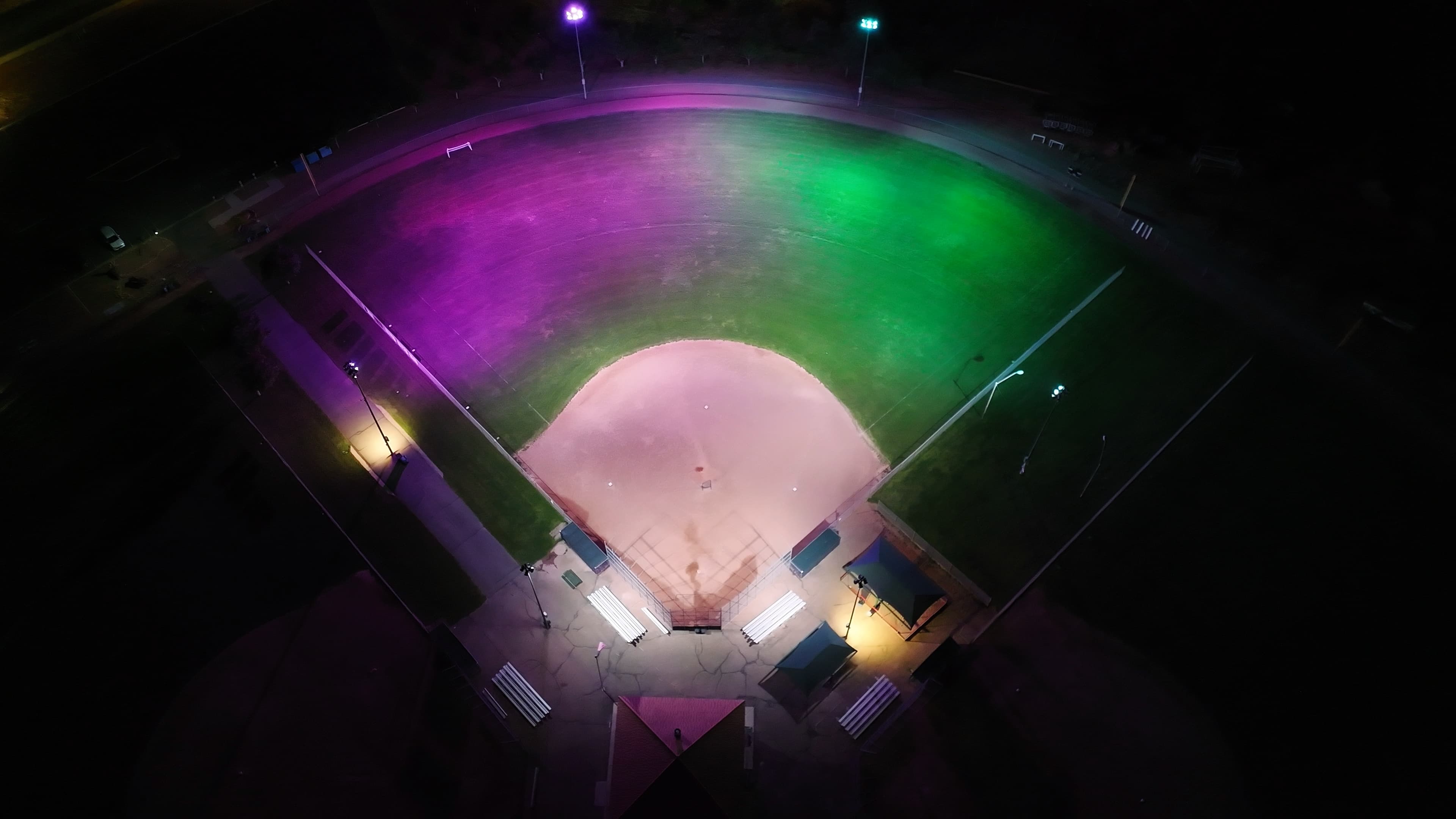
Why Baseball Lighting Is Having Its Own Ninth-Inning Comeback
Across North Carolina's Piedmont Triad, baseball and softball never really go out of season in spirit — and increasingly, the fields that host these games are being asked to perform at a higher standard. From Little League complexes in High Point and Greensboro to travel ball facilities in Winston-Salem, Kernersville, and Burlington, facility operators are confronting the same question: is our lighting infrastructure holding back the quality of play, the safety of athletes, and the sustainability of our operations?
The answer, for many aging metal halide and HPS-equipped fields, is yes. The good news is that the LED revolution that has already transformed indoor arenas, parking lots, and commercial buildings is now delivering equally dramatic results on the diamond. Understanding what that means for your specific facility — and what it takes to do it right — is the first step toward making an informed investment decision.
This article explores the state of baseball and softball LED lighting, what the technology can realistically deliver, and what High Point-area organizations should know before embarking on a lighting upgrade project.
The Case for LED: More Than an Energy Story
Energy savings are real, significant, and often the headline number in any LED upgrade conversation. Modern LED systems typically consume dramatically less energy than the metal halide or HPS fixtures they replace, translating directly into lower utility bills — a meaningful consideration given Piedmont Triad electricity rates and the operating realities of facilities running multiple fields several evenings per week.
But reducing the conversation to kilowatt-hours undersells what a well-engineered LED system actually accomplishes on a baseball or softball field:
- Uniform Light Distribution — Baseball is a game of fast-moving objects, split-second decisions, and precise depth perception. Poorly distributed light creates shadows in the outfield gap, inconsistent foot-candle levels across the warning track, and hot spots that fatigue players' eyes. Modern LED systems, engineered with photometric precision, deliver consistent uniformity across every zone of play.
- Instant-On Performance — Metal halide fixtures require a warm-up and re-strike cycle that can run 15–20 minutes. LED systems reach full brightness immediately — a practical advantage for rain-delay restarts, scheduled evening events, and broadcast productions where timing matters.
- Glare Control — Advances in LED optics and fixture design have made it possible to direct light where it's needed and minimize spill into neighboring properties and residential areas — an increasingly important consideration for urban and suburban parks in communities like Jamestown, Trinity, and Archdale that surround High Point.
- Longer Lifespan — Quality LED fixtures are designed for 100,000+ hours of operation, reducing maintenance burden and the safety risks associated with burned-out or flickering field lighting.
- Controls Integration — Smart lighting controls allow facility managers to schedule lighting, dim non-active zones, and monitor energy consumption remotely — capabilities that connect naturally to the broader conversation around sports facility technology that our sibling article on pickleball LED lighting solutions and our LED gymnasium lighting solutions content explore in more depth.
What Professional-Grade Design Actually Looks Like
Not all LED field lighting projects are created equal. The difference between a quality installation and a disappointing one often comes down to engineering discipline — specifically, whether the design was purpose-built for the sport and the facility, or simply adapted from a generic commercial lighting template.
Baseball and softball have specific lighting demands that set them apart from other athletic applications:
- Pole Placement and Height — Pole positioning must account for the geometry of the field, the throw angles of infielders, and the sightlines of batters. Improperly placed poles can create dangerous glare conditions for hitters — a safety issue with serious liability implications.
- Photometric Modeling — Before a single pole is set, quality lighting design begins with a detailed photometric study that models foot-candle levels, uniformity ratios, and spill light across the entire field. This ensures the finished installation meets the standards set by governing bodies including Little League Baseball, NFHS, NCAA, and professional associations.
- League and Governing Body Compliance — Recreational leagues, travel ball organizations, high school athletics programs, and collegiate facilities each operate under different lighting standards. A professionally engineered design accounts for these requirements from the start, not as an afterthought.
- Voltage and Infrastructure Planning — Field lighting systems are high-demand electrical loads. A competent installation team evaluates existing service capacity, conduit routing, grounding, and control wiring as part of the overall project scope — not as a surprise discovered during installation.
VOSS approaches every baseball and softball lighting project as a full-service electrical contractor, not simply a fixture supplier. That means our team manages photometric design, structural coordination, electrical infrastructure, installation, commissioning, and post-installation support under one accountable relationship.
A Proof Point: What Real-World Projects Demonstrate
While our direct experience with baseball and softball facilities speaks for itself in project after project, it's worth understanding how the principles of large-scale LED lighting and procurement translate across contexts.
When Lewis Central Community Schools in Council Bluffs, Iowa faced a failed bond issue and needed to address aging building infrastructure — including lighting — VOSS helped the district demonstrate to voters and administrators that LED lighting upgrades could be funded entirely within the existing operating budget. Rather than adding to bond requirements, the energy savings generated by the upgrade effectively funded the project itself. Operations Director Jim Ettleman described the experience: "My experience with Voss Lighting has been fantastic. Their team is attentive and more than competent."
The lesson for High Point-area park and recreation departments, school districts, and nonprofit athletic organizations is directly applicable: LED lighting upgrades don't have to wait for capital budget cycles. When properly modeled, the energy economics often support alternative funding pathways — including utility incentive programs and cooperative purchasing mechanisms that reduce procurement complexity.
Public agencies, school districts, and municipal parks departments in Guilford County, Forsyth County, and Alamance County that are evaluating field lighting upgrades may have access to cooperative purchasing programs including Sourcewell, Omnia Partners, BuyBoard, TIPS, and AEPA — established vehicles that satisfy competitive bidding requirements and streamline the path from decision to installation. Our experience helping Lewis Central navigate Iowa's competitive bidding rules through the Omnia Partners framework reflects the same kind of procurement guidance we bring to public-sector clients in North Carolina.
The High Point Market: A Growing Demand for Quality Field Infrastructure
High Point's identity is well established in furniture manufacturing and the furniture market industry, but the city's parks, recreation, and athletic infrastructure tell a parallel story of a community that invests in quality of life for its 115,000 residents. The High Point Parks and Recreation system, along with the numerous travel ball organizations, high school programs across Guilford County Schools, and private athletic facilities serving communities from Thomasville to Asheboro, collectively represent a significant and growing base of field lighting need.
The broader Greater Triad market — anchored by Greensboro and Winston-Salem, and connected through the I-40 and I-85 corridors — has seen sustained investment in sports infrastructure as communities compete to host regional and national tournaments. Travel softball and baseball tournaments generate measurable economic activity, and the quality of facility lighting is increasingly a factor in how organizations evaluate and award hosting rights. Fields that can reliably deliver broadcast-quality illumination for evening championship rounds are simply more competitive in that environment.
For facility managers and parks directors weighing a lighting project, this is both a quality-of-life investment and a strategic one. Our Raleigh branch team serves the full Piedmont Triad region, including High Point, Greensboro, Winston-Salem, Burlington, and surrounding communities in Guilford, Forsyth, Randolph, Davidson, and Alamance counties.
Readers interested in the broader landscape of LED upgrade economics — including utility rebate programs available in this region — will find relevant context in our article on Utility Lighting Rebates in Raleigh, NC, which is part of the same Latest Lighting content series.
Service Availability
While VOSS offers a comprehensive suite of national services, specific capabilities may vary by location. Please contact your local branch to confirm the current availability of specific services, technology solutions, or contracting capabilities in your immediate market.
Talk to Our Raleigh Team About Your Facility
Whether you're a parks director evaluating a multi-field complex renovation, a high school athletics administrator trying to bring aging infrastructure into compliance, or a private facility owner looking to reduce operating costs and improve the player experience, the right next step is a conversation with someone who understands both the technology and the local context.
VOSS's Raleigh branch serves the High Point area and the broader Piedmont Triad region. We welcome the opportunity to discuss your facility's specific situation — field dimensions, current infrastructure, budget structure, governing body requirements — and help you understand what a well-engineered LED lighting project could realistically deliver.
VOSS Raleigh Branch Phone: (919) 779-8777 Toll-Free: (866) 292-0529
Reach out to schedule a no-pressure consultation. We're here to help you make the most informed decision for your facility, your players, and your community.