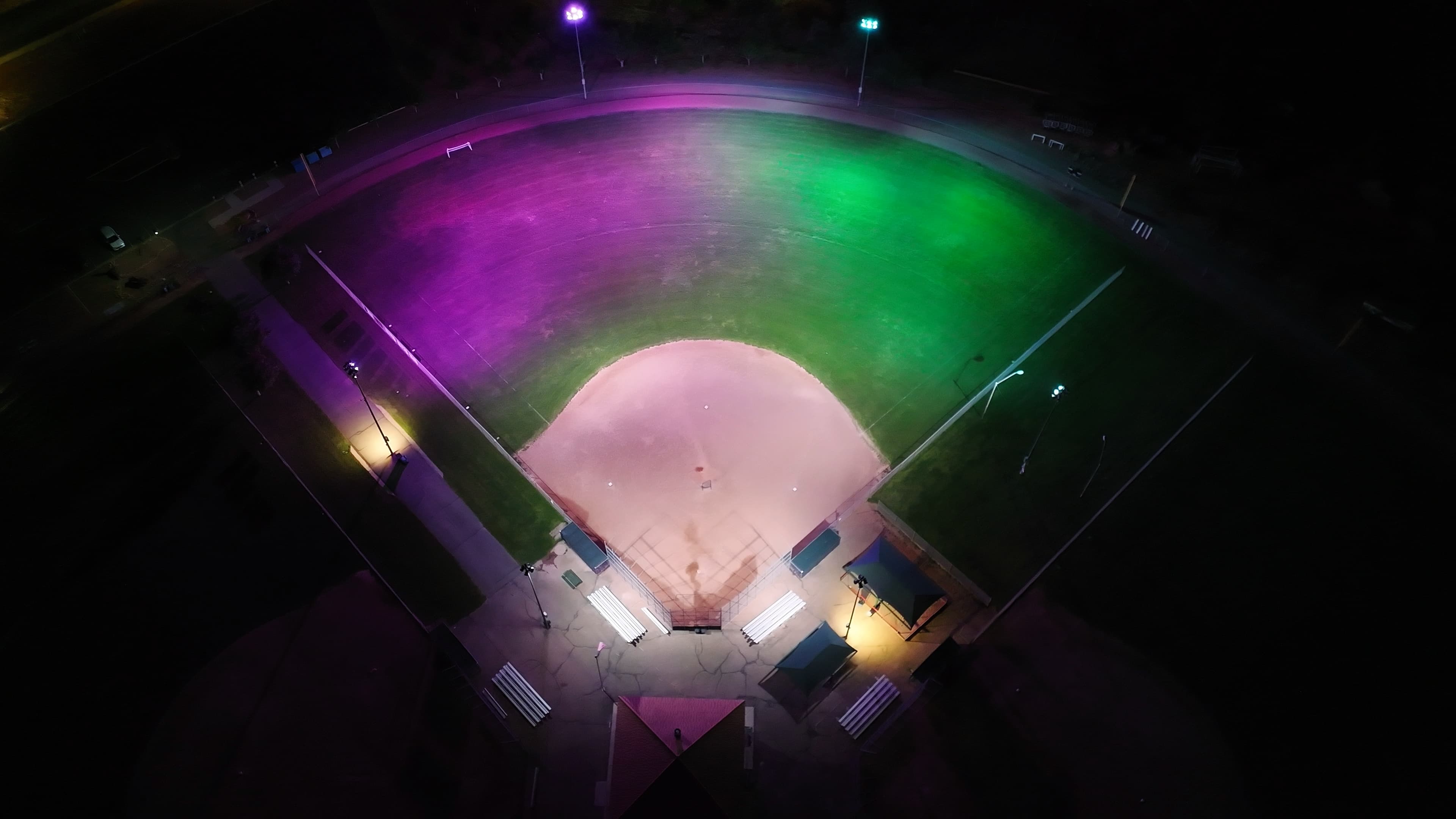
Why Baseball Lighting Is Having a Moment — and Why Greensboro Is Paying Attention
Baseball and softball have always been evening sports. The crack of the bat under the lights is as much a part of the experience as the game itself. But the technology powering those lights is undergoing a fundamental shift — and facilities across North Carolina that haven't yet made the move to LED are increasingly finding themselves on the wrong side of the gap in quality, cost, and compliance.
Across Greensboro and the broader Piedmont Triad region — including communities like High Point, Burlington, Kernersville, and Winston-Salem — parks departments, school athletic programs, and private sports complexes are confronting the same crossroads: aging metal halide and high-pressure sodium (HPS) systems that cost more to operate every season, fail to meet modern league standards, and deliver an inconsistent experience for players and spectators alike. Understanding what LED technology can actually do — and what a well-designed conversion project looks like — is the first step toward making a smart, long-term decision.
What Modern LED Baseball Lighting Actually Delivers
The performance difference between traditional sports lighting and a properly engineered LED system is significant. It isn't simply about swapping one bulb for another — it's about rethinking how light interacts with the field.
Uniform Illumination Across the Entire Playing Surface
Baseball is uniquely demanding from a lighting perspective. A batter tracking a 90-mph fastball, a center fielder reading a fly ball off the warning track, and an umpire judging a tag play at second base all require consistent, shadow-free light — simultaneously, across a very large area. Modern LED systems, designed using photometric modeling tools, achieve uniformity ratios that older systems simply cannot match. Shadows in the infield, dark spots in the outfield corners, and harsh glare that obscures high fly balls are engineering problems — and LED technology, when properly specified, solves them.
Energy Efficiency That Changes the Operating Economics
Metal halide systems — still common at Greensboro-area parks and school athletic facilities — consume significantly more energy than equivalent LED installations. LED fixtures draw substantially less wattage for the same or better light output, and they don't require the long warm-up and cool-down cycles that metal halide demands. For a facility running night games multiple evenings per week across a spring and summer season, the energy cost reduction is meaningful and ongoing. For parks departments managing tight municipal budgets and school districts balancing athletic capital needs against classroom priorities, that matters.
Instant-On Performance and Controls Integration
LED systems reach full brightness immediately — no 15-to-20-minute warm-up period waiting for metal halide lamps to reach operating temperature. That means faster response to rain delays, more flexibility in game scheduling, and cleaner experiences for broadcast and streaming productions. Pair that with smart lighting controls — programmable schedules, remote management, dimming capability for practice versus game conditions — and facilities gain operational tools that older systems never offered.
Longer Fixture Life and Reduced Maintenance
Quality LED sports fixtures are rated for dramatically longer service life than metal halide lamps, which require regular relamping — often at significant cost when you factor in the labor and equipment required to access poles at 60 to 80 feet. Reduced maintenance frequency translates directly into lower long-term ownership costs and fewer disruptions to field availability.
The Greensboro and Piedmont Triad Sports Landscape
Greensboro is a serious baseball and softball market. The city is home to the Greensboro Grasshoppers, the High-A affiliate of the Pittsburgh Pirates, playing at First National Bank Field in downtown — a venue that represents the professional standard that community facilities increasingly aspire to match. Beyond professional play, the region supports a rich ecosystem of youth recreational leagues, travel ball programs, high school varsity programs across Guilford County and surrounding Alamance, Forsyth, and Rockingham counties, and collegiate athletic programs at institutions including UNC Greensboro and Guilford College.
That diversity of facility types — from community park backstops in neighborhoods like Latham Park and Fisher Park to dedicated travel ball complexes and high school stadiums — means the baseball lighting conversation in this market covers a wide range of scales, budgets, and standards. Youth leagues have different illumination requirements than varsity programs. High school facilities operated by Guilford County Schools face different procurement and budget considerations than a privately operated sports complex. And all of them are navigating the same broader trend: the industry and governing bodies are raising the bar on what adequate lighting means.
For facility managers and parks administrators in Greensboro, High Point, Burlington, and the surrounding communities, understanding that LED solutions exist across every point of that spectrum — not just for major stadiums — is an important starting point.
Designing for the Sport: What Separates a Good Project from a Great One
Not all LED retrofits are created equal, and baseball lighting is one of the more technically demanding applications in the sports lighting category. The variables that determine project quality include pole placement and height, mounting angle and aiming strategy, fixture selection and optical control, and the specific illuminance targets required by the governing body — whether that's Little League Baseball, the NFHS for high school play, the NCAA for collegiate facilities, or local parks and recreation standards.
A well-designed system begins with photometric analysis — computational modeling that predicts how light will distribute across the playing surface before a single pole is set. This process accounts for field orientation, pole location constraints, obstructions, and the specific uniformity ratios required by league standards. It's the difference between a system that passes inspection and one that genuinely improves the game experience.
Glare control is another critical design variable. Improperly aimed fixtures create glare that affects batters, fielders, and fans — and in broadcast applications, camera exposure. Quality LED optics and proper aiming protocols address this directly. Similarly, spill light management — controlling where light goes beyond the field boundary — matters for facilities in residential or mixed-use areas, a consideration relevant to many Greensboro-area park sites.
VOSS brings this engineering discipline to projects of every scale. Our team manages the full project lifecycle — from initial photometric design and utility coordination through installation, commissioning, and post-installation verification — ensuring that the finished system performs as designed.
What a Real Project Looks Like: Lessons from the Field
Thinking through the planning and execution of a baseball LED lighting upgrade benefits from understanding how similar projects have come together in practice. While every facility is different, the core project phases — site assessment, photometric design, equipment specification, permitting, installation, and commissioning — follow a consistent logic.
One area worth noting for public-sector facilities in North Carolina — including municipal parks departments and school districts across Guilford, Alamance, and Forsyth counties — is procurement. Public entities are often required to follow competitive bidding rules, which can create complexity when sourcing specialized electrical and lighting services. Cooperative purchasing programs, including Sourcewell, Omnia Partners, BuyBoard, TIPS, and AEPA, offer a legally defensible alternative to traditional bid processes, allowing eligible organizations to access pre-competitively awarded contracts and move projects forward more efficiently.
VOSS has navigated exactly this kind of procurement challenge on behalf of public clients. Working with Lewis Central Community Schools in Council Bluffs, Iowa — a district managing budget constraints and a pending bond issue — our team helped district leadership understand how Omnia Partners' publicly awarded contract satisfied Iowa's competitive bidding requirements. That work allowed the district to proceed with lighting upgrades funded from within the existing operating budget, supporting the broader community confidence in how public funds were being managed. The lesson for North Carolina public agencies is the same: cooperative purchasing tools exist to simplify the process, and working with a contractor experienced in navigating them makes a real difference.
Controls, Connectivity, and the Smarter Sports Facility
LED lighting is increasingly the foundation of a broader smart systems approach to sports facility management. Modern controls platforms allow facility operators to manage lighting remotely — scheduling games, activating maintenance modes, adjusting light levels for different event types, and monitoring energy consumption — from a web-based interface or mobile device.
For parks departments managing multiple fields across Greensboro and surrounding communities, centralized controls represent a meaningful operational upgrade. Rather than dispatching staff to manually switch field lighting on and off, administrators can manage schedules remotely and respond to weather events or schedule changes in real time. For school athletic directors juggling varsity games, practice schedules, and facility rentals, that same flexibility simplifies coordination considerably.
Controls integration also supports energy documentation — tracking consumption data that can be useful for utility rebate applications and sustainability reporting. North Carolina utilities and state energy programs have offered incentive pathways for commercial and institutional energy upgrades; connecting your lighting project to available rebate opportunities is a practical step worth exploring early in the planning process. Our page on Utility Lighting Rebates for Raleigh, NC, which appears alongside this article in our Latest Lighting series, covers that topic in more detail.
Related Topics in This Series
This article is part of VOSS's broader Latest Lighting content series, which covers a range of topics relevant to facility operators across North Carolina and the Southeast. Related articles explore LED solutions for other sports applications — including Pickleball LED Lighting Solutions, Tennis Court Lighting and Energy Solutions, LED Gymnasium Lighting Solutions, and LED Football Stadium Lights and Sports Field Lighting Solutions — as well as broader topics like Commercial LED Outdoor Lighting, Parking Lot and Outdoor LED Lighting Upgrades, and Energy Audits, Incentives, and Rebate Navigation for Businesses. Each addresses a distinct segment of the commercial and institutional lighting landscape.
Service Availability
While VOSS offers a comprehensive suite of national services, specific capabilities may vary by location. Please contact your local branch to confirm the current availability of specific services, technology solutions, or contracting capabilities in your immediate market.
Talk to Our Raleigh Team About Your Facility
If you're managing a baseball or softball facility in Greensboro, High Point, Burlington, Winston-Salem, or anywhere across the Piedmont Triad, and you're thinking through what a lighting upgrade could look like — we'd welcome the conversation. Whether your questions are about photometric design, energy savings projections, procurement pathways, or simply where to start, our team is available to help you think through the specifics.
VOSS — Raleigh Branch
Phone: (919) 779-8777 Toll-Free: (866) 292-0529
Reach out to schedule a consultation with our local team. There's no obligation — just a conversation about your facility and what the right solution might look like.