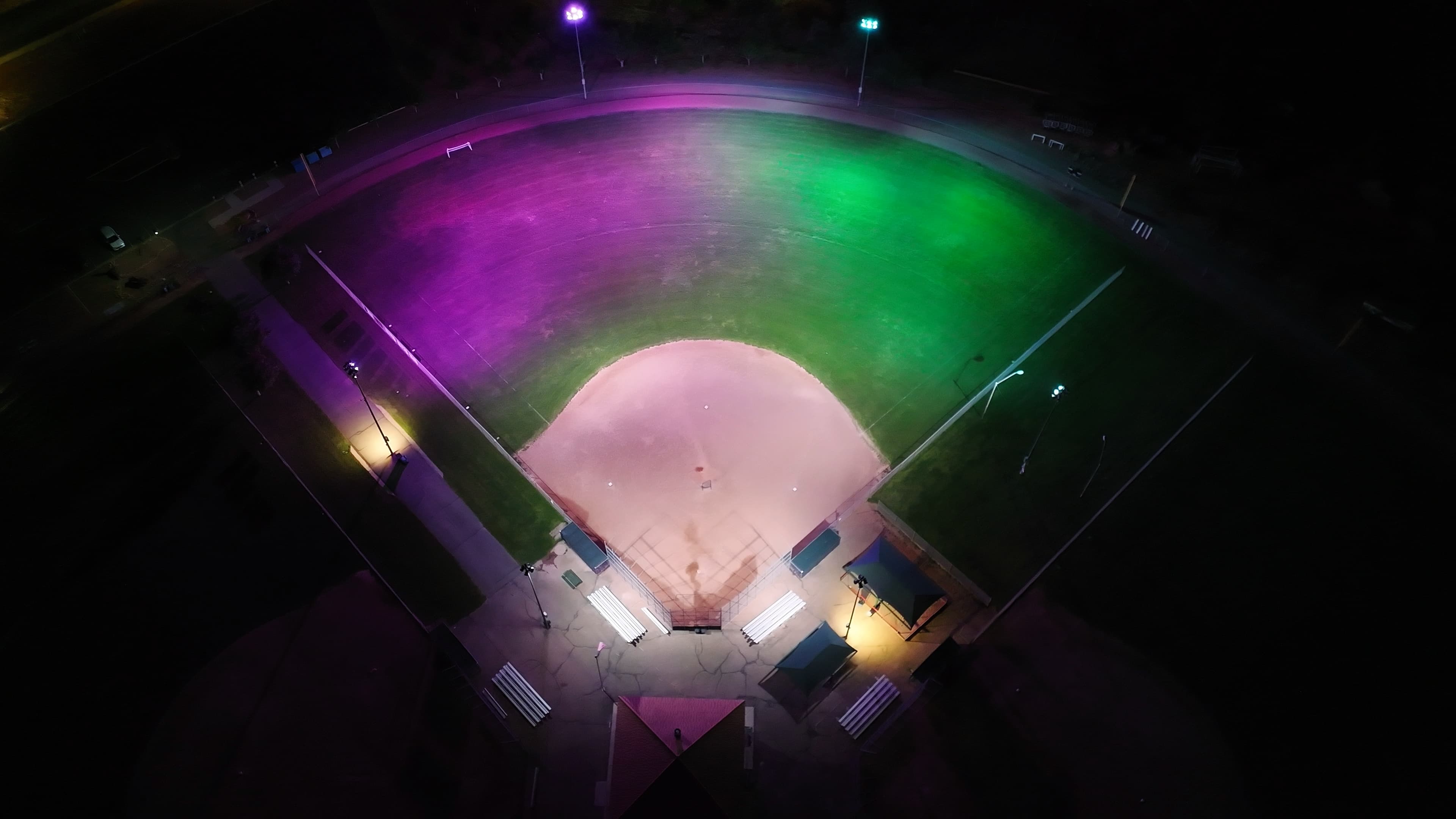
Why Baseball Lighting Is a High-Stakes Decision in Peoria, AZ
Peoria, Arizona is more than just a growing suburb of Phoenix — it's one of the most active baseball communities in the American Southwest. Home to the Peoria Sports Complex, the shared spring training home of the San Diego Padres and Seattle Mariners, the city has long set a high standard for how the game looks and feels at every level. That legacy extends well beyond the professional complex, reaching into the city's parks, recreation leagues, and school athletic programs that serve a community of 200,000 residents.
With that level of baseball activity comes real infrastructure responsibility. Whether you manage a municipal park system, a high school athletic department, a travel ball organization, or a multi-field recreation complex, the quality of your lighting has a direct impact on player safety, game quality, and the long-term operating costs of your facility. Across the Greater Phoenix market — from Glendale and Surprise to Goodyear and Avondale — facility operators are increasingly asking the same question: is it time to make the move to LED?
The answer, for most fields still running aging metal halide or high-pressure sodium (HPS) systems, is almost certainly yes.
The Case for LED: What's Driving the Shift on Arizona Fields
The trend toward LED sports lighting is not new, but its pace has accelerated dramatically over the past several years — and the desert Southwest is no exception. A handful of converging forces are making LED upgrades especially compelling for baseball facilities in the Peoria area right now.
Energy costs and climate realities matter here. Arizona's hot summers mean extended evening play seasons, which in turn means more hours on the lights. Fields that run metal halide or HPS systems are paying significantly more per hour of illumination than they would with modern LED technology. LED fixtures typically consume 50–70% less energy than the systems they replace, and in a market like Greater Phoenix — where air-conditioned team facilities, concession operations, and scoreboards are already driving up utility bills — that kind of reduction in lighting overhead is meaningful.
Light quality has become a competitive differentiator. Players, coaches, and parents expect a certain standard when they arrive at a modern facility. Poor uniformity, excessive glare, dark corners in the outfield, or visible flicker on video replay are no longer acceptable — even at the youth level. LED systems engineered specifically for baseball deliver consistent, high-CRI (Color Rendering Index) light that improves depth perception for batters, makes fly balls more trackable for outfielders, and ensures umpires and fans have a clear, unobstructed view of the action.
Instant-on performance changes operations. Traditional metal halide fixtures require 15–20 minutes to reach full brightness — and they can't simply be switched off during a rain delay and back on again without a lengthy re-strike cycle. LED systems reach full output in seconds. For facilities managing tight scheduling windows, broadcast obligations, or multiple games in a single evening, that operational flexibility is a genuine advantage.
From the Field: A Proven Result in Arizona
VOSS has a demonstrated track record of delivering successful baseball and softball lighting projects across Arizona. A notable example is our work in Page, AZ — a project that illustrates what thoughtful LED design and experienced installation can accomplish for a community athletic facility.
The Page project involved upgrading an existing baseball facility to a modern LED system designed to meet established sport-specific lighting standards. The results included dramatically improved field uniformity, meaningful reductions in energy consumption, and a noticeably better experience for players and spectators alike. Projects like this one reinforce a central truth about sports lighting: the technology is only as good as the design and execution behind it.
Photometric modeling, pole placement, mounting heights, beam angles, and glare control all have to work together. Getting that right requires more than sourcing a fixture catalog — it requires experience on real fields, in real Arizona conditions, with real league compliance requirements in mind.
What a Professional Baseball Lighting Design Actually Involves
Facility managers and administrators who haven't been through a sports lighting project before are sometimes surprised by the depth of engineering that goes into a well-executed installation. Understanding what's involved helps set realistic expectations and explains why working with an experienced contractor matters.
Photometric design and compliance modeling are the foundation of any serious project. VOSS engineers use advanced simulation tools to model how light will distribute across the playing surface at every position — infield, outfield, warning track, and dugout areas. Designs are calibrated against the standards established by organizations like the Illuminating Engineering Society (IES) and applicable league governing bodies, whether that's Little League International, NFHS, NJCAA, NCAA, or professional standards.
Pole placement and structural assessment are equally critical. Where poles are positioned — and at what height — determines whether the field achieves the target foot-candle levels with appropriate uniformity ratios. For retrofit projects, existing pole infrastructure may be evaluated for reuse; in other cases, new structural work is required. VOSS manages this evaluation and coordinates all associated permitting and structural requirements.
Controls integration is an area where modern LED systems offer capabilities that simply didn't exist with legacy technology. Dimming, scheduling, zone control, and remote management can all be built into a new LED system, giving facility operators precise control over energy consumption and operational flexibility that reduces staff burden. For parks departments managing multiple fields across a city like Peoria, that kind of centralized control capability can be transformative.
Broadcast and media readiness is a consideration that applies not just to professional venues but increasingly to competitive travel ball and high school facilities where video streaming, photography, and live broadcast have become commonplace. LED systems can be specified to eliminate flicker at high camera frame rates, ensuring your facility looks as good on screen as it does in person.
Who This Matters For in the Peoria Area
The Peoria market is home to a wide range of organizations that operate or oversee baseball and softball facilities — and the considerations vary meaningfully by organization type.
Municipal parks and recreation departments in Peoria and neighboring communities like Surprise, Glendale, Goodyear, and El Mirage manage some of the region's highest-volume recreational fields. For these organizations, energy efficiency and long-term maintenance cost reduction are typically the dominant priorities. LED systems with extended rated lifespans — often 100,000 hours or more — dramatically reduce the frequency and cost of re-lamping, which for elevated field lighting fixtures is a significant operational expense.
Public school districts operating in the West Valley face the dual challenge of aging athletic infrastructure and tightening capital budgets. Lighting upgrades at high school baseball and softball facilities often qualify for utility incentive programs, and public agencies in Arizona may be able to access VOSS products and services through our approved Arizona state contract — or through cooperative purchasing programs including Sourcewell, BuyBoard, TIPS, AEPA, Omnia Partners, and others. These vehicles simplify procurement, ensure compliance, and can significantly accelerate project timelines.
Private club and travel ball organizations are increasingly investing in purpose-built or upgraded facilities to attract and retain players in a competitive West Valley market. For these operators, the player and family experience is paramount — and lighting quality is one of the most visible indicators of facility professionalism.
College and university athletic programs in the broader Phoenix metro region, including those in the West Valley, must meet sport-specific lighting standards for NCAA play and competition scheduling. Retrofitting or newly designing a compliant LED system is both an athletic and an institutional statement.
Related Topics Worth Exploring
Baseball and softball lighting doesn't exist in isolation. If your organization is evaluating a broader facility upgrade, several related topics covered in the Latest Lighting section may be relevant to your planning. The LED Football Stadium Lights and Sports Field Lighting Solutions article addresses multi-sport venue considerations, while Pickleball LED Lighting Solutions and Tennis Court Lighting and Energy Solutions explore lighting design for other athletic contexts. For organizations seeking to understand the full financial picture of an LED transition, the articles on Energy Audits, Incentives, and Rebate Navigation for Businesses and Maximize ROI with Commercial LED Lighting Rebates in Dallas, TX offer useful frameworks. If outdoor infrastructure is a broader priority, Parking Lot and Outdoor LED Lighting Upgrades and Navigating Solar Infrastructure for DFW Parks provide additional context.
Service Availability
While VOSS offers a comprehensive suite of national services, specific capabilities may vary by location. Please contact your local branch to confirm the current availability of specific services, technology solutions, or contracting capabilities in your immediate market.
Talk to VOSS About Your Peoria-Area Baseball Lighting Project
Whether you're planning a full LED retrofit of an existing multi-field complex, designing a new facility from the ground up, or simply trying to understand what a modern lighting upgrade would cost and deliver for your organization, VOSS is here to help you think it through.
Our Phoenix branch team brings local market knowledge, established relationships with Arizona utility and permitting authorities, and a track record of completed sports lighting projects across the state. We work with facility owners and administrators at every stage — from initial photometric modeling and fixture selection through installation, commissioning, and post-project support.
VOSS — Phoenix Branch Phone: (602) 340-9500 Toll-Free: (800) 788-8676
Reach out to schedule a consultation with our team. We'll start with your facility, your budget, and your goals — and help you understand exactly what's possible.