Why Mesa and the Greater Phoenix Valley Are Rethinking Baseball Field Lighting
Baseball is more than a pastime in Mesa, AZ — it's woven into the identity of the city and the broader Greater Phoenix region. From the spring training legacy at Sloan Park, home of the Chicago Cubs' Cactus League operations, to the hundreds of youth and adult recreational fields managed by Mesa Parks, Recreation and Community Facilities, this market supports one of the most active baseball and softball ecosystems in the country. With a metro population exceeding 4 million and Mesa alone home to roughly 517,000 residents, demand for high-quality, well-lit athletic facilities has never been greater.
Yet many of the fields serving this community — from youth leagues in Gilbert and Chandler to adult softball complexes in Scottsdale and Tempe — still rely on aging metal halide or high-pressure sodium (HPS) lighting systems. These technologies were the industry standard for decades, but compared to modern LED alternatives, they fall significantly short on energy efficiency, light quality, controllability, and long-term cost of ownership. Across the Valley, facility managers, parks directors, and athletic administrators are increasingly asking the same question: is it time to upgrade?
Understanding the trends, technology, and real-world outcomes behind baseball LED lighting upgrades is essential for any decision-maker responsible for a diamond in this region.
The Technology Shift: What Makes LED Different for Baseball and Softball
Not all LED lighting is created equal — and sports lighting, particularly for baseball and softball, demands a level of engineering precision that general commercial lighting simply cannot deliver. The geometry of a baseball field is uniquely challenging: a large, asymmetrical playing surface with varying sightlines for batters, fielders at multiple depths, and spectators in multiple orientations.
Photometric Design Is Everything
Professional-grade baseball LED lighting systems are built around detailed photometric modeling — computer-generated analysis of how light from each fixture and pole will interact with the full playing surface. The goal is uniform illuminance: consistent foot-candle levels across the infield, outfield, warning track, and foul territory, with tight control over spill light and glare. A poorly designed system creates hot spots or shadows that affect depth perception for batters and fielders alike, and can even create unsafe conditions.
Key performance factors that distinguish a well-engineered baseball LED system include:
- Uniformity ratios — The ratio between maximum and minimum foot-candle readings across the field; tighter uniformity means fewer visual inconsistencies for players and broadcasters
- Glare control — Precise optical engineering minimizes direct glare into batters' eyes and camera lenses, which is especially important for high-camera-angle broadcast setups
- Pole placement and mounting height — Strategic positioning reduces the number of poles needed while maximizing coverage and minimizing obstruction to play
- Color Rendering Index (CRI) — High-CRI LEDs (typically 70+, and 80+ for broadcast-quality fields) reproduce natural colors more accurately, improving visibility for tracking fly balls and reading pitch spin
Instant Performance and Controllability
Unlike metal halide systems, which require 15–20 minutes to reach full output and cannot be restarted immediately after a power interruption, LED systems achieve full brightness instantly. For a region like Greater Phoenix, where afternoon monsoon storms can cause mid-game power disruptions, this is a meaningful operational advantage. LED systems also integrate seamlessly with lighting controls platforms — enabling dimming, scheduling, scene presets for different event types, and remote management. A parks department overseeing fields across Mesa, Tempe, Gilbert, and Chandler can monitor and adjust multiple facilities from a single dashboard.
Dramatically Reduced Energy Consumption
Arizona's hot climate means that sports facilities here often operate lighting systems during some of the highest-demand periods on the grid. LED systems typically use 50–70% less energy than equivalent metal halide installations, a reduction that translates directly to lower utility costs and, for public agencies, lower operational burden on taxpayers. For facilities enrolled in Arizona Public Service (APS) or Salt River Project (SRP) demand management programs, LED upgrades can also reduce demand charges — one of the most significant line items on a commercial or municipal utility bill.
A Proven Example: Professional-Grade Results in Page, AZ
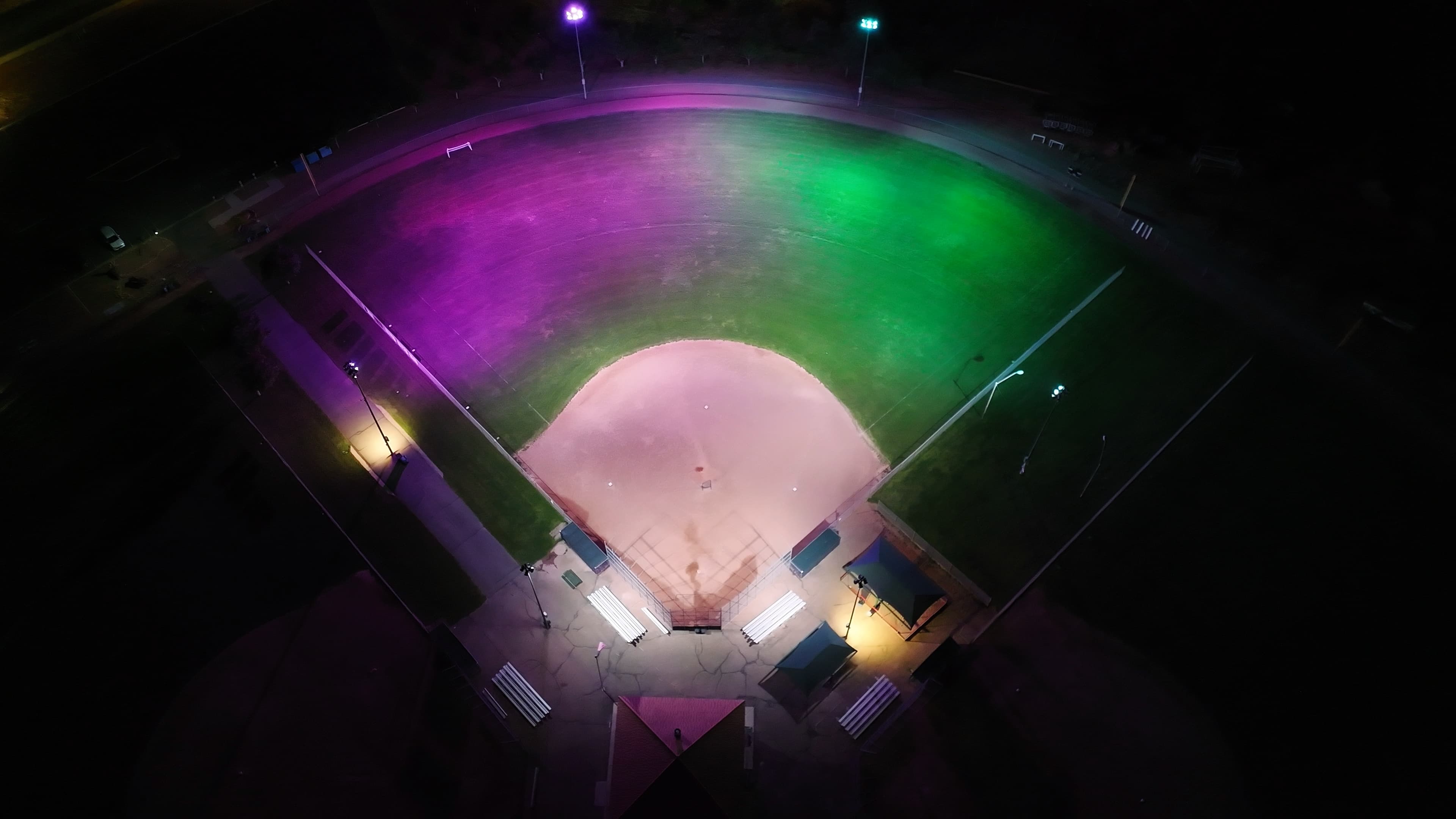
One of the most compelling proof points for baseball and softball LED lighting in Arizona comes from a project VOSS completed in Page, AZ — a community that, like many across the state, needed to modernize aging athletic infrastructure while managing a constrained public budget.
The Page project demonstrates that professional-grade LED sports lighting outcomes are achievable outside major metropolitan markets, and that the same engineering standards applied to high-profile stadiums can be delivered effectively at the community and municipal level. The project involved the full design, supply, and installation of LED sports lighting systems engineered to meet sport-specific foot-candle and uniformity standards, replacing legacy technology that had exceeded its useful life.
The results aligned with what the industry broadly demonstrates for well-executed LED sports lighting retrofits: meaningfully improved light quality and uniformity, significant reductions in energy consumption, and a system designed for decades of reliable operation with minimal maintenance. For a community like Page — and by extension, for parks departments and school districts across Maricopa County — this type of project shows what is achievable when an experienced contractor brings the right engineering resources and installation capability to bear.
For facilities managers and parks administrators in Mesa and the surrounding East Valley, this project is instructive: the barriers to a quality LED sports lighting upgrade are lower than many assume, particularly when utility incentives, cooperative purchasing agreements, and long-term operational savings are factored into the analysis.
Who This Affects: Baseball and Softball Facilities Across the East Valley
The Greater Phoenix market encompasses an extraordinary range of baseball and softball facilities, each with its own set of stakeholders, funding structures, and performance requirements. The LED lighting conversation looks different depending on where you sit:
Municipal Parks and Recreation Departments
Cities like Mesa, Gilbert, Chandler, Tempe, and Scottsdale manage extensive networks of lighted athletic fields. For parks directors and facility managers, the LED upgrade question is primarily one of lifecycle cost management: when does it make financial sense to replace aging fixtures, and how do available incentives and procurement vehicles change that calculation? Mesa's parks system, which serves one of Arizona's largest cities, faces this question across dozens of field complexes. The good news is that Arizona's cooperative purchasing infrastructure — including programs like Sourcewell, BuyBoard, TIPS, Omnia Partners, and AEPA — gives public agencies a compliant, cost-effective pathway to procure lighting upgrades without the burden of a standalone bid process. VOSS also holds an approved state contract in Arizona, giving state agencies direct access to our products and services with full compliance assurance.
School Districts and University Athletic Programs
Arizona high school baseball and softball programs compete at a high level, and many district-owned facilities host evening games, tournaments, and community rental events that demand reliable, high-quality lighting. Districts across Maricopa County — including Mesa Public Schools, Chandler Unified, Gilbert Public Schools, and others — are evaluating LED upgrades as part of broader facility modernization efforts. For school business officials and facilities directors, the conversation often begins with energy cost reduction and maintenance savings, but quickly expands to include player safety, community image, and the long-term capital planning benefits of a lower-maintenance lighting infrastructure.
Private and Semi-Pro Facilities
From privately operated training academies to independent league venues, the Phoenix metro's baseball economy supports a wide range of non-public facilities. For these operators, the ROI case for LED is often the most straightforward: reduced energy bills, lower lamp replacement costs, and a better product for paying customers who expect professional lighting standards.
Spring Training and Professional Venues
The Valley's Cactus League ecosystem — spanning facilities in Mesa, Goodyear, Surprise, Peoria, Scottsdale, and Tempe — represents the top end of the baseball lighting market. These venues often already operate at or near professional LED standards, but ongoing upgrades, controls modernization, and broadcast-quality lighting enhancements remain active priorities for facility operators and their MLB team partners.
Standards and Compliance: What the Numbers Actually Mean
For anyone evaluating a baseball or softball LED lighting project, understanding the governing standards is important context. The Illuminating Engineering Society (IES) publishes sport-specific lighting recommendations, and governing bodies at every level — Little League International, the National Federation of State High School Associations (NFHS), the NCAA, and Major League Baseball — reference or adopt these standards with varying requirements by level of play.
As a general frame of reference:
- Recreational youth leagues typically require 30–50 foot-candles of maintained horizontal illuminance at field level
- High school varsity competition generally calls for 50–75 foot-candles
- Collegiate and minor league play often requires 75–125 foot-candles, with higher uniformity ratios
- Professional and broadcast-quality venues may specify 150 foot-candles or more, with stringent vertical illuminance requirements for high-definition camera systems
Photometric design must account not only for initial illuminance levels but also for the gradual reduction in light output over time (known as lumen depreciation). A well-designed LED system will be engineered to maintain required foot-candle levels throughout the expected useful life of the fixture — a factor that distinguishes a professionally designed system from an off-the-shelf retrofit.
VOSS' design process begins with a detailed photometric analysis tailored to the specific geometry of each field, the intended level of play, and any broadcast or recording requirements. We manage the full project lifecycle, from initial design and permitting through installation, commissioning, and ongoing support.
The Relationship Between Controls and Lighting Performance
One of the underappreciated aspects of a modern LED sports lighting system is the role that controls integration plays in long-term value. A well-designed controls platform transforms a lighting upgrade from a one-time capital investment into an ongoing operational asset.
For baseball facilities in Mesa and across the East Valley, controls integration can deliver:
- Automated scheduling that turns lights on and off based on reservation systems, eliminating the energy waste of fields left illuminated after games
- Scene presets that allow a single field to be configured for youth practice (lower output, reduced energy use), varsity competition, or broadcast events with a single command
- Remote monitoring and fault detection that alerts facilities teams to outages or underperforming fixtures before they affect scheduled events
- Demand response participation — in coordination with utilities like APS or SRP, controlled dimming during peak demand periods can reduce demand charges and support grid stability
For parks departments managing multiple facilities across a large geographic area, centralized controls represent a meaningful reduction in operational labor. Rather than dispatching staff to each site, maintenance teams can monitor system status, adjust schedules, and receive fault alerts from a central interface.
This topic connects naturally to several related discussions in the Latest Lighting series — including the broader conversation about commercial LED outdoor lighting upgrades, pickleball and tennis court lighting solutions, and LED gymnasium lighting, all of which share the same underlying principles of photometric design, controls integration, and energy performance.
Service Availability
While VOSS offers a comprehensive suite of national services, specific capabilities may vary by location. Please contact your local branch to confirm the current availability of specific services, technology solutions, or contracting capabilities in your immediate market.
Talk to VOSS About Your Baseball or Softball Facility in Mesa or Greater Phoenix
Whether you manage a single community field in Mesa or oversee a network of athletic complexes across the East Valley, VOSS is prepared to bring engineering expertise, local market knowledge, and proven project execution to your LED lighting project. We serve the full Greater Phoenix region — including Tempe, Chandler, Gilbert, Scottsdale, Peoria, Surprise, Goodyear, and surrounding communities — from our Phoenix branch.
We invite you to start with a conversation. Bring us your field geometry, your current lighting challenges, your energy cost data, and your budget parameters — and let our team show you what a professionally designed LED sports lighting system can do for your facility.
VOSS Phoenix Branch Phone: (602) 340-9500 Toll-Free: (800) 788-8676
Contact us today to schedule a lighting assessment or photometric consultation for your baseball or softball facility.