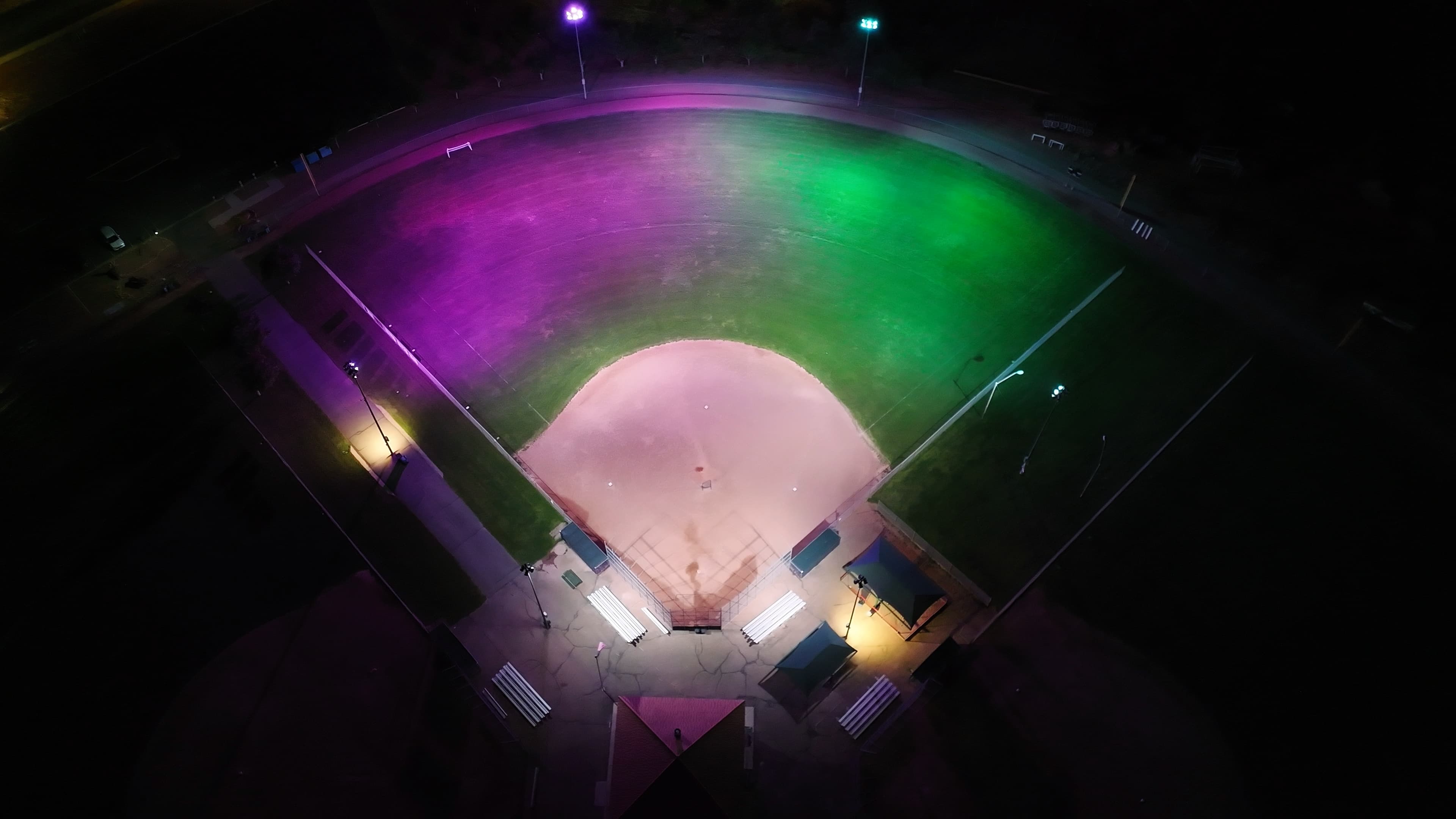
Why Baseball Field Lighting Is a Critical Investment in Gilbert, AZ
Gilbert, Arizona has grown from a small agricultural town into one of the most dynamic communities in the Greater Phoenix metro — and its parks and recreation infrastructure has had to keep pace. With a population of nearly 289,000 and a deeply rooted youth sports culture, Gilbert and the surrounding East Valley communities of Chandler, Mesa, Tempe, Queen Creek, and San Tan Valley collectively host thousands of baseball and softball games each year, from T-ball and Little League to high school varsity and adult recreation leagues.
That volume of play puts significant demands on athletic field infrastructure. Outdated metal halide or high-pressure sodium (HPS) lighting systems — long the standard for ballfields — are increasingly mismatched with how these facilities are actually used. Warm-up delays, uneven light distribution, high energy costs, and frequent maintenance disruptions are not just inconveniences; they affect game quality, scheduling flexibility, and the long-term financial sustainability of parks departments and private operators alike.
The shift to LED technology is not a trend — it is a generational upgrade that is reshaping how baseball and softball facilities operate across Arizona and the country.
What Makes Baseball and Softball Lighting Uniquely Complex
Not all sports lighting challenges are created equal. Baseball and softball present a specific set of optical and engineering demands that separate a well-designed system from one that simply meets the minimum footcandle threshold on paper.
The geometry of the game matters. A baseball diamond combines a tightly defined infield with a deep, wide outfield — two environments that require different lighting angles, pole placements, and fixture orientations. Light that works well for the pitcher's mound can create dangerous glare for a center fielder tracking a fly ball into the Arizona evening sky. Batter's eye contrast, shadow elimination along the basepaths, and adequate illumination of the warning track all require deliberate photometric modeling, not off-the-shelf fixture placement.
Key engineering considerations for baseball LED lighting projects include:
- Pole placement and height — Positioning poles to minimize obstruction of fly balls while maximizing light coverage across the full playing surface
- Glare control — Managing spill light to protect batter sightlines and prevent discomfort for players, umpires, and spectators
- Uniformity ratios — Ensuring consistent footcandle levels across the infield and outfield to meet standards set by governing bodies such as Little League International, the NFHS, and the NCAA
- Color rendering index (CRI) — High-CRI LED fixtures make it easier for players to track the ball against the night sky and for video cameras and broadcast systems to capture sharp, accurate footage
- Controls integration — Programmable lighting scenes for practice, game play, and post-game allow facilities to reduce energy use without sacrificing performance
For facilities in Gilbert and across the Phoenix metro, the intense Arizona sun also means that daytime UV exposure and extreme heat cycles accelerate wear on luminaires and poles. Specifying fixtures rated for the desert Southwest's climate conditions is an important and often overlooked part of a durable lighting design.
Proof Point: Engineered LED Baseball Lighting in Action — Page, AZ
One of the most instructive examples of what a well-executed baseball LED lighting project looks like comes from VOSS' work in Page, Arizona — a community in northern Arizona that faced many of the same challenges Gilbert's parks and recreation leaders grapple with today.
The Page project demonstrated what is possible when a lighting upgrade is approached as an engineered solution rather than a simple fixture swap. By applying sport-specific photometric design, precise pole configuration, and high-performance LED fixtures, the project delivered meaningful improvements in light quality and uniformity while substantially reducing energy consumption compared to the legacy system. The result was a facility that better served players and spectators, reduced ongoing operational costs, and extended the useful life of the infrastructure investment.
For Gilbert's parks system — which manages some of the most heavily used athletic fields in Maricopa County — that combination of performance and operational efficiency is exactly the kind of outcome facility managers and budget-conscious administrators are looking for.
The Energy Efficiency Equation in the Arizona Desert
Arizona's energy landscape adds an important financial dimension to any LED sports lighting decision. The Greater Phoenix region is served by major utilities including Arizona Public Service (APS) and Salt River Project (SRP), both of which have historically offered energy efficiency incentive programs for commercial and municipal customers. While program details and availability change over time, LED lighting upgrades at parks and athletic facilities can be strong candidates for rebate consideration — reducing the effective upfront cost of the project.
For Gilbert's municipal parks department and for school districts operating fields in the East Valley, this matters. LED baseball field lighting typically consumes 50–70% less energy than equivalent metal halide systems, which translates directly to lower utility bills season after season. For fields that operate 5 to 7 nights per week during peak spring and fall seasons, those savings compound quickly.
Beyond energy costs, LED fixtures offer dramatically longer service life — often 100,000 hours or more — compared to metal halide lamps that require frequent relamping. For parks staff managing multiple facilities across Gilbert, Chandler, Mesa, and Queen Creek, reducing maintenance callouts and lamp replacement cycles has real operational value.
Our broader Latest Lighting content series explores related financial tools in depth — including our articles on maximizing ROI with commercial LED lighting rebates and navigating utility incentive programs — which provide useful context for facilities leaders evaluating the full economics of a lighting upgrade.
Who Benefits from a Baseball LED Lighting Upgrade in Gilbert
The business case for LED baseball and softball lighting resonates across a wide range of organizations operating in the Greater Phoenix area:
Municipal Parks & Recreation Departments Gilbert and neighboring cities like Chandler, Mesa, and Tempe collectively manage extensive parks systems. For public administrators, the priorities are straightforward: reduce operating costs, extend infrastructure life, and deliver a high-quality experience for residents. LED lighting checks all three boxes — and for Arizona public agencies, procurement can be simplified through VOSS' approved Arizona state contract, ensuring compliance and value without a lengthy competitive bid process. Eligible organizations may also access VOSS through cooperative purchasing programs including Sourcewell, TIPS, BuyBoard, AEPA, and Omnia Partners, among others.
School Districts and Athletic Programs High schools across the East Valley — including those in the Gilbert Unified, Higley Unified, and Chandler Unified school districts — operate varsity and junior varsity baseball programs that frequently play under the lights. Upgraded LED systems improve the quality of competition, enhance broadcast and streaming capabilities, and reduce the energy and maintenance burden on facilities departments already stretched thin.
Private and Semi-Professional Venues The Phoenix metro has a strong tradition of travel baseball, club softball, and competitive amateur leagues. Private facility operators who invest in professional-grade lighting can attract higher-caliber tournaments, extend rental hours into the evening, and justify premium pricing — creating a direct return on the lighting investment.
Youth Sports Organizations Little League, youth softball associations, and recreational leagues are the backbone of Gilbert's sports community. For these organizations, improved lighting means safer play, longer practice windows, and a better experience for families and volunteers who give their time to run these programs.
What a Modern Baseball Lighting Project Looks Like
For facility managers and decision-makers who have not been through a commercial athletic lighting project before, understanding the process helps set realistic expectations and supports better planning.
A well-managed baseball LED lighting project typically moves through these phases:
- Site Assessment & Photometric Modeling — Before any fixture is specified, a thorough site assessment establishes existing conditions: pole locations and heights, current light levels, field dimensions, and any broadcast or league compliance requirements. Photometric modeling software then generates a precise, data-driven design that predicts light levels, uniformity ratios, and spill before a single fixture is installed.
- Fixture & Controls Specification — Not all LED sports fixtures perform equally. Specification decisions — including fixture mounting style, optics, color temperature, CRI, and dimming capability — directly affect long-term performance and energy savings. Controls integration, from simple scheduling timers to full networked sports lighting systems, can add meaningful flexibility and additional energy reduction.
- Permitting & Utility Coordination — Commercial athletic lighting projects in Arizona require electrical permitting and, in many cases, coordination with the local utility for service upgrades or new service connections. VOSS manages this process as part of full project delivery.
- Installation & Commissioning — Proper installation technique — including pole setback, conduit routing, fixture aiming, and commissioning of controls — determines whether a well-designed system actually performs to specification in the field.
- Ongoing Support — LED systems are low-maintenance by nature, but having a licensed electrical contractor available for commissioning adjustments, warranty support, and system expansions protects the long-term value of the investment.
For facilities exploring related upgrades, our LED Gymnasium Lighting Solutions, Pickleball LED Lighting Solutions, and Tennis Court Lighting and Energy Solutions articles in the Latest Lighting series offer parallel guidance for other athletic environments commonly found alongside baseball fields in parks and school campuses.
Service Availability
While VOSS offers a comprehensive suite of national services, specific capabilities may vary by location. Please contact your local branch to confirm the current availability of specific services, technology solutions, or contracting capabilities in your immediate market.
Talk with VOSS About Your Gilbert or East Valley Baseball Lighting Project
Whether you are managing a single community ballfield in Gilbert or overseeing a multi-field complex serving Chandler, Mesa, Queen Creek, or the broader Maricopa County region, VOSS brings the engineering depth, project management experience, and local presence to deliver a lighting solution that performs — season after season.
We welcome the conversation. Reach out to our Phoenix branch team to discuss your facility's specific needs, explore design options, and learn how LED technology can transform the experience at your field.
VOSS — Phoenix Branch
Phone: (602) 340-9500 Toll-Free: (800) 788-8676