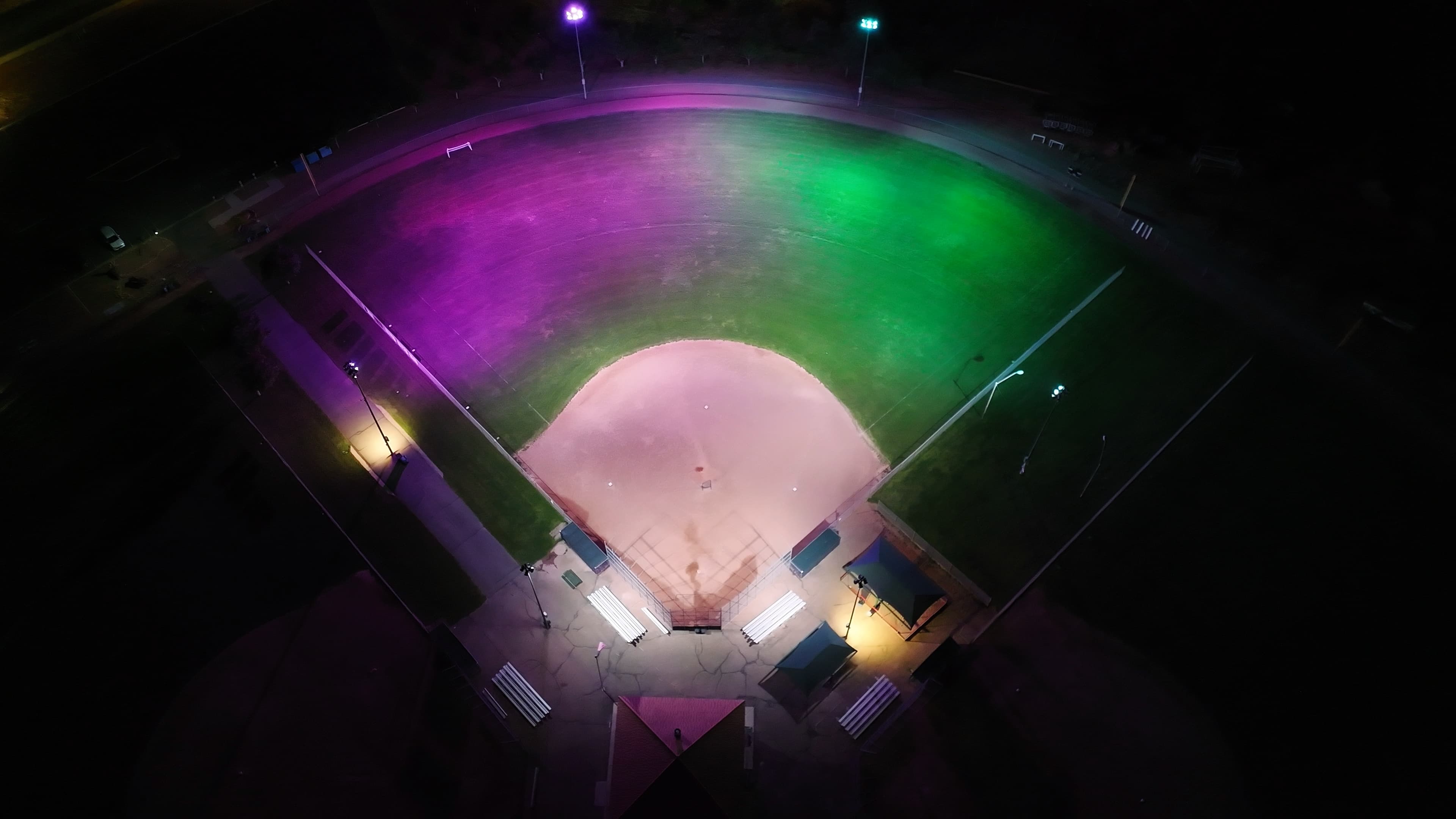
The State of Baseball Lighting in Sioux City and the Siouxland Region
Baseball is woven into the fabric of Sioux City and the broader Siouxland community. From youth recreational leagues in South Sioux City and North Sioux City to scholastic programs at local high schools and collegiate-level facilities, athletic fields across Woodbury County and the surrounding tri-state area draw thousands of players and fans every season. Yet many of these facilities still rely on aging metal halide or high-pressure sodium (HPS) lighting systems — technology that was standard decades ago but has since been surpassed in nearly every measurable category by modern LED sports lighting.
For facility managers, parks and recreation directors, school athletic directors, and municipal leaders across the Sioux City metro, the question today is less whether to upgrade to LED and more when — and how to do it right. Understanding what drives that transition, and what best-in-class implementation looks like, is the first step toward making a smart, lasting investment in your facility.
Why LED Technology Is Transforming Baseball and Softball Facilities
The shift toward LED lighting in athletic facilities isn't a trend — it's a fundamental industry transition driven by measurable performance advantages. Here's what facility stakeholders across the Siouxland region need to understand:
Visibility and Player Performance
High-quality LED systems produce consistent, uniform light distribution across every zone of a baseball or softball field — the infield, outfield, warning track, and foul territories. Unlike older lighting technologies that often create uneven pools of light or harsh shadows, well-engineered LED arrays are designed using photometric modeling to eliminate dead zones and minimize glare. For batters tracking a pitch, outfielders reading a fly ball, or umpires calling a play at the plate, that consistency is not a luxury — it's a safety and performance standard.
Sport-specific LED designs also account for the unique geometry of baseball and softball fields. Pole placement, mounting height, beam angles, and fixture spacing all interact in ways that require precise engineering, not off-the-shelf assumptions.
Energy Efficiency and Operating Cost Reduction
LED fixtures consume significantly less energy than the metal halide systems that currently light most older baseball facilities. For organizations operating multiple fields — like municipal park systems serving communities across the Sioux City metro, from Sergeant Bluff to Le Mars and beyond — those savings accumulate rapidly across a full season of evening games. Reduced lamp replacement frequency and lower maintenance overhead add to the long-term financial picture.
This matters especially to parks and recreation administrators and school district business officials in the region, who are managing tighter operating budgets without compromising program quality.
Instant-On Performance and Controls Integration
Unlike metal halide technology, which requires a warm-up cycle before reaching full brightness, LED systems deliver full output the moment they're switched on. This is a practical advantage for facilities managing rain delays, late-start games, or practice schedules that shift on short notice. Modern LED systems can also integrate with smart controls platforms — enabling remote scheduling, dimming, zone-by-zone management, and real-time monitoring from a phone or facility management dashboard. For a parks department overseeing fields across multiple Sioux City locations, centralized controls can meaningfully reduce staff time and prevent unnecessary energy consumption from fields left illuminated after hours.
What a Professional Baseball Lighting Project Actually Involves
One of the most common misconceptions among facility decision-makers is that a baseball LED lighting project is primarily a fixture swap. In reality, a well-executed project is a multi-phase engineering and construction effort. VOSS manages every phase with the depth of a full-service commercial electrical contractor:
- Photometric Design — We model your specific field dimensions, orientation, and use case to develop a layout that meets the lighting standards established by governing bodies such as the Illuminating Engineering Society (IES) and applicable league requirements (Little League, NFHS, NCAA, or professional standards)
- Structural and Electrical Assessment — Existing poles, foundations, and electrical infrastructure are evaluated to determine what can be retained and what must be upgraded to safely support modern LED fixtures
- Permitting and Compliance — Local permit requirements across Woodbury County and the surrounding jurisdictions are navigated as part of the project scope
- Installation and Commissioning — Our crews handle the full installation, including pole work, fixture mounting, wiring, and system commissioning and testing
- Ongoing Support — Post-installation, VOSS provides continued support to ensure the system performs as designed through years of operation
This comprehensive approach is what separates a lighting project that meets expectations from one that creates persistent problems with glare, uneven coverage, or premature equipment failure.
Proof in Practice: LED Lighting Delivering Results for Public Facilities
While the specifics of every project differ, VOSS's experience across government and municipal facilities demonstrates what thoughtful lighting design can accomplish. In a library project in Georgia, a facility that patrons consistently described as too dark — even during daytime hours on overcast days — was transformed through careful photometric planning and the installation of 50 flat panel fixtures in an optimized layout. The result was even, bright illumination across the entire space, regardless of outdoor conditions.
The same principle applies to outdoor athletic facilities: the goal is not simply to add light, but to engineer the right light in the right places at the right levels. For baseball and softball fields in Sioux City and across the Siouxland region, that means designing systems that hold up through Nebraska and Iowa weather conditions, serve players from youth leagues through adult recreational programs, and continue performing reliably for years after installation.
A Note for Schools, Parks Departments, and Municipal Facilities
Public-sector organizations in the Sioux City metro — including school districts, city parks departments, and county recreation authorities — may have access to cooperative purchasing programs that streamline procurement and reduce administrative burden. Eligible organizations can often leverage established cooperative contracts to procure lighting equipment and services without a full competitive bid process.
VOSS works with a range of cooperative purchasing programs available to qualifying public entities, including Sourcewell, TIPS, BuyBoard, AEPA, Omnia Partners, PACE, and the Nebraska ESU Co-Op. These programs can accelerate project timelines and simplify the contracting process for schools and municipal agencies across the region.
Explore the Full Landscape of LED and Sports Lighting Solutions
Baseball and softball lighting is one dimension of a broader conversation happening across athletic and recreational facilities in the Sioux City area. VOSS's Latest Lighting content section covers adjacent topics that may be relevant to your facility planning — including LED gymnasium lighting solutions, pickleball LED lighting, tennis court lighting and energy solutions, and LED football stadium lights and sports field lighting solutions. If your organization manages multiple facility types, these resources offer insight into how a coordinated lighting strategy can deliver compounding benefits across your entire portfolio.
Service Availability
While VOSS offers a comprehensive suite of national services, specific capabilities may vary by location. Please contact your local branch to confirm the current availability of specific services, technology solutions, or contracting capabilities in your immediate market.
Talk to VOSS About Your Sioux City Baseball Lighting Project
Whether you're managing a community park system, a high school athletic complex, or a regional tournament facility, VOSS brings the engineering depth and project management experience to get your baseball or softball lighting right — the first time. Our Omaha branch serves the Sioux City metro and the greater Siouxland region, including communities across Woodbury County, Dakota County, and the surrounding tri-state area.
We invite you to connect with our team for a consultative conversation about what a lighting upgrade could mean for your facility — from photometric design through long-term performance.
VOSS — Omaha Branch Phone: (402) 328-2283