Why Baseball Field Lighting Is Having a Moment — and Why Papillion Should Pay Attention
Across the country, parks and recreation departments, school athletic programs, and privately operated sports complexes are rethinking how they light their baseball and softball fields. The shift is being driven by three converging forces: the dramatic maturation of LED technology for sports applications, the rising cost of energy, and a growing recognition that poor lighting — dark outfield corners, glare in batters' eyes, inconsistent illumination across the warning track — directly affects the quality and safety of play.
In Papillion, Nebraska, this conversation is especially relevant. As one of the fastest-growing communities in the Greater Omaha metro, Papillion has made strategic investments in parks, athletic infrastructure, and quality of life amenities that attract families and businesses alike. That growth creates both an opportunity and a responsibility: ensuring that the athletic facilities serving Papillion's youth leagues, high school programs, and recreational players are equipped to meet modern standards. The communities surrounding Papillion — La Vista, Bellevue, Ralston, Gretna, and Springfield — face the same infrastructure questions, and forward-thinking facility managers in Sarpy County are increasingly looking to LED upgrades as the practical answer.
This article explores what today's best-in-class baseball and softball LED lighting looks like, what it delivers, and what facility operators and decision-makers across the Greater Omaha region should understand before embarking on a lighting project.
What Makes Baseball Lighting Uniquely Challenging
Not all sports lighting problems are the same, and baseball presents some of the most demanding photometric challenges in the industry. Unlike a basketball court or a rectangular soccer field, a baseball diamond radiates outward at irregular angles. The infield, the outfield, the foul lines, the warning track, and the bullpens all require different light levels and different angles of delivery — and getting any one of them wrong creates cascading problems.
Consider the batter's experience: a high-velocity pitch arrives in under half a second. Any inconsistency in the light behind the pitcher's release point, or any glare from a pole positioned at the wrong angle, can be a genuine safety issue — not just a performance complaint. Similarly, outfielders tracking a fly ball against a dark sky need uniform, shadow-free illumination that gives them accurate depth perception.
The Illuminating Engineering Society (IES) and governing bodies like Little League International, the NCAA, and Major League Baseball each publish lighting standards that address these concerns. Meeting those standards requires engineered photometric design — not just installing bright fixtures and hoping for the best. Key design variables include:
- Pole placement and height — Positioning poles to minimize glare in players' lines of sight while achieving required foot-candle levels across every zone of the field
- Fixture aiming angles — Each luminaire must be precisely aimed to contribute to uniform illumination without creating hot spots or shadow corridors
- Uniformity ratios — The ratio between the brightest and darkest points on the field must fall within defined tolerances for each class of play
- Spill light control — Especially important for fields near residential neighborhoods, as is common in suburban communities like Papillion and La Vista, where light trespass onto adjacent properties must be managed
This is why the choice of lighting partner matters as much as the choice of fixture. A technically rigorous photometric study, conducted before a single pole is placed, is the foundation of any successful baseball lighting project.
The LED Advantage: What the Numbers Actually Mean for Field Operators
For facility managers and parks directors evaluating an LED upgrade, the conversation often starts with energy savings — and for good reason. Traditional metal halide and high-pressure sodium (HPS) systems that light most older baseball fields across Nebraska consume enormous amounts of electricity. LED systems designed for sports applications typically reduce energy consumption by 50–70% compared to legacy metal halide technology, which translates directly into lower utility bills every month the lights are on.
But the financial case for LED extends well beyond the energy line on the utility bill. Consider:
Maintenance cost elimination. Metal halide lamps on athletic fields typically require replacement every 2,000–4,000 hours. For a field running night games and practices, that can mean lamp replacements every two to three years — plus the labor cost of lifting technicians to fixture height on poles that may be 60, 70, or 80 feet tall. Modern LED sports fixtures are rated for 100,000+ hours of operation, dramatically reducing maintenance frequency and the associated lifecycle costs.
Instant-on performance. Metal halide systems require a warm-up period of 15–20 minutes to reach full brightness — and if a lamp is extinguished mid-game (say, during a rain delay), it must cool before it can re-strike, meaning another 20-minute wait. LED systems illuminate instantly at full output, and they can be switched off and back on without penalty. For fields with tight scheduling windows or unpredictable weather — a familiar reality on Nebraska spring evenings — this is a genuine operational advantage.
Controls integration. Today's LED sports lighting systems can be integrated with advanced controls platforms that allow facility operators to dim lights for practice sessions, schedule automatic on/off times, enable occupancy-based switching, and even manage the system remotely from a smartphone or web interface. This is not a luxury feature — it is a practical tool for reducing energy waste during low-attendance events and for giving parks staff the visibility they need to manage multiple facilities efficiently.
Broadcast and event readiness. For facilities that host tournament play, college showcases, or events that will be filmed or livestreamed, LED systems eliminate the flicker issues that plague metal halide installations when captured on video. High-quality LED sports luminaires are rated for high-speed camera compatibility — increasingly important as youth and amateur sports video production becomes commonplace.
VOSS has seen these benefits play out in real projects across Nebraska. When we retrofitted the Salvation Army Kroc Center gymnasium in Omaha — a facility with year-round, high-intensity use — we reduced the total fixture count from 99 to 47, cut energy usage in half, and projected over $4,000 in annual savings. While a gymnasium is a different environment than an outdoor baseball field, the underlying principle is the same: intelligent LED design that right-sizes the system delivers compounding returns over time.
Regional Proof Point: What LED Upgrades Look Like in Practice
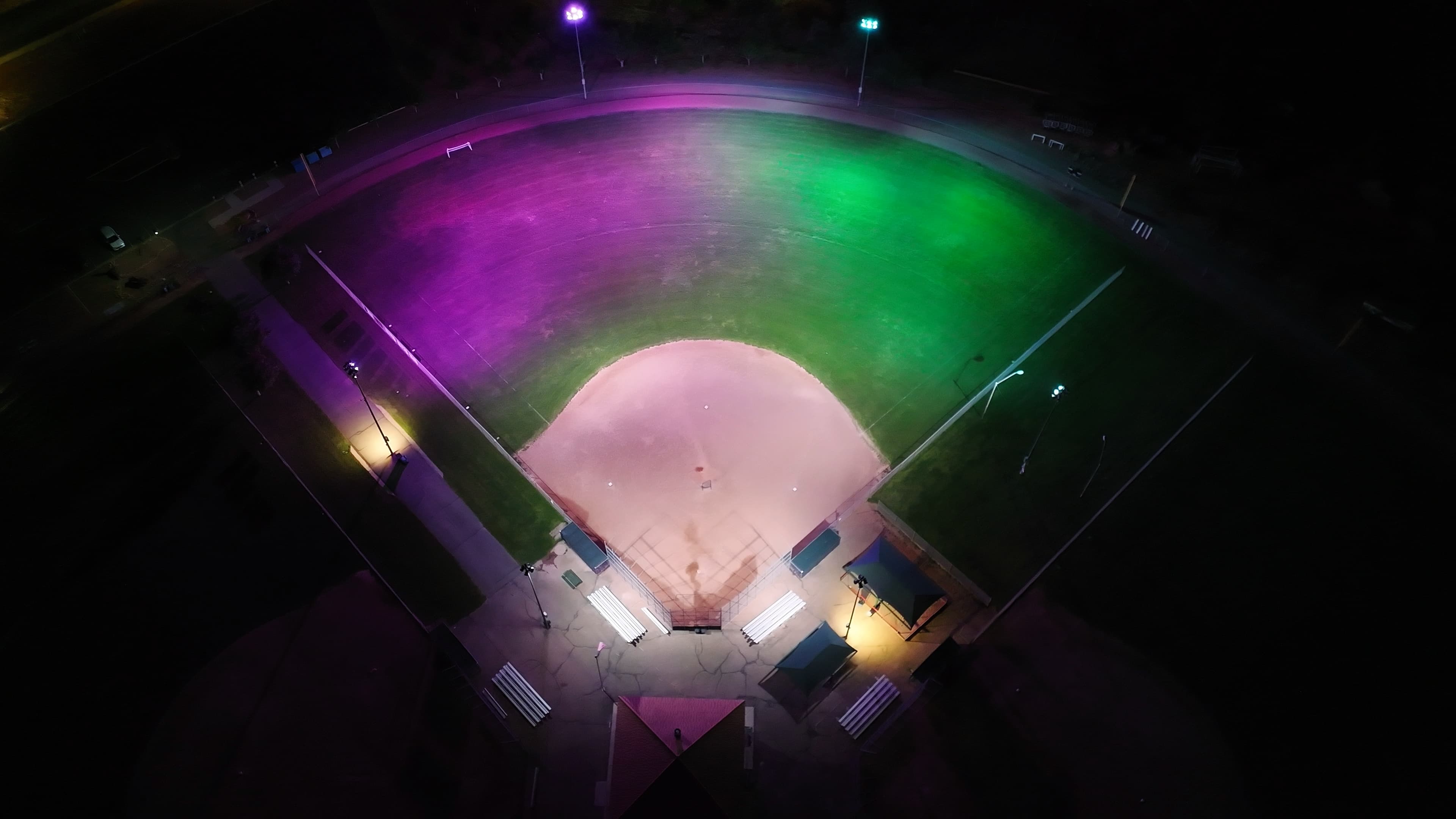
One of the most instructive examples of what a well-executed baseball LED lighting project can accomplish comes from Page, Arizona — a community that invested in upgrading its baseball facility lighting to modern LED technology. The results demonstrated the core value proposition that applies equally to parks departments in Papillion, Bellevue, and across Sarpy County: better light quality, lower operating costs, and a facility that can serve the community for decades without the ongoing burden of lamp replacements and emergency maintenance calls.
Projects like this confirm that the benefits of LED sports lighting are not theoretical — they are realized by real communities making strategic investments in their athletic infrastructure. For a growing municipality like Papillion, where the parks and recreation system supports thousands of youth athletes across multiple sports seasons, the long-term return on a well-designed LED upgrade is compelling.
Considerations for Different Types of Baseball Facilities in the Greater Omaha Area
The right LED lighting solution looks different depending on the type and scale of the facility. Operators and decision-makers across the Papillion–Omaha metro should understand the key variables for their specific context:
Municipal and Community Parks Fields Community fields used for youth recreation leagues and adult softball are typically lit to Class I or Class II standards (IES classifications), which require lower foot-candle levels than competitive or broadcast-quality venues. For these fields, the priority is delivering safe, uniform light at the most efficient cost — and ensuring the system is simple enough for parks staff to operate without specialized training. Controls with simple scheduling and remote access are particularly valuable here.
High School Varsity and Junior Varsity Fields High school programs in the Greater Omaha area — including those in Papillion-La Vista Community Schools — typically need lighting that meets NSAA (Nebraska School Activities Association) standards for competitive play. These systems must deliver higher uniformity and foot-candle levels than recreational fields, and they benefit from dimming capability that allows the same field to serve practices at lower intensity before a varsity game at full competition levels.
Competitive Tournament and College-Level Facilities Facilities hosting NAIA, NCAA, or high-level tournament play require photometric designs that meet the most demanding uniformity and illuminance standards. At this level, fixture selection, pole engineering, and aiming precision are all critical — and the design process often involves coordination with facility architects, governing body representatives, and broadcast technical teams.
Private and Semi-Professional Venues Independent baseball organizations, training academies, and semi-professional venues have unique flexibility in their specifications but often face the same financial pressure as public facilities. For these operators, the energy savings and maintenance reduction that LED delivers are especially impactful, since they directly affect the bottom line of a privately operated facility.
Procurement Pathways for Public-Sector Facilities
For parks departments, school districts, and government entities in Papillion, Sarpy County, and across Nebraska, procurement compliance is a real consideration when planning a lighting capital project. VOSS holds an approved state contract in Nebraska, which means eligible public entities can procure VOSS lighting services and products through a compliant, pre-vetted channel — streamlining the purchasing process and reducing administrative burden.
In addition, VOSS participates in several cooperative purchasing programs that are available to qualifying organizations, including AEPA, BuyBoard, TIPS, Sourcewell, Omnia Partners, PACE, and the Nebraska ESU Co-Op. These programs allow eligible buyers to access VOSS services without the time and cost of a standalone competitive bid process — a meaningful advantage for parks and recreation departments working within constrained procurement timelines.
If your organization is evaluating a baseball or softball field lighting project and needs to understand which procurement pathway applies, our local team can walk you through the options.
How VOSS Approaches a Baseball Lighting Project
VOSS brings more than 85 years of full-service commercial electrical contracting experience to every sports lighting engagement. Our process is designed to take facility operators from initial concept to a fully commissioned, operational system — with clear communication and technical rigor at every phase:
- Site Assessment & Goal Setting — We begin by understanding your facility's current condition, your league or governing body requirements, your energy goals, and your budget parameters.
- Photometric Design — Our team develops a detailed lighting layout using industry-standard photometric modeling software, producing a design that demonstrates compliance with applicable standards before any hardware is purchased.
- Fixture and System Specification — We specify LED sports luminaires appropriate for your facility's class of play, pole height requirements, and controls integration needs.
- Installation & Commissioning — VOSS manages the full installation process, including pole work, wiring, fixture mounting, and aiming — and commissions the system to confirm that real-world performance matches the design model.
- Controls Configuration & Training — We configure any integrated controls systems and provide hands-on training so your staff can manage the facility confidently. This mirrors the approach we took at Trinity Lutheran Church in Omaha, where we commissioned every fixture and provided training that empowered the team to control their lighting system with ease.
- Ongoing Support — Our Omaha branch is available for ongoing technical support, warranty coordination, and future system modifications as your facility's needs evolve.
Our work with Blue Cross Blue Shield of Nebraska on a parking lot lighting upgrade in Nebraska further illustrates our commitment to this full-service model: we completed the lighting layout, specified appropriate lens optics, managed the energy rebate process, and delivered a result that reduced overall energy usage by over 56%. The same discipline — precise design, careful specification, and rebate optimization — applies directly to outdoor athletic field projects.
Related Topics Worth Exploring
Baseball and softball field lighting sits within a broader landscape of sports and recreation lighting challenges. If your organization is also evaluating gymnasium lighting — whether for an indoor batting cage, a multi-purpose athletic facility, or a school gym — our LED Gymnasium Lighting Solutions article covers that environment in depth. For facilities that include tennis or pickleball courts, our Pickleball LED Lighting Solutions and Tennis Court Lighting and Energy Solutions pages address those specific design considerations. And if your facility or organization is evaluating solar infrastructure, outdoor area lighting, or commercial EV charging as part of a broader campus improvement initiative, VOSS covers all of those topics across our Latest Lighting resource section.
Service Availability
While VOSS offers a comprehensive suite of national services, specific capabilities may vary by location. Please contact your local branch to confirm the current availability of specific services, technology solutions, or contracting capabilities in your immediate market.
Talk to VOSS About Your Papillion or Greater Omaha Facility
Whether you are a parks director planning a multi-field LED upgrade across Sarpy County, an athletic director at a Papillion-area school evaluating your varsity field, or a private facility operator looking to reduce operating costs and improve the quality of play — VOSS is ready to have that conversation.
Our Omaha branch serves Papillion, La Vista, Bellevue, Ralston, Gretna, Springfield, and communities throughout the Greater Omaha region. We bring local knowledge, national resources, and the technical depth to design and deliver a lighting system that performs at the highest level for the life of your facility.
VOSS — Omaha Branch
(402) 328-2283
Contact us today to schedule a site assessment or photometric consultation. We will help you understand what a well-designed LED lighting system can do for your facility — and your budget.